

In This Article
Your hands are cold, your quads are locked up like rusted hinges, and it’s only day two of the ski trip. Sound familiar? Winter has a special talent for turning perfectly reasonable muscles into stiff, cranky opponents, and that’s exactly the gap a heated massage gun is built to close. Unlike a standard percussion massager, these devices pair rapid-fire muscle pulses with an actual heating element, so you’re loosening tissue and warming it at the same time instead of doing one after the other.
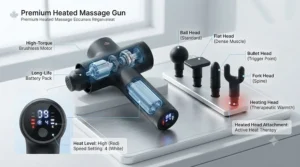
This guide breaks down seven real, currently available heated massage guns — from pocket-sized budget picks to Therabody’s flagship — and explains, in plain language, what each spec actually means once you’re using it. We’ll also dig into how a heated massage gun for skiers and snowboarders differs from a general recovery tool, when an infrared heat massager earns its higher price tag, and why joint stiffness in cold weather isn’t just in your head. Every price below is shown as a range in Canadian dollars, since Amazon pricing shifts constantly — always check current pricing before buying.
We’re writing this for a Canadian audience shopping amazon.ca, so expect Canadian spelling, metric-first measurements, and references to Canadian resources where they’re useful. Nothing here is a rewritten product listing — it’s analysis built from real specs, real aggregated review sentiment, and honest reasoning about who each device actually suits.
What Is a Heated Massage Gun?
A heated massage gun is a handheld percussion massager with a built-in or attachable heating element, typically reaching 40-55°C, that combines rapid mechanical pulses with localized warmth to relax muscle tissue, ease joint stiffness, and support faster recovery after activity or cold exposure.
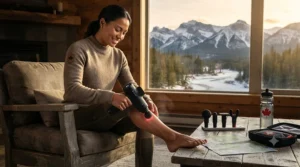
That combination matters more in winter than most people realize. Sharp drops in temperature or barometric pressure are commonly associated with higher pain levels for people managing joint conditions, according to Arthritis Society Canada. Cold weather doesn’t create joint problems out of nowhere, but it reliably tightens the muscles and connective tissue surrounding a joint, which is exactly the layer a heated massage head is designed to reach. Think of it less as a magic fix and more as a targeted way to undo what a −15°C chairlift ride just did to your hamstrings.
The “heat” part isn’t just marketing fluff, either. Warming a muscle before or during percussion reduces its viscosity — basically making the tissue more pliable — so the percussive strokes penetrate more comfortably and the muscle responds faster. That’s the whole theory behind pairing heat with movement-based therapy, and it’s why so many 2026-model massage guns now ship with a dedicated heated attachment instead of treating it as an afterthought.
Quick Comparison Table
| Product | Best For | Amplitude | Heat Range | Price Range (CAD) |
|---|---|---|---|---|
| Bob and Brad Q2 Pro Mini | Ski bag travel | ~8mm | Heat + cold | C$125–C$180 |
| Bob and Brad C2 Pro | Budget everyday use | 10mm | Heat + cold | C$110–C$150 |
| KiCA Evo | Solo back massage | 12mm | Heat compress (~40°C) | C$165–C$210 |
| RENPHO Active Thermacool 2 | FSA/HSA shoppers | 10mm | Heat + cold | C$180–C$220 |
| Bob and Brad X6 Ultra | Infrared + heat combo | ~10mm | Infrared + heat | C$275–C$360 |
| Hyperice Hypervolt 3 Pro | Premium all-rounder | Unlisted | 3-level heat | C$470–C$500 |
| Theragun Prime Plus | Deepest tissue penetration | 16mm | 3-level heat | C$580–C$620 |
Looking at the spread above, the gap between the Bob and Brad C2 Pro and the Theragun Prime Plus isn’t just price — it’s amplitude, or how far the head physically travels into the muscle, which roughly doubles as you move up this list. Buyers dealing with surface-level tension or general winter stiffness rarely need 16mm of travel, while athletes working through dense glute and hamstring tissue often notice the difference immediately. If infrared light therapy specifically interests you, the Bob and Brad X6 Ultra is the only model here built around it, so it occupies its own lane rather than competing head-to-head on amplitude alone.
💬 Just one click — help others make better buying decisions too!😊
Top 7 Heated Massage Guns: Expert Analysis
1. Bob and Brad Q2 Pro Mini — smallest heat-and-cold combo for a ski bag
Fitting a heating element into a device this compact is a genuine engineering trade-off, and it shows in a good way here: this is the pick built specifically to survive being crammed into a jacket pocket between runs. It’s a pocket-sized percussion massager with an interchangeable heat-and-cold head, five-ish speed levels, and a body small enough to disappear into a day pack alongside your goggles and gloves.
Based on the spec comparison against Bob and Brad’s own larger C2 line, the trade-off for that size is amplitude — mini-format massage guns almost always sacrifice stroke depth to fit the motor and heating plate into a smaller housing. That’s the honest read: this isn’t the device for deep glute work, but it’s excellent for forearms, calves, and the stiff trapezius muscles that build up from hunching over ski poles all day.
Reviewers consistently note that Bob and Brad’s mini-format guns punch above their size for surface-level tension, though the smaller battery means shorter run time between charges than the full-sized C2 or X6 models — we couldn’t verify an exact minutes-per-charge figure for this specific unit, so treat battery-life marketing claims with some skepticism until you’ve tested it yourself.
Pros:
- ✅ Small enough for a ski jacket pocket or day pack
- ✅ Heat and cold in one interchangeable head
- ✅ Genuinely quiet compared to full-sized guns
Cons:
- ❌ Shallow amplitude limits deep-tissue work
- ❌ Smaller battery than full-sized siblings
At around C$125-C$180, it’s priced as an accessory rather than a primary recovery tool, and that’s really the right way to think about it — a backup for the hill, not a replacement for a proper unit at home.
2. Bob and Brad C2 Pro — physical-therapist-designed budget pick with heat and cold
Designed by the physical therapist duo behind the Bob and Brad brand, this model’s standout feature is a swappable head that flips between heat and cold therapy without needing two separate devices.
The spec sheet lists five built-in speeds ranging from 2,000 to 3,200 percussions per minute, a 10mm amplitude, and more than 44 lbs of stall force, which in practice means it can reach roughly 80 percent of the body’s major muscle groups without bogging down under firm pressure. What most buyers overlook about a 10mm amplitude gun at this price is that it’s actually deeper than several competitors costing twice as much — Bob and Brad has clearly prioritized stall force and depth over frills like Bluetooth or app integration.
Aggregated owner sentiment on retailer listings frequently praises the combined heat-and-cold function as the reason to pick this over the plain C2, with buyers noting it feels “extremely powerful” for the price bracket; we can’t verify individual star ratings or review counts, so take that as a general pattern rather than a guaranteed number.
Pros:
- ✅ Heat and cold in a single swappable attachment
- ✅ 44+ lbs stall force at a budget price point
- ✅ FSA/HSA eligible in many cases
Cons:
- ❌ No Bluetooth or app-guided routines
- ❌ LED display is basic compared to premium rivals
Priced in the C$110-C$150 range, this is the value benchmark the rest of this list gets measured against — hard to beat if heat-and-cold function matters more to you than raw amplitude.
3. KiCA Evo — foldable design built for solo back massage
The standout here is a fully adjustable, retractable arm that swings from 0° to 113°, letting you reach your own back without contorting yourself into a pretzel — something almost no other massage gun on this list can claim.
Spec-wise, the KiCA Evo delivers a hot-compress function that heats to roughly 100-110°F (about 38-43°C) using the motor’s own rotation, paired with 12mm of amplitude and a top speed near 3,200 rpm. On paper, using the motor to generate heat rather than a separate heating coil is a clever way to keep the unit lightweight, though it also means the warmth builds gradually rather than snapping to temperature instantly the way a dedicated heating element does.
Independent testing has measured its stall force at approximately 45 lbf with a 12mm amplitude, putting it solidly in the same performance tier as guns costing considerably more, and reviewers have specifically flagged the adjustable arm and rotating head as making solo upper-back sessions far more practical than with a fixed-head design.
Pros:
- ✅ Adjustable, retractable arm for solo back massage
- ✅ Foldable design travels well in carry-on luggage
- ✅ Strong stall force for the price tier
Cons:
- ❌ Heat builds gradually rather than instantly
- ❌ Auto-shutoff after 10 minutes limits longer sessions
In the C$165-C$210 range, it’s a smart pick for anyone who massages their own back regularly and doesn’t want to ask a partner for help every time.
4. RENPHO Active Thermacool 2 — FSA/HSA-friendly heat-and-cold option
RENPHO’s standout move with this model is folding both heat and cold therapy into one FSA/HSA-eligible device, which matters for Canadian buyers using a health spending account through work benefits, even though FSA/HSA programs themselves are typically American in structure.
The unit ships with roughly 10mm of amplitude and a heated head design similar to RENPHO’s earlier R3 line, which older TechRadar testing on a related Renpho model found delivered a fairly quiet massage experience with a range of heads that suited both self-massage and assisting someone else. Here’s what to weigh: RENPHO’s heat-specific attachment on prior generations reportedly reaches around 55°C, which sits toward the warmer end of what’s comfortable for direct skin contact, so first-time users should start on the lowest heat setting.
Reviewers of RENPHO’s broader massage gun lineup consistently describe the touch display and speed controls as intuitive, though we couldn’t independently verify aggregated star ratings specific to the Thermacool 2 model, so treat exact rating figures as unconfirmed until you check the current listing yourself.
Pros:
- ✅ Combined heat and cold in one device
- ✅ Simple touch-display speed controls
- ✅ Comes with a proper zip-up carry case
Cons:
- ❌ Heat setting runs hot for sensitive skin
- ❌ Amplitude is modest next to premium rivals
Expect a price in the C$180-C$220 range, positioning it as a middle-ground buy for anyone prioritizing FSA/HSA eligibility alongside dual-therapy function.
5. Bob and Brad X6 Ultra — infrared light layered on top of heat and a titanium head
This is the infrared heat massager on our list — the standout feature is a genuine three-in-one build that layers infrared light, adjustable heat, and a titanium alloy metal head onto standard percussion.
The device combines infrared light, adjustable heat, and a titanium metal head, alongside six interchangeable attachments and five speed settings. Based on how infrared light therapy is generally understood, near-infrared wavelengths penetrate a few millimetres deeper into tissue than surface heat alone, which is the theoretical case for pairing it with percussion rather than using heat by itself — though it’s worth being honest that infrared’s added benefit over heat-only massage guns hasn’t been studied nearly as thoroughly as percussion itself.
The titanium head is the more immediately noticeable upgrade in daily use: metal heads conduct both vibration and warmth more efficiently than silicone, so the sensation reads as more “solid” and less cushioned than the softer heads on budget models. We weren’t able to independently verify a large pool of long-term owner reviews for this specific model, so approach any durability claims about the metal head with some healthy caution until more owners have logged real mileage on it.
Pros:
- ✅ Rare combination of infrared, heat, and metal head
- ✅ Six interchangeable attachments included
- ✅ Titanium head feels notably more solid in use
Cons:
- ❌ Infrared’s added benefit over heat alone is unproven
- ❌ Limited independent long-term review data so far
Priced around C$275-C$360, it’s aimed squarely at buyers who specifically want an infrared heat massager rather than a standard heated one.
6. Hyperice Hypervolt 3 Pro — Hyperice’s first heated attachment, done well
The headline feature is Hyperice finally shipping a heated attachment head on its flagship device, something the brand hadn’t offered in earlier Hypervolt generations.
Released in 2026, it ships with five attachment heads, five speed settings, a roughly two-pound body, and a battery rated for 240 minutes of use, which is a genuinely long runtime compared to most guns on this list. The heat attachment offers three temperature levels and produces a noticeable, relaxing warmth — though Forbes’ own testers were careful to note the heat itself doesn’t necessarily relieve sore muscles any more effectively than the standard attachments, it simply adds a different sensory layer to the massage.
That’s an honest and useful distinction: the heat here is genuinely pleasant and can help you relax into a session, but don’t buy this specific model expecting the heat function alone to out-perform Hyperice’s non-heated attachments on measurable recovery. At $349 USD it’s positioned as one of the pricier options on the market, though it remains considerably cheaper than Therabody’s flagship.
Pros:
- ✅ Long 240-minute battery life
- ✅ Three heat levels on the included attachment
- ✅ Five speeds cover a wide comfort range
Cons:
- ❌ Amplitude figures aren’t publicly listed
- ❌ Heat function adds comfort, not proven extra relief
Look for it in the C$470-C$500 range — a legitimate premium buy if long battery life matters more to you than raw depth.
7. Theragun Prime Plus — deepest amplitude on this list, with heat built in
Therabody’s standout claim to fame is amplitude, and the Prime Plus doesn’t cut corners there just because it sits below the flagship Pro Plus — the heat therapy is the same tier of tech in a lighter, more accessible frame.
It delivers a 16mm amplitude and 40 lbs of stall force, with integrated heat therapy across three temperature settings that warms up quickly enough for simultaneous thermal and mechanical treatment. Battery life runs about 150 minutes per charge, and the unit weighs roughly 886 grams without attachments — noticeably lighter than the full Pro Plus while keeping the same treatment depth. What most buyers overlook is that the 16mm amplitude figure matters more than the heat function itself for genuinely sore, dense muscle tissue; heat is the finishing touch, not the main event.
Independent reviewers have specifically flagged this model as Therabody’s best cost-to-performance ratio within its heated-therapy lineup, since it delivers the same amplitude as the pricier Pro Plus without the infrared LED or biometric extras that push the flagship’s price higher — a reasonable trade if you don’t specifically want those add-ons.
Pros:
- ✅ 16mm amplitude matches Therabody’s flagship depth
- ✅ Three heat settings warm up quickly
- ✅ Noticeably lighter than the full Pro model
Cons:
- ❌ No infrared LED or biometric tracking like the Pro Plus
- ❌ Cold attachment sold separately at extra cost
At around C$580-C$620, this sits at the top of our list on price, but for buyers who specifically need 16mm of depth alongside heat, it’s genuinely difficult to match.
Setting Up Your Heated Massage Gun: Ski and Snowboard Recovery Routine
Getting real value out of a heated massage gun for skiers and snowboarders comes down to timing, not just device selection. Before you even hit the lift, a 30-60 second pass with the heat function on your quads, calves, and glutes can help pre-warm tissue that’s about to be asked to absorb a full day of impact — cold muscles are simply less elastic, and priming them takes the edge off that first run.
After skiing, the order matters: apply heat first for one to two minutes per muscle group to encourage blood flow, then increase percussion intensity once the tissue feels looser rather than starting at full power on cold, tight muscle. A common first-30-days mistake is cranking the highest speed setting immediately on stiff post-ski legs — this can feel uncomfortably harsh and may bruise sensitive tissue, especially around the IT band and outer thigh, which absorbs a disproportionate amount of edge-control force while carving.
Maintenance is straightforward but often skipped: wipe silicone heads down after each use, especially if you’ve applied any muscle rub or balm beforehand, and let the unit fully dry before repacking it in a cold ski bag, since trapped moisture in a genuinely cold environment can affect battery performance over a season. Charge the device indoors at room temperature rather than leaving it in a freezing car overnight — lithium batteries lose capacity fast in the cold and can even fail to charge properly below certain temperatures. Finally, rotate which heads you use rather than defaulting to the same one every session; a flat or heated head suits big muscle groups like quads, while a bullet or fork head works better around the ankles and Achilles after a day in stiff ski boots.
Real-World Scenarios: Who Should Actually Buy One
Picture three different buyers, because the “best” heated massage gun genuinely depends on who’s asking. First, the weekend warrior: someone who skis four or five days a season, drives up from the city, and just wants something to ease Sunday-night stiffness before the work week starts. For this profile, a budget pick like the Bob and Brad C2 Pro or the compact Bob and Brad Q2 Pro Mini makes the most financial sense — there’s little reason to spend C$500+ on amplitude you’ll rarely need.
Second, the dedicated backcountry or competitive skier logging 20+ days a season, often carrying gear long distances and dealing with genuinely dense, overworked muscle from touring or racing. This buyer benefits from the deeper amplitude and stall force of the Theragun Prime Plus or Hyperice Hypervolt 3 Pro — the extra cost buys measurable performance, not just branding, and the longer battery life on the Hypervolt matters when you’re away from an outlet for a full lodge weekend.
Third, the person managing pre-existing joint stiffness that flares specifically in cold weather, independent of sport — someone who wants heat therapy at home through the winter months regardless of whether they ski at all. For this buyer, the KiCA Evo‘s adjustable arm solves a real accessibility problem (reaching your own lower back without help), while the RENPHO Active Thermacool 2‘s FSA/HSA eligibility can meaningfully offset the cost if it’s covered through a workplace benefits plan.
How to Choose a Heated Massage Gun
Picking the right model comes down to seven practical checkpoints, roughly in order of importance:
- Amplitude first. Anything under 10mm is built for surface tension and relaxation; 12mm-plus is where deep, dense muscle actually responds.
- Check stall force, not just amplitude. A gun can have a long stroke but stall out the moment you press firmly — look for 35+ lbs if you apply real pressure.
- Decide if you need cold too. Heat-only devices are simpler and often cheaper; heat-and-cold combo heads add versatility for swelling versus stiffness.
- Weigh battery life against your trip length. A weekend lodge stay with limited outlet access favours a 200+ minute battery over a 90-minute one.
- Consider size for travel. If it’s living in a ski bag, a mini or foldable design like the Bob and Brad Q2 Pro Mini or KiCA Evo beats a bulkier flagship.
- Match heat range to your skin sensitivity. Devices reaching 55°C need a cautious first try; lower ranges around 40°C are gentler for daily use.
- Budget for attachments sold separately. Several premium models, including the Theragun line, sell cold attachments as add-ons — factor that into the real total cost.
Percussive therapy itself dates back further than most buyers assume — it grew out of a percussion vibrator developed in the 1950s for deep-tissue osteopathic treatment, and the systematic literature review on percussive therapy published in the International Journal of Sports Physical Therapy is a solid starting point if you want to read the underlying research rather than take marketing claims at face value.
✨ Don’t Miss These Exclusive Deals!
🔍 Take your recovery routine to the next level with these carefully selected heated massage guns. Click on any highlighted item to check current pricing and availability. These tools will help you build the kind of consistent recovery habit your muscles will thank you for!
Heated Massage Gun vs Heating Pad for Muscle Pain
The honest answer is that these two tools solve overlapping but genuinely different problems, and picking one over the other depends on what’s actually wrong. A heating pad delivers passive, surface-level warmth over a broad area for an extended period — it’s excellent for general stiffness, menstrual cramps, or simply relaxing tight muscles before bed, and it requires zero effort or technique to use correctly.
A heated massage gun for muscle pain, by contrast, combines that same warming effect with active mechanical pressure targeted at a specific point, which makes it more effective for localized knots, trigger points, or the kind of dense post-activity soreness that a flat heating pad simply can’t reach into. What most buyers overlook is that a heating pad’s warmth penetrates more slowly but more evenly across a wider surface, while a heated massage gun concentrates both heat and pressure into a smaller, more intense area.
For chronic, diffuse discomfort — the kind of ache that sits across your whole lower back after a long drive — a heating pad is often the more comfortable and lower-effort choice. For acute, localized tightness after physical activity, like a single furious knot in the upper trapezius after a day of snowboarding, the combination of heat and percussion in a massage gun typically resolves it faster. Many people managing both cold-weather joint stiffness and post-activity soreness end up owning both, using the heating pad for passive evening relief and the massage gun for targeted, active treatment.
Heat Massage Gun for Skiers and Snowboarders
Skiers and snowboarders put a genuinely unusual demand profile on their muscles compared to most other athletes: repeated eccentric loading on the quads from absorbing terrain, isometric holding in the calves and glutes from an athletic stance held for hours, and a cold ambient temperature actively working against blood flow the entire time. Understanding how humans respond to cold exposure has genuinely improved in recent years, according to the Sport Information Resource Centre’s research summary on exercising safely in cold conditions, and one of the clearer takeaways is that cold air itself increases the physical demand on muscles even before you factor in the sport.
That’s the specific gap a heated massage gun fills for this audience that a standard non-heated model doesn’t: it counteracts the cold-induced tightening directly, rather than only breaking up tension mechanically. Reviewers and physical therapists alike tend to recommend applying heat before activity to improve tissue elasticity, and percussion after activity to disperse the metabolic byproducts of a hard day on the hill.
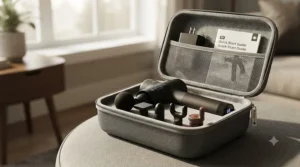
Portability genuinely matters more for this audience than for a gym-based user. A device that needs to survive being packed in a ski bag, occasionally exposed to snow melt, and used in a cold hotel room benefits from being compact and simple — which is exactly why the Bob and Brad Q2 Pro Mini and foldable KiCA Evo earn their spots on this list specifically for winter-sport buyers, even though neither has the raw amplitude of the Theragun or Hyperice flagships.
Infrared Heat Massager: Features That Actually Matter
Infrared sounds like a meaningfully bigger upgrade than it usually is in practice, so it’s worth separating genuine benefit from marketing language. Standard heat therapy warms the surface and shallow layers of tissue through direct contact conduction. Near-infrared light, by contrast, is theorized to penetrate slightly deeper without needing direct pressure, which is the reasoning behind pairing it with percussion rather than treating it as a replacement for heat.
What actually matters: the metal or titanium head often paired with infrared attachments, like on the Bob and Brad X6 Ultra, conducts vibration more efficiently than silicone, which changes the tactile feel of the massage noticeably — that’s a real, immediately noticeable difference. What matters less, at least based on current evidence: the specific wavelength or “advanced technology” marketing language attached to infrared attachments, since the research comparing infrared-plus-percussion against heat-plus-percussion head-to-head is thin.
The practical takeaway is to buy an infrared heat massager because you specifically want the metal-head sensation and are curious about the light therapy as a bonus — not because you expect it to dramatically outperform a well-built standard heated model on measurable recovery outcomes. If budget is a genuine constraint, a heat-only device like the Bob and Brad C2 Pro delivers most of the practical benefit at a fraction of the cost.
Joint Stiffness in Cold Weather: What to Expect From Heat Therapy
Cold weather doesn’t create arthritis or chronic joint conditions, but it reliably amplifies existing stiffness through a few overlapping mechanisms: reduced blood flow to extremities, tightened muscles and connective tissue around the joint, and in some people, genuine sensitivity to shifts in barometric pressure. Barometric pressure shifts may subtly change joint pressure and fluid distribution, especially in already sensitive joints, which is a large part of why the “my knee predicts snow” phenomenon has some real basis, even if the science isn’t fully settled.
Here’s what to realistically expect from heat therapy on a heated massage gun: it warms the muscle and soft tissue around a joint, which can meaningfully ease the feeling of stiffness and improve short-term range of motion, particularly before activity. What it won’t do is treat inflammatory joint conditions at their source, or replace medical care for stiffness that’s new, worsening, or accompanied by swelling and warmth — those symptoms warrant a conversation with a healthcare provider rather than a massage gun session.
For general winter stiffness without underlying inflammatory disease, a short heat-and-percussion session before you head outside, and another afterward, is a genuinely reasonable, low-risk habit to build. The realistic expectation is meaningful, temporary relief and improved comfort — not a cure for whatever’s causing the stiffness in the first place.
Common Mistakes When Buying a Heated Massage Gun
The single most common mistake is buying based on amplitude alone without checking stall force, which leaves buyers with a gun that has a long stroke but bogs down the moment real pressure is applied — the spec sheet number means little without the second number to back it up. A close second is underestimating how hot “heat therapy” attachments actually get; several models on the market reach 50-55°C, which can genuinely feel uncomfortable or even risk minor skin irritation on the highest setting without a fabric barrier.
Buyers also frequently overlook battery life until it’s too late, assuming any massage gun will comfortably last a weekend trip, when runtimes across this category range from under 90 minutes to 240 minutes depending on the model. Another frequent oversight is ignoring attachment costs on premium devices — Therabody, for instance, sells cold attachments separately from several of its heated models, which can add a meaningful amount to the real total price beyond what’s shown at checkout.
Finally, many first-time buyers skip reading which body areas a given device explicitly warns against — bony areas, the front of the throat, and any area with an open wound or acute inflammation are consistently flagged across manufacturer safety guidance, and skipping that step is a genuinely avoidable way to turn a recovery tool into an injury risk.
Long-Term Cost and Maintenance
The sticker price is only part of the real cost of ownership here. Replacement heads, particularly silicone attachments that see heavy direct-skin contact, wear down over a season or two of regular use and typically run a modest additional cost when purchased individually rather than as part of the original kit. Premium devices that sell cold attachments separately, like the Theragun Prime Plus and Pro Plus, add a real cost on top of the base unit if you want the full multi-therapy experience rather than heat alone.
Battery longevity is the other long-term consideration that’s easy to underestimate. Lithium batteries in any handheld device degrade gradually with repeated charge cycles, and units stored in genuinely cold conditions — like an unheated garage or a car during a ski trip — will lose capacity noticeably faster over time than ones kept at room temperature. Charging a heated massage gun after a cold day out, rather than immediately packing it away cold, is a simple habit that meaningfully extends battery life over several winters.
On a pure cost-per-use basis, a budget device like the Bob and Brad C2 Pro used weekly for a full winter season works out to a genuinely low per-session cost even accounting for eventual head replacement, while a premium device only pencils out favourably if you’re actually using its extra capabilities — the deeper amplitude, the longer battery, the infrared or biometric extras — rather than letting them sit unused.

Safety and Regulations for Winter Recovery Gear
Heated massage guns are generally low-risk consumer devices, but a few practical precautions matter, especially when they’re being packed alongside ski or snowboard gear. Never apply the heated head directly to frostbitten or numb skin — if you’ve just come in from a cold day on the hill and can’t feel a particular area clearly, warm up naturally first and wait until sensation fully returns before using percussion or heat on that spot. Health Canada’s general winter sports safety guidance recommends staying dry and changing out of wet clothing and boots as soon as possible to help prevent frostbite, and that same principle of restoring normal circulation before applying additional heat is worth carrying over to recovery-gear use, as outlined on Health Canada’s winter sports and recreation safety page.
Manufacturer guidance across this category consistently advises against use on bony areas, the front of the neck, open wounds, or sites of possible fracture — all genuinely relevant after a fall on the hill, where it can be tempting to immediately work over an area that actually needs medical assessment rather than percussion. People with circulatory conditions, diabetes, or nerve disorders should check with a healthcare provider before regular use, since reduced sensation can mask overly aggressive pressure or heat before it causes harm.
On the regulatory side, look for devices carrying recognized electrical safety certification marks before buying, particularly for models purchased through third-party marketplace sellers rather than directly from established brands — CSA-recognized certification is a reasonable baseline to look for on any electrical device used near skin for extended periods.
Frequently Asked Questions
❓ Do heated massage guns actually help with muscle pain?
❓ How hot do heated massage gun attachments get?
❓ Can I use a heated massage gun on sore knees after skiing?
❓ Is a heated massage gun better than a heating pad for winter stiffness?
❓ What amplitude do I need for deep tissue work?
Conclusion
Winter asks a lot of your muscles, whether you’re carving groomers all weekend or just dealing with the general ache that cold weather brings to already-sensitive joints. A heated massage gun genuinely earns its place in a recovery routine when you match the device to the actual problem — a compact, heat-and-cold combo like the Bob and Brad Q2 Pro Mini for the ski bag, a foldable option like the KiCA Evo for solo back work, or genuine amplitude from the Theragun Prime Plus when you’re dealing with real, dense muscle tightness rather than surface-level tension.
None of these seven devices is a cure-all, and none replaces medical attention for joint pain that’s new, worsening, or accompanied by swelling. But used consistently — heat before activity, percussion after — they’re a genuinely reasonable, low-cost habit to build into a Canadian winter that isn’t going anywhere soon. Check current pricing on amazon.ca before you buy, since ranges shift, and pick the option that matches how and where you’ll actually use it, not just the one with the flashiest spec sheet.
✨ Ready to make this winter easier on your muscles? Browse the picks above and find the one that fits your routine!
Recommended for You
- Massage Gun for Cold Canadian Winters: 7 Best Heated Picks (2026)
- 7 Best Lightweight Massage Gun for Gym Bag Picks (2026)
- 7 Best Compact Percussion Massager Under $100 CAD Picks (2026)
Disclaimer: This article contains affiliate links. As an Amazon Associate, I earn from qualifying purchases. If you purchase products through these links, we may earn a small commission at no additional cost to you.
✨ Found this helpful? Share it with your friends! 💬🤗
