
In This Article
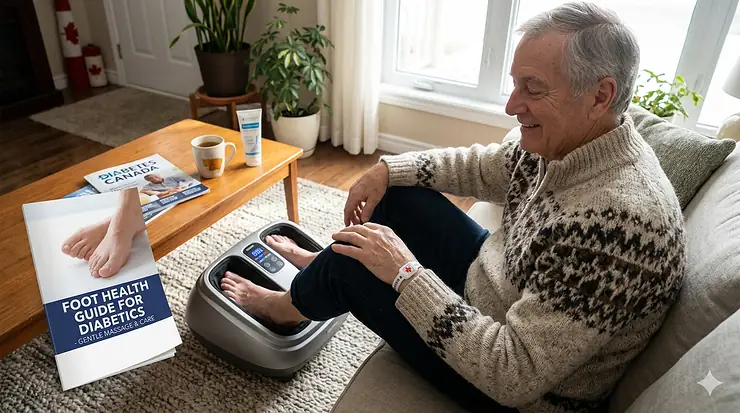
A foot massager for diabetics is a device — electric or manual — designed to support circulation and ease discomfort in feet affected by diabetes, while avoiding the heat, pressure, or electrical risks that can be dangerous for someone with reduced sensation. Not every foot massager on the market qualifies. The right one respects the fact that diabetic feet don’t always send reliable warning signals when something’s wrong.
That’s the part most “best of” lists skip past, and it’s the reason I wanted to write this one differently. If you or someone you’re shopping for has diabetes, the question isn’t just “which foot massager feels nicest” — it’s “which one won’t hurt me without my knowing it.”
Here in Canada, that question carries extra weight. According to Diabetes Canada’s clinical practice guidelines on foot care, foot complications are a major source of illness and death among people with diabetes, and people with diabetic neuropathy and peripheral arterial disease face elevated risk of foot ulcers and infections that can lead to amputation. The guidelines note that Canadian adults with diabetes are roughly 20 times more likely to be hospitalized for a non-traumatic lower-limb amputation than adults without diabetes. A primary-care pathway built on those guidelines puts a number on it: 14 lower-limb amputations happen across Canada every day because of a diabetic foot ulcer that didn’t heal properly, even though research suggests up to 85% of amputations are preventable with the right prevention and treatment habits. Diabetes Canada’s patient foot-care checklist is worth a read on its own before buying anything.
None of that means a foot massager is dangerous by default. It means the type of foot massager matters more than the brand name on the box. With that framing, here’s how to actually choose one — and seven real options sold on Amazon.ca that fit different needs and budgets (all prices in CAD; ranges only, since Amazon pricing shifts often).
Quick Comparison Table
| Product | Type | Heat | Best For | Price Range (CAD) |
|---|---|---|---|---|
| MedMassager Foot Massager | Oscillating, medical-grade | No | Neuropathy, doctor-recommended use | $250–$320 |
| RENPHO Shiatsu Foot Massager | Shiatsu kneading + heat | Yes, adjustable | General comfort, no neuropathy concerns | $130–$180 |
| Cloud Massage Shiatsu Massager | Shiatsu + air compression | Yes, adjustable | Calves and feet together | $110–$150 |
| HoMedics Shiatsu Air 2.0 | Air compression + shiatsu | Yes, adjustable | Gentle, low-pressure sessions | $90–$140 |
| FIT KING EMS/TENS Foot Massager | Electrical stimulation | No | Circulation under doctor supervision | $90–$130 |
| TheraFlow Wooden Foot Roller | Manual, no electricity | No | Budget, full sensory control | $20–$35 |
| TheraFlow Dual Foot Roller | Manual, no electricity | No | Portability, gift-giving | $25–$40 |
A pattern is worth pointing out before moving on: the manual rollers and the FDA-registered MedMassager sit at opposite ends of the price spectrum, but both avoid the single biggest risk category for diabetic feet — uncontrolled heat against skin that can’t reliably feel a burn coming. The shiatsu-and-heat devices in the middle aren’t off the table, but they’re the ones where the heat setting and session length actually matter, not just the massage style.
💬 Just one click — help others make better buying decisions too! 😊
✨ Don’t Miss These Exclusive Deals!
🔍 Take your foot care routine to the next level with these carefully selected products. Click on any highlighted item to check current pricing and availability on Amazon.ca.
How to Choose a Foot Massager for Diabetics in Canada
Before getting into specific products, it helps to know what separates a genuinely diabetic-friendly massager from one that’s just marketed at diabetics. MedMassager’s own clinical guidance on foot massagers for diabetic neuropathy lays out the core hazards clearly: heat-only or heat-primary devices create a burn risk because reduced temperature sensation means a user may not feel an unsafe heat source building, roller-and-ball designs with high point pressure can damage neuropathic tissue where skin integrity is already a concern, and thin or unstable platforms raise fall risk in people whose balance is already affected by neuropathy.
- Check for adjustable, low-set heat with auto shutoff. If a massager has heat, it should be optional and capped at a modest temperature, not a fixed high setting you can’t dial down.
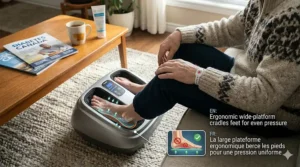
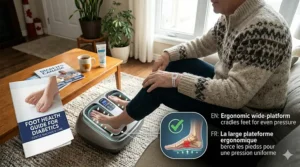
- Favour broad, even-pressure platforms over pinpoint rollers. A wide, flat surface spreads pressure across the foot instead of concentrating it on one nerve-sensitive spot.
- Look for multiple intensity levels, not just one speed. Diabetic skin and nerves respond unpredictably; a single fixed intensity removes your ability to back off if something feels off.
- Prioritize stability. A massager that wobbles or tips is a real fall hazard for anyone with neuropathy-related balance issues.
- Ask whether it’s a registered medical device or a general wellness product. Devices like MedMassager’s line carry FDA Class I registration aimed specifically at therapeutic use; most shiatsu massagers are general consumer wellness items, which isn’t disqualifying but is worth knowing.
- Skip water-based foot spas if neuropathy is present. As MedMassager’s diabetic foot safety guide puts it plainly, the combination of hot water and reduced sensation is a documented and preventable burn risk for diabetic users.
- Talk to your doctor or podiatrist first if you have any neuropathy, poor circulation, or an open wound. This one isn’t optional — it’s the single biggest factor in whether a foot massager helps or harms.
Top 7 Foot Massagers for Diabetics — Expert Analysis
1. MedMassager Foot Massager (Classic/MMF Series) — Best Medical-Grade Option
This is the option built around the neuropathy use case rather than retrofitted for it. The product itself uses an oscillating platform rather than rollers or balls, and the brand specifically markets it as clinically positioned to reduce pain and discomfort caused by neuropathy, diabetes, heel spurs, and impact injuries. What that means in practice: instead of digging a roller into one spot, the whole platform vibrates rapidly underfoot, which spreads stimulation evenly rather than concentrating it where nerves are already compromised — exactly the design flaw MedMassager’s own guidance warns against in cheaper roller-style units.
What most Canadian buyers overlook here is the speed range. The full-size version offers settings from roughly 1,000 to 3,700 RPM, which means a first-time user with sensitive feet can start at the bottom and work up over weeks rather than being stuck with one intensity. That matters because MedMassager’s own usage guidance recommends starting conservatively, with initial sessions limited to 5–10 minutes since some neuropathy patients experience temporary symptom flares after first use, and gradually building duration from there.
Pros: No heat element to worry about · multiple speed settings for gradual adjustment · wide, stable platform for seated use
Cons: Pricier than shiatsu competitors · vibration-based, not a kneading massage feel
Price & value: Expect around $250–$320 CAD. For someone managing diagnosed neuropathy under a doctor’s guidance, the price gap over a $130 shiatsu unit buys a device built around the specific risks diabetic feet carry, not general relaxation.
2. RENPHO Shiatsu Foot Massager — Best for General Comfort
The RENPHO Shiatsu Foot Massager is the most recognizable name in this category for a reason: it combines rotation balls, a rolling stick, and adjustable heat in one fully enclosed unit, and it’s genuinely available and shipped through Amazon.ca. The heat tops out at a moderate, fixed ceiling rather than running unchecked, which is the detail that actually matters for diabetic users more than the wattage or massage pattern.
In practice, this is the massager for someone whose diabetes is well-managed, who has no diagnosed neuropathy or only mild tingling, and who wants a relaxing shiatsu-style session rather than a therapeutic one. What most buyers don’t realize is that the kneading rollers in this category apply more concentrated pressure than a flat oscillating platform — fine for most people, but worth raising with a doctor first if you have any numbness, since you may not feel a roller pressing too hard on a vulnerable spot.
Pros: Adjustable heat and intensity · enclosed, no-water design avoids spa-style burn risk · widely stocked on Amazon.ca
Cons: Roller-based pressure isn’t ideal for diagnosed neuropathy · one foot at a time on some models
Price & value: Around $130–$180 CAD. Strong value if your foot sensation is intact and you’re managing diabetes without neuropathy complications.
3. Cloud Massage Shiatsu Foot Massager — Best for Feet and Calves
Cloud Massage’s listing on Amazon.ca markets the unit directly for diabetics and neuropathy, but the more useful detail is the mode lineup: three distinct intensity levels, with guidance to start at the lowest setting and adjust from there to avoid discomfort, plus an adjustable bar that extends the massage to ankles and calves. The five-mode system — rolling, compression, sway, heat therapy, and a quiet mode — gives more granular control than a single on/off heat switch.
What this is genuinely useful for: people whose diabetes-related circulation issues extend up into the lower leg, not just the foot. A device that only treats the foot misses that the same poor circulation often shows up as calf tightness or swelling. The trade-off is that it’s a bigger, enclosed unit — better suited to a dedicated spot in a living room than something you tuck under a desk.
Pros: Treats calves and feet together · clearly labelled low-to-high intensity progression · quiet mode for sensitive sessions
Cons: Larger footprint than foot-only units · heat therapy mode still needs the same caution as any heated device
Price & value: Around $110–$150 CAD. A solid middle ground if lower-leg circulation, not just foot sensation, is part of the picture.
4. HoMedics Shiatsu Air 2.0 Foot Massager — Best for Gentle, Low-Pressure Sessions
HoMedics sells directly into Canada (its Canadian site lists a dedicated CA model line), and the Air 2.0 leans on air compression rather than aggressive rolling balls — a meaningfully gentler mechanism for feet that can’t reliably report pain. The unit lets you run air compression alone, kneading alone, or both, each with low/medium/high intensity, so a user can dial pressure down to almost nothing while still getting some circulatory benefit.
The practical upside for diabetic users specifically: air compression squeezes evenly across the whole foot rather than poking at one spot, which lines up with the “broad pressure, not pinpoint pressure” principle that matters most for neuropathic skin. It’s not marketed as a medical device, so it shouldn’t replace anything your podiatrist has recommended — but as a low-intensity option for someone with mild, well-controlled diabetes, it’s one of the gentler shiatsu-category picks on Amazon.ca.
Pros: Air compression is gentler than ball rollers · washable liner for hygiene, which matters given diabetics’ higher infection risk · toe-touch controls, no bending required Cons: Less intense for those wanting a deep-tissue feel · heat function still needs the same low-and-monitored approach as any heated device
Price & value: Around $90–$140 CAD, often the most accessible heat-and-compression option on this list.
5. FIT KING EMS/TENS Foot Circulation Massager — Best for Doctor-Supervised Circulation Support
This one needs more caveats than the others, so I’ll lead with them. It’s an electrical stimulation device — EMS and TENS technology delivering small pulses to the foot rather than mechanical massage — and the listing itself is explicit that it should not be used by anyone under 18, or with a pacemaker, heart disease, DVT, or who is pregnant, without medical guidance.
Why include it anyway: for some people with diabetes-related circulation issues, low-level electrical stimulation is something their doctor or physiotherapist has specifically recommended, and FIT KING’s unit is registered as an FDA Class II device with adjustable intensity across 10 modes and up to 99 intensity levels, which allows very fine-grained control. The catch is the same one that applies to all stimulation and heat devices on neuropathic skin: you need to feel the electrode contact and intensity accurately to use it safely, which is precisely what diabetic neuropathy can compromise. This is not a “buy and figure it out” product for anyone with diagnosed nerve damage — it’s a “bring it to your next appointment and ask” product.
Pros: Wide intensity range for fine control · no heat element · FDA Class II registration
Cons: Electrical stimulation requires accurate sensation to use safely — a problem if neuropathy is advanced · explicit contraindications for several common conditions
Price & value: Around $90–$130 CAD. Worth it only alongside a clinician’s input, not as a self-directed purchase for advanced neuropathy.
6. TheraFlow Wooden Foot Massager Roller — Best Budget, Lowest-Risk Pick
No motor, no heat, no electrical pulse — just a contoured wooden roller you move with your own foot, at whatever pressure you choose to apply. That single fact makes it, almost by elimination, one of the lower-risk options on this list for diabetic feet: there’s no device-driven heat to misjudge and no fixed intensity setting working against reduced sensation, because you are the intensity control.
The honest trade-off is that it doesn’t do anything circulation-specific the way an oscillating or compression device might; it’s closer to a manual reflexology tool. Several Amazon.ca reviewers note it can slide or tip on harder, smoother floors when downward pressure is applied unevenly, so a non-slip mat underneath is a sensible add-on rather than an optional one. For someone newly diagnosed and nervous about more “active” devices, or for a Canadian winter gift where simplicity beats features, this is the lowest-stakes entry point into foot massage.
Pros: No heat or electrical risk at all · fully user-controlled pressure · inexpensive
Cons: Can tip on slick floors without a mat · no adjustable settings, since there’s nothing to adjust
Price & value: Around $20–$35 CAD — the cheapest credible option on this list, and arguably the safest by virtue of having no automated components.
7. TheraFlow Dual Foot Massager Roller — Best for Portability and Gifting
A close sibling to the wooden roller above, with a dual-roller layout that lets both feet rest and roll at once rather than alternating. It’s light enough to keep under a desk, by a recliner, or to pack for a trip to family over the holidays — relevant in a country where a lot of foot-care gift shopping happens around Christmas, Mother’s Day, and Father’s Day.
The use-case match here is specific: this suits someone who wants a low-commitment way to build a daily foot-care habit without learning a control panel, or a family member looking for a safe, inexpensive gift for a relative managing diabetes who doesn’t want to navigate heat settings or speed dials. It won’t replace anything a podiatrist has prescribed, but as a no-frills daily habit-builder, it does its one job without adding any of the risk factors found in motorized devices.
Pros: Compact and travel-friendly · dual-foot design speeds up sessions · no settings to misconfigure
Cons: Same flip/slide risk as the single roller on hard floors · minimal circulatory benefit compared to compression or oscillating devices
Price & value: Around $25–$40 CAD.
Looking at the lineup as a whole, the highest-value pick depends entirely on where someone sits on the neuropathy spectrum. For intact sensation and general diabetes management, the RENPHO or HoMedics units deliver the most relaxation per dollar. For diagnosed neuropathy, the MedMassager is the only entry actually engineered around that condition, and the TheraFlow rollers are the safest fallback if a motorized device feels like too much uncertainty. The FIT KING stimulator is the one item here that really shouldn’t be a solo decision — it belongs in a conversation with a healthcare provider first.
Real-World Scenario: Three Canadian Profiles
Profile 1 — Retired in Halifax, diagnosed neuropathy, mostly indoors in winter. A gentle, no-heat option matters most here, since cold weather already reduces peripheral circulation and numbness can mask injury. The MedMassager’s adjustable oscillation, started at the lowest setting per the brand’s own guidance, fits better than anything roller-based.
Profile 2 — Working from home in Toronto, type 2 diabetes, no diagnosed neuropathy, on her feet for client calls all day. Sensation is intact, so the priority shifts to comfort and stress relief rather than risk avoidance. The Cloud Massage or RENPHO units, used at a moderate heat setting for 15–20 minutes after work, fit this case well.
Profile 3 — University student in Vancouver buying a gift for a grandparent in a care setting, budget around $30 CAD. Simplicity and safety outrank features. A TheraFlow wooden roller, paired with a non-slip mat, is a low-risk, low-cost gift that doesn’t require the recipient to learn a new device.
Common Mistakes When Buying a Foot Massager for Diabetics
The most frequent mistake is choosing based on massage style (shiatsu vs. air vs. rolling) before checking heat and pressure design — exactly backwards from how it should go for diabetic feet. A close second is skipping the “ask your doctor first” step because the product description uses words like “neuropathy” or “diabetic” prominently; marketing language isn’t a medical clearance. A third common error is buying a foot spa with hot water, which MedMassager’s own safety content flags directly as a documented and preventable burn risk when combined with reduced sensation. Finally, many buyers assume a higher price tag means a safer device — it doesn’t; a $300 unit with uncontrolled high heat is riskier than a $25 wooden roller with none.
Canadian Regulations and Safety Standards
Massage devices sold in Canada fall under Health Canada’s Medical Devices Regulations framework depending on how they’re marketed. A device explicitly marketed for a therapeutic medical claim (like circulation support for a diagnosed condition) is more likely to fall under those regulations, while general wellness shiatsu massagers are typically treated as consumer electronics. As with any electrical household appliance sold in Canada, look for a CSA Group mark or an equivalent Standards Council of Canada–accredited mark (cUL, cETL) on the packaging — this confirms the unit has been tested against Canadian electrical safety standards, not just shipped in from an overseas factory. Bilingual (English/French) packaging and instructions are a legal requirement for consumer products sold in Canada, so genuine Canadian retail listings should include both languages even when the Amazon.ca product photos default to English.
What to Expect: Real-World Performance in Canadian Winters
Cold weather constricts peripheral blood vessels, which is part of why feet often feel colder and more numb in a Canadian winter regardless of diabetes status — and that effect compounds with any existing neuropathy. A foot massager with gentle heat (kept low and time-limited) can genuinely help here by warming tissue gradually rather than relying on a space heater or hot water, both of which carry sharper burn risk for reduced-sensation feet. The flip side: don’t use the warming function as your only check on temperature. If a room is already cold and you can’t easily judge how hot the device feels, that’s exactly the scenario where a foot inspection before and after use — checking for redness or marks you didn’t feel happen — matters most.
Long-Term Cost and Maintenance in Canada
Electric massagers in this price range generally carry one- to two-year manufacturer warranties; check whether warranty service requires shipping the unit back to a US address, since cross-border return shipping can erase any savings versus buying through a Canadian-stocked Amazon.ca listing in the first place. Manual wooden rollers have essentially no maintenance cost beyond an occasional wipe-down, which is part of why they remain the lowest total-cost-of-ownership option here. For motorized units, factor in that replacement liners, pads, or remotes (if lost) are typically sourced from the manufacturer directly rather than through Amazon, and availability for Canadian addresses can be slower than US shipping.
Features That Actually Matter (And Those That Don’t)
Adjustable intensity, auto shutoff on heat, and platform stability matter. App connectivity, “smart” Bluetooth modes, and elaborate multi-color LED displays don’t move the needle on safety or effectiveness for diabetic foot care — they’re convenience features for general consumers, not considerations specific to diabetes. Marketing claims like “improves blood sugar” or “reverses neuropathy” don’t belong in this category at all; no consumer foot massager treats diabetes itself, and any listing implying otherwise is overselling.
FAQ
❓ Is it safe for a diabetic to use a foot massager?
❓ Can diabetics use heated foot massagers in Canada?
❓ What type of foot massager is best for diabetic neuropathy?
❓ Do foot massagers for diabetics ship across Canada, including remote areas?
❓ Are EMS or TENS foot massagers safe for diabetics?
Conclusion
The right foot massager for a diabetic isn’t the one with the most settings or the highest star rating — it’s the one matched to that person’s actual nerve sensation and circulation status. A wooden roller and an FDA-registered oscillating platform sit at opposite price points but share the same underlying logic: minimize uncontrolled heat, avoid concentrated pressure on compromised tissue, and keep the user in control of intensity. The shiatsu-and-heat units in the middle of this list are good, popular, genuinely available-on-Amazon.ca options for diabetics whose sensation is intact — just not a substitute for checking with a doctor or podiatrist first if neuropathy is part of the picture. Diabetes Canada’s data on preventable amputations is a sober reminder that foot care decisions for diabetics carry more weight than they do for the general population, and a little caution up front costs nothing.
If you’re managing diabetic neuropathy or any loss of foot sensation, talk to your doctor or podiatrist before adding any massage device — electric or manual — to your routine.
Recommended for You
- 7 Best Budget Foot Massagers Under $100 Canada 2026
- 7 Best Travel Foot Massager Compact for Canadians (2026)
- 7 Best Under Desk Foot Massager Office Picks in Canada 2026
Disclaimer: This article contains affiliate links. As an Amazon Associate, I earn from qualifying purchases. If you purchase products through these links, we may earn a small commission at no additional cost to you.
✨ Found this helpful? Share it with your friends! 💬🤗
