
In This Article
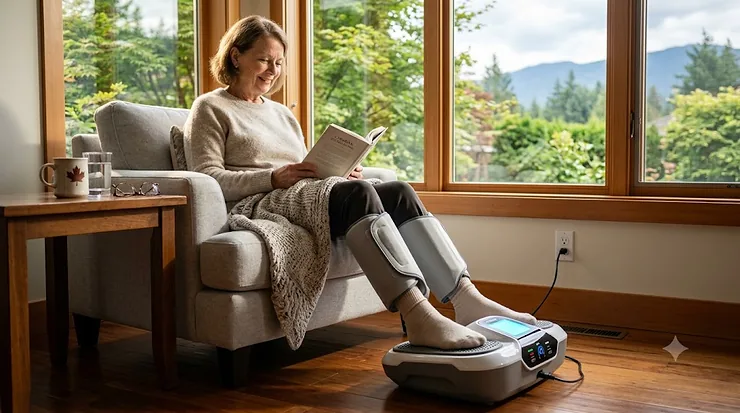
If you’ve ever finished a 12-hour shift, a cross-country flight, or just a regular Tuesday at a desk job and looked down to find your ankles have quietly turned into sausages, you already know why people start shopping for a leg circulation machine. These are electric devices — usually air-compression sleeves or electrical stimulation pads — that you strap onto your calves or feet to encourage blood flow back toward your heart, ease swelling, and warm up legs that have gone cold and achy from sitting too long.
This guide walks through seven real options sold on Amazon.ca, what the spec sheets actually mean once you’re using the thing on your own couch in February, and where these devices fit (and don’t fit) if you’re managing an actual circulation condition. Prices below are in CAD and given as ranges, since retail pricing on Amazon.ca shifts week to week.
Quick Comparison: Best Leg Circulation Machines in Canada
| Product | Type | Price Range (CAD) | Best For |
|---|---|---|---|
| Revitive Medic | NMES + IsoRocker | $300–$350 | Diagnosed circulation conditions, daily clinical-style use |
| Revitive Essential | NMES electrical stim | $180–$260 | Everyday leg/foot discomfort, simpler routine |
| DR-HO’S Circulation Promoter | TENS/EMS (AMP tech) | $150–$250 | Canadians who want a Canadian-made option |
| Nekteck Leg Massager | Air compression + heat | $90–$130 | Full-leg coverage, family use |
| FIT KING Leg Massager | Air compression + heat | $100–$160 | Office workers, RLS-type leg fatigue |
| RENPHO Leg Massager | Air compression + heat | $90–$140 | First-time buyers, gift purchases |
| Snailax Leg & Foot Massager | Shiatsu + compression + heat | $50–$90 | Budget shoppers, occasional use |
A quick read on that table: the two cheapest categories — Snailax and the basic air-compression sleeves from RENPHO, Nekteck, and FIT KING — are essentially relaxation massagers with a circulation side-benefit, while Revitive and DR-HO’S sit in a different category entirely, since both are electrical stimulation devices marketed and labelled specifically for circulation support rather than general muscle relaxation. If your goal is “my feet are cold and puffy after a long shift,” any of the air-compression options will likely do the job. If you’re managing a diagnosed condition like peripheral artery disease or chronic venous insufficiency, the NMES devices are the ones actually built — and in some cases licensed — for that purpose, though none of this replaces an actual diagnosis or treatment plan from your doctor.
💬 Just one click — help others make better buying decisions too! 😊
✨ Don’t Miss These Exclusive Deals!
🔍 Take your leg comfort routine to the next level — click through to check current pricing and availability on Amazon.ca before you commit to one model.
Top 7 Leg Circulation Machines in Canada: Expert Analysis
| Product | Mechanism | Heat | Cordless | Price Range (CAD) |
|---|---|---|---|---|
| Revitive Medic | NMES + rocking pedals | No | No (plug-in) | $300–$350 |
| Revitive Essential | NMES | No | No (plug-in) | $180–$260 |
| DR-HO’S Circulation Promoter | TENS/EMS (AMP) | No | Yes (battery) | $150–$250 |
| Nekteck Leg Massager | Air compression | Yes | No (plug-in) | $90–$130 |
| FIT KING Leg Massager | Air compression | Optional | No (plug-in) | $100–$160 |
| RENPHO Leg Massager | Air compression | Yes | Partial | $90–$140 |
| Snailax Leg & Foot Massager | Shiatsu rollers + compression | Yes | No (plug-in) | $50–$90 |
Looking at the table, the split is really between two technologies wearing similar marketing language. NMES (neuromuscular electrical stimulation) devices contract your calf muscles with a mild electrical pulse, which is the same mechanism your muscles use naturally when you walk — that’s why Revitive and DR-HO’S both come with pacemaker and DVT warnings on the box. Air-compression sleeves, by contrast, just squeeze and release rhythmically, the way a blood pressure cuff does, and carry far fewer use restrictions. If you’ve got any of those contraindications, the compression sleeves are the safer starting point, full stop.
1.Revitive Medic
Revitive Medic is Revitive’s flagship unit, and it’s the one most often recommended in Canadian pharmacy aisles by people who already know the brand. It combines NMES with a patented IsoRocker footplate that physically rocks your foot through a heel-to-toe motion while the electrical pulses contract your calf muscles — the idea being to mimic the pumping action that walking normally provides.
What that means in practice: you sit with bare feet on the pads, dial up the intensity until your calves visibly contract, and let it run for 30–60 minutes while you watch TV. The included body pads also double as a basic TENS unit for your back or shoulders, which is a nice bit of extra value most buyers don’t expect. Revitive lists this model as suitable for people managing peripheral artery disease or chronic venous insufficiency, though that’s a manufacturer claim, not something I’d take as a substitute for your own doctor’s advice — particularly because the box explicitly says not to use it with a pacemaker, an implanted defibrillator, during pregnancy, or if you have symptoms of deep vein thrombosis.
Canadian reviewers tend to mention a genuine, gradual reduction in evening leg swelling after weeks of daily use rather than instant relief, which lines up with the “use daily for 6–8 weeks” guidance on the package.
✅ Pros: most clinically-framed option on this list; dual foot + body pad use; widely available in Canadian pharmacies for in-person comparison
❌ Cons: highest price on this list; not cordless
Price range: $300–$350 CAD. At this tier, you’re paying for the rocking footplate mechanism specifically — if you don’t need that, Revitive Essential below gets you similar electrical stimulation for considerably less.
2.Revitive Essential
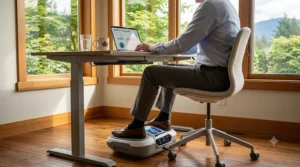
Revitive Essential strips the IsoRocker mechanism out and keeps the core NMES foot-pad stimulation, making it Revitive’s entry point rather than its flagship. You still place bare feet on the pads and build up intensity until your calf muscles contract, just without the rocking motion.
For someone whose main complaint is “my feet and lower legs feel heavy and tired by 6pm” rather than a diagnosed vascular condition, Essential is genuinely the more sensible buy — you’re not paying for a rocking mechanism most casual users won’t use to its full extent anyway. It carries the same safety restrictions as the Medic model (no pacemakers, no DVT symptoms, not during pregnancy), since the underlying electrical stimulation technology is identical.
✅ Pros: noticeably cheaper than Medic; same core NMES technology; simple one-button operation
❌ Cons: no IsoRocker movement; still requires daily use over weeks for noticeable results
Price range: $180–$260 CAD.
3.DR-HO’S Circulation Promoter
DR-HO’S Circulation Promoter is genuinely Canadian — the company is Canadian-owned, has been selling pain-relief devices through Canadian infomercials and pharmacies for decades, and the Circulation Promoter combines TENS and EMS with the brand’s own “AMP” (Auto-Modulating Pulse) technology, which automatically varies the stimulation pattern so your body doesn’t adapt to it the way it can with a single repeated pulse.
What stands out for Canadian buyers specifically is that this is a battery-powered, fully cordless unit — useful if your power outlets are inconveniently placed, or if you want to use it in a cottage or RV without rewiring your evening. The foot base has built-in electrodes targeting reflexology points, and the kit includes extra body pads for shoulders or lower back. Like the Revitive devices, it carries the standard pacemaker/DVT/pregnancy warnings.
Secondhand listings on Kijiji consistently show these reselling in the $100–$150 range after being barely used, which tells you something honest about adoption: people buy it with good intentions and the daily-use habit doesn’t always stick — worth knowing before you commit to a higher-tier package.
✅ Pros: 100% Canadian-owned brand; cordless/battery operated; AMP technology varies stimulation automatically
❌ Cons: requires AAA batteries (not always included depending on package); same contraindications as other NMES devices
Price range: $150–$250 CAD depending on package (Deluxe vs. Pro).
4.Nekteck Leg Massager
Nekteck Leg Massager moves us into air-compression territory, and it’s the most full-coverage option of the bunch — built-in airbags compress your feet, calves, and thighs in sequence, while a separate vibration setting works the calves and a heating element warms the feet and knee area.
The practical upside of covering thigh-to-foot rather than just the calf is that it suits people whose discomfort isn’t confined to one zone — long-haul drivers and people who’ve been on their feet in a retail or warehouse job all day tend to feel it everywhere, not just the ankles. The adjustable Velcro straps fit a wide range of leg sizes, which matters more than spec sheets usually let on, since an air-compression sleeve that’s even slightly too loose just won’t generate useful pressure. It auto-shuts off after 20 minutes, which is a sensible default rather than a limitation — most guidance on these devices recommends 20–30 minute sessions anyway.
✅ Pros: covers feet, calves, and thighs in one unit; heat and vibration as separate adjustable functions; 1-year warranty
❌ Cons: not cordless; sizing needs to be measured carefully before buying given the strap range
Price range: $90–$130 CAD.
5.FIT KING Leg Massager
FIT KING’s leg and foot massager line is an air-compression sleeve aimed specifically at office workers and people managing restless-leg-type fatigue, and the brand has built a reputation in Canada largely through word-of-mouth in physiotherapy and chiropractic circles rather than mainstream advertising. Most models in the range include size extensions for larger calves, a handheld controller with multiple intensity levels, and on the higher-end units, a pressure sensor that auto-adjusts to your leg size instead of requiring manual Velcro fiddling.
Where FIT KING tends to differentiate itself from RENPHO and Nekteck is the inclusion of an LCD display on some models, which sounds minor until you’re trying to remember which of six modes gave you the comfortable squeeze last time — not having to guess by feel each session is a small but real quality-of-life upgrade, especially for older users who find unlabelled buttons frustrating.
✅ Pros: dedicated office/RLS-fatigue marketing with appropriate features; size extensions included; LCD models reduce guesswork
❌ Cons: heat function is sometimes a separate add-on rather than standard; pricing varies more widely across the model range than competitors
Price range: $100–$160 CAD depending on whether you choose a basic or LCD-display model.
6.RENPHO Leg Massager
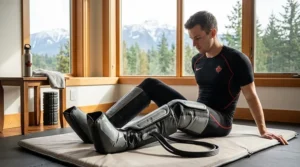
RENPHO’s Leg Massager with Heat and Compression is the brand most first-time buyers land on, mainly because RENPHO has built broad trust through its other wellness products (scales, foot massagers) and tends to show up at the top of Amazon.ca’s best-seller lists in this category. The leg massager itself inflates and deflates around your calf and foot to simulate a manual squeeze, with three intensities, six modes, and two heat settings layered on top.
The practical commentary worth adding here: RENPHO explicitly markets this as gift-purchase-friendly, and that’s not just marketing fluff — the controls are genuinely simpler than FIT KING’s LCD units, which makes it a safer pick if you’re buying it for a parent who isn’t going to read a manual. It’s described by the brand as helpful for people who stand for long shifts — nurses, teachers, delivery drivers — which tracks with the kind of “tired, swollen legs by end of day” use case most buyers in this price bracket are actually solving for, rather than a diagnosed vascular issue.
✅ Pros: simplest controls on this list; well-known, trusted brand; reasonably priced for the feature set
❌ Cons: “not a shiatsu massager” per the product listing, so don’t expect kneading — it’s pure inflate/deflate compression
Price range: $90–$140 CAD.
7.Snailax Leg & Foot Massager
Snailax’s foot and leg massager line is the budget anchor of this list, combining shiatsu rolling, compression, vibration, and heat in a single under-desk-style unit. It’s worth being upfront that this is a relaxation massager first and a circulation aid second — the shiatsu rollers and kneading action are the main event, with compression and heat layered in as secondary functions.
For someone whose actual problem is “my feet are cold and tense after a long Canadian winter commute” rather than measurable swelling, this is honestly a perfectly reasonable starting point, and at this price you’re not committing to much if it turns out not to be your thing. It has a 15-minute auto shut-off and a washable inner sleeve, both sensible touches at this price tier.
✅ Pros: cheapest entry point by a wide margin; combines four massage functions; washable cover
❌ Cons: less true “compression” pressure than the dedicated air-compression sleeves above; more general relaxation tool than targeted circulation device
Price range: $50–$90 CAD.
How to Choose a Leg Circulation Machine in Canada
- Start with what’s actually wrong. Cold, tense feet after a long day point toward a relaxation massager like Snailax or RENPHO. Visible swelling or aching that builds through the day points toward a proper air-compression sleeve like Nekteck or FIT KING. A diagnosed condition like PAD or chronic venous insufficiency points toward the NMES category — Revitive or DR-HO’S — and a conversation with your doctor first.
- Check the contraindication list before you check the price. Every NMES device on this list warns against use with a pacemaker, implanted defibrillator, during pregnancy, or with active DVT symptoms. If any of those apply to you, default to compression sleeves and confirm with your doctor regardless.
- Measure your calf circumference. Several of the air-compression sleeves (Nekteck in particular) note maximum strap sizes, and a sleeve that’s too small for your leg simply won’t deliver useful pressure no matter how high you crank the intensity.
- Decide if cordless matters to you. Only DR-HO’S on this list runs on batteries; everything else needs to be near an outlet, which is worth considering if you’d use it somewhere other than your living room couch.
- Be realistic about the timeline. Both Revitive devices state results build over 6–8 weeks of daily use, not overnight. If you’re hoping for an instant fix before a flight tomorrow, a compression sleeve session will feel more immediately noticeable, even if the longer-term physiological case is stronger for daily NMES use.
- Factor in who else will use it. If it’s a household item, adjustable strap ranges (Nekteck, FIT KING) matter more than they would for a single user buying their own unit.
- Buy from a seller that ships reliably to your province. Most of these are sold and shipped by Amazon.ca directly or by established sellers like Revitive’s own storefront, which matters for remote and northern postal codes where third-party seller delivery times can stretch out.
Getting the Most Out of Your Leg Circulation Machine
A few habits separate people who actually stick with these devices from people who use them twice and shove them in a closet:
Start low, build up. Every manufacturer on this list recommends starting at the lowest intensity, particularly with NMES devices — jumping straight to a high setting on Revitive or DR-HO’S can be genuinely uncomfortable and won’t speed up results.
Consistency beats intensity. A 20-minute session every evening will outperform an occasional 90-minute marathon session on a Sunday. This matters even more through a Canadian winter, when reduced daylight and more time indoors often mean more sedentary hours overall.
Store it somewhere you’ll actually see it. This sounds trivial, but the secondhand listings for barely-used DR-HO’S units suggest the biggest failure point for these devices isn’t the hardware — it’s forgetting they exist after week two.
Clean the straps and pads regularly, especially on the washable-cover models like Snailax, since sweat and skin oils break down Velcro grip over time.
Winterize storage if you’re not using it daily. None of these units are designed for unheated garage or cottage storage — keep the control units somewhere temperature-stable, the same way you’d treat any electronics with a rechargeable battery or sensitive circuitry.
Real Canadians, Real Legs: Who Should Use Which Machine
The Toronto condo-dweller working from home, sitting 9+ hours a day: A budget compression sleeve or the Snailax unit is the realistic starting point — the goal is simply breaking up long sedentary stretches, which lines up with Government of Canada data showing the average Canadian adult logs over nine hours of sedentary time daily, well above the recommended eight-hour ceiling.
The Calgary delivery driver or retail worker on their feet all shift: This is the clearest case for a full-coverage air-compression sleeve like Nekteck or FIT KING — the swelling pattern from standing all day responds well to compression, and the size-extension straps matter if you’re shopping for a bigger build.
The Halifax retiree managing diagnosed PAD or venous insufficiency: This is the situation where the NMES category — Revitive Medic or Essential, or DR-HO’S — earns its higher price tag, but only as a complement to, never a replacement for, whatever your vascular specialist has already prescribed.
The Ottawa parent buying a Father’s Day or Mother’s Day gift: RENPHO or Snailax hit the simplicity-to-price ratio best for a gift recipient who isn’t going to read a manual cover to cover.
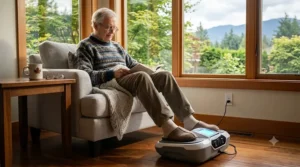
Leg Circulation Machines vs. Traditional Circulation Remedies
| Approach | Upfront Cost (CAD) | Effort Required | Best Suited To |
|---|---|---|---|
| Leg circulation machine | $50–$350 (one-time) | Low (sit and use) | Daily relief without lifestyle change |
| Compression socks | $20–$60/pair | Low (wear daily) | All-day, on-the-go support |
| Daily walking program | $0 | Moderate (consistency needed) | Building genuine vascular health, not just symptom relief |
| Elevating legs / leg pillows | $20–$80 | Low | Evening swelling reduction |
The honest read here is that a leg circulation machine isn’t a replacement for movement — it’s a complement to it. The Canadian Foundation for Cardiovascular Health notes that walking until symptoms occur, then resting, is one of the most effective non-surgical approaches for improving leg circulation in people with peripheral arterial disease, which no massager or stimulation device replicates on its own. Where these machines genuinely add value is on days when walking isn’t practical — after a long flight, during a Canadian ice storm when the sidewalks aren’t safe, or in the evening after you’ve already done your activity for the day.
Common Mistakes When Buying a Leg Circulation Machine in Canada
- Buying an NMES device without checking contraindications first. This is the single most common — and most avoidable — mistake. If you have a pacemaker or any implanted electronic device, skip Revitive and DR-HO’S entirely.
- Ignoring sizing and ending up with a sleeve that won’t fit properly. Always check the listed maximum calf or thigh circumference before buying, not after.
- Expecting overnight results from electrical stimulation devices. Both Revitive models are explicit that results build over 6–8 weeks; expecting day-one relief sets you up for disappointment.
- Skipping the warranty and return window check. Canadian return policies on Amazon.ca generally run 30 days standard, but bundled “deluxe package” versions of devices like DR-HO’S sometimes carry different terms — read the listing.
- Assuming a relaxation massager will manage a real medical diagnosis. Snailax, RENPHO, Nekteck, and FIT KING are comfort products. If you’ve been told you have PAD or venous insufficiency, that’s a conversation for your doctor, not a product review.
What to Expect: Real-World Performance in Canadian Winters
Cold weather genuinely changes how these devices feel and perform. Cold skin constricts blood vessels as a natural response, which is part of why feet feel colder and stiffer in winter regardless of any underlying circulation issue — the heat function on Nekteck, RENPHO, FIT KING, and Snailax becomes far more relevant for half the year than it might seem when you’re comparing spec sheets in summer. None of the seven devices on this list are designed to be used cold straight out of an unheated car or garage; let any unit reach room temperature before plugging it in, the same precaution you’d take with most rechargeable electronics.
Battery-powered units like the DR-HO’S Circulation Promoter will also see reduced runtime in cold rooms, consistent with how lithium and alkaline batteries generally perform in lower temperatures — worth knowing if you’re hoping to use it in a cool basement or a cottage without baseboard heat running.
Long-Term Cost & Maintenance in Canada
None of these devices carry ongoing subscription costs, which is a genuine point in their favour compared to, say, a physiotherapy clinic membership. The real long-term costs to budget for are:
- Replacement pads/electrodes for the TENS/EMS devices (Revitive, DR-HO’S) — these wear out with regular use and typically run $15–$30 CAD for a replacement set.
- Strap and Velcro wear on the air-compression sleeves, which is mostly a non-issue if you’re cleaning them regularly per the manufacturer’s care instructions.
- Warranty coverage — most brands on this list offer 1–2 year limited warranties; Health Canada doesn’t require warranty registration for these device classes, so it’s worth keeping your own receipt rather than relying on automatic registration.
Compared against a single private physiotherapy session in most Canadian provinces — commonly $80–$120 CAD per visit, and generally not covered by provincial health plans unless bundled into extended health benefits — even the priciest device on this list, Revitive Medic, pays for itself against roughly three sessions if daily home use genuinely reduces how often you’d otherwise book one.
Canadian Regulations & Safety Standards for Circulation Devices
Electrical stimulation devices like Revitive and DR-HO’S fall under Health Canada’s medical device framework, and depending on classification, may require an active medical device licence. You can verify any device’s licensing status directly through Health Canada’s Medical Devices Active Licence Listing (MDALL) — it’s a free public search by device or company name, and it’s worth five minutes if you want independent confirmation rather than relying on a product listing’s claims. Simple air-compression and shiatsu massagers like Snailax, RENPHO, Nekteck, and FIT KING generally fall into lower-risk product categories rather than licensed therapeutic devices, since they’re marketed for general comfort rather than treatment of a specific condition.
Separately, any electrical device sold in Canada should carry a recognized Canadian electrical safety certification mark — CSA, cUL, or cETL — visible on the plug or packaging. All seven products listed here are sold through Amazon.ca’s Health & Personal Care category, which requires sellers to meet these baseline safety standards for the Canadian market, but it’s still a reasonable thing to double-check on the box when your order arrives.
Frequently Asked Questions
❓ What is a leg circulation machine and how does it work?
❓ Are leg circulation machines safe for people with diabetes?
❓ Will these ship to all provinces in Canada, including remote areas?
❓ Can a leg circulation machine treat venous insufficiency or PAD?
❓ How long until I notice less swelling or warmer feet in winter?
Conclusion
If you’re shopping for genuine end-of-day relief from tired, cold, or mildly swollen legs, the air-compression sleeves — Nekteck, FIT KING, or RENPHO — give you the most bang for your buck without any of the contraindication concerns that come with electrical stimulation. If budget is the deciding factor and your main complaint is cold, tense feet rather than visible swelling, Snailax is a sensible low-risk starting point. And if you’re managing an actual diagnosed circulation condition, Revitive Medic, Revitive Essential, or the Canadian-made DR-HO’S Circulation Promoter are built for that use case specifically — though all three should sit alongside your doctor’s guidance, not replace it. None of these devices are a substitute for movement; pairing whichever one you choose with regular walking, even short indoor laps during a Canadian cold snap, will do more for your circulation long-term than the machine alone.
Recommended for You
- Best Calf Massager for Sore Muscles: Top 7 Picks in Canada 2026
- 7 Best Hockey Recovery Massagers in Canada (2026 Guide)
- 7 Best Calf Massagers in Canada (2026): Tested for Runners & Recovery
Disclaimer: This article contains affiliate links. As an Amazon Associate, I earn from qualifying purchases. If you purchase products through these links, we may earn a small commission at no additional cost to you. This content is for general informational purposes only and is not medical advice — consult a healthcare professional before using any circulation device, particularly if you have a pacemaker, implanted electronic device, are pregnant, or have symptoms of deep vein thrombosis.
✨ Found this helpful? Share it with your friends! 💬🤗
