

In This Article
Somewhere between the third time bag on the carousel and the fourth cramped middle seat of your life, your neck files a formal complaint. A travel massage gun is a compact, battery-powered percussion massager — usually under 1.5 pounds — built to fit airline carry-on rules and knock out muscle tension before or after a flight. That’s the whole pitch, really, and it’s a good one if you’ve ever landed somewhere beautiful only to spend the first evening hunched over a hotel bathtub trying to work a knot out of your own trapezius with a tennis ball.
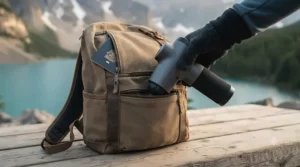
We’ve all made peace with certain travel indignities — the 100 ml liquid limit, the shoes-off shuffle, the seatmate who reclines the instant the seatbelt sign dims. But sore muscles don’t have to be one of them. Mini massage guns have quietly become one of the more sensible things frequent flyers pack, right up there with compression socks and a decent neck pillow, except this one actually does something instead of just looking supportive. A clinical study measuring percussive therapy’s effect on field athletes found meaningful drops in post-treatment pain scores alongside real gains in hip and knee range of motion — which is a fairly clinical way of saying it works, and works fast.
This guide breaks down seven real travel massage gun options across budget, mid-range, and premium tiers, walks through what Canadian air travellers specifically need to know about packing one, and gives you the practical, un-sponsored truth about battery life, airline rules, and which model actually earns a spot in your carry-on. No fabricated five-star reviews here — just spec comparisons, aggregated review sentiment, and honest analysis you can act on before your next flight.
Quick Comparison: Travel Massage Guns at a Glance
| Product | Weight | Battery Life | Noise Level | Best For |
|---|---|---|---|---|
| Theragun Mini (3rd Gen) | 0.88 lbs | ~150 min | Quiet (QuietForce) | Best overall for travel |
| Hypervolt Go 2 | 1.5 lbs | ~2-3 hrs | ~55 dB | Best value for carry-on |
| Ekrin Athletics Bantam | 1.1 lbs | Longest-lasting in class | Moderate | Best battery + warranty |
| Bob and Brad Q2 Mini | Under 1 lb | ~2 hrs | Moderate | Best budget pick |
| Bob and Brad M7 Plus Mini | ~1 lb | ~2 hrs | Moderate | Best with heat function |
| Sportneer Mini 3 | ~1 lb | ~2-3 hrs | Louder at max | Best stall force on a budget |
| ReAthlete FOLD | Under 1 lb | ~150 min (USB-C) | 45-55 dB | Best foldable design |
Looking at the table, the pattern that jumps out is how tightly matched battery life has become across price tiers — even budget options are landing in the two-hour range, which simply wasn’t true a couple of product cycles ago. The real differentiators now are noise level (a genuine concern in hotel rooms and shared Airbnbs) and warranty support, where Ekrin Athletics Bantam pulls ahead of nearly everyone. If your main constraint is packing space and TSA peace of mind, weight under 1.5 pounds should be your hard cutoff before you even look at percussion strength.
💬 Just one click — help others make better buying decisions too!😊
Top 7 Travel Massage Guns: Expert Analysis
1. Theragun Mini (3rd Gen) — best overall for travel
At just 0.88 pounds and roughly the size of a large fist, the Theragun Mini (3rd Gen) is built around one obvious goal: disappearing into a bag until you actually need it. The compact QuietForce motor keeps operating noise low enough that you can run it in a hotel room without waking a roommate, which matters more than most spec sheets let on. Three speed settings and 12mm of amplitude give it real deep-tissue capability despite the small footprint — Bluetooth connectivity ties into the Therabody app for guided routines, which is a nice touch for anyone who wants structure rather than just aimlessly jabbing at their calves. Based on the spec comparison, this is one of the few minis that doesn’t feel like a compromise next to full-size guns; reviewers consistently note that the ergonomic triangular handle is easier on the wrist during longer sessions than the standard L-shaped competitors. The tradeoff is price — this sits at the top of the mini category, in the mid-C$200s range, and the smaller handle can make certain hard-to-reach spots (mid-back, especially) genuinely awkward to hit solo.
Pros:
- ✅ Compact QuietForce motor is genuinely quiet in shared spaces
- ✅ App-guided routines add real structure for beginners
- ✅ Comes with its own protective travel case
Cons:
- ❌ Premium price relative to other minis
- ❌ Small handle makes mid-back self-massage awkward
Price sits in the mid-C$200s range at the time of research — check current price before buying, as availability and promotions shift often.
2. Hypervolt Go 2 — lightest pick for carry-on bags
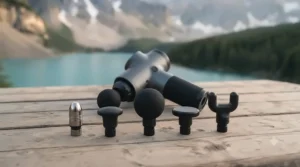
Hyperice built the Hypervolt Go 2 around a single number: 1.5 pounds, which puts it among the lightest devices we cover here without sacrificing a usable percussion feel. Three speed settings and two included attachment heads keep things simple — this isn’t trying to be a Swiss army knife, it’s trying to be the thing you actually grab because it’s not a hassle. What most buyers overlook about this model is that its roughly 55 dB output at max speed is quiet enough for a shared hotel room but still delivers a firm enough strike to matter on tight traps and calves. Reviewers consistently point out that it lacks a dedicated carrying case, which feels like an odd omission for something explicitly marketed on portability, so you’ll want a pouch of your own. At around C$180-C$220, it undercuts most of the premium field while still being explicitly TSA-approved for carry-on, and its simple three-button interface means there’s basically no learning curve.
Pros:
- ✅ Among the lightest travel massage guns available
- ✅ TSA-approved design with quiet 55 dB max output
- ✅ Simple three-speed interface, no learning curve
Cons:
- ❌ No included travel case or pouch
- ❌ Only two attachment heads limit versatility
Expect to pay in the C$180-C$220 range at the time of research, with prices subject to change.
3. Ekrin Athletics Bantam — best battery life and warranty
The Ekrin Athletics Bantam weighs 1.1 pounds, technically a touch heavier than the Theragun Mini, but it wins where it counts most for travellers: it comes with a lifetime warranty and battery life that reviewers say simply doesn’t quit, even after hours of cumulative use. Four attachment heads are included, and the 10mm amplitude — slightly shallower than the Theragun Mini’s 12mm — still delivers a satisfying percussive punch for everyday recovery. Here’s what to weigh: if you’re the type who forgets to charge things before a trip, or you’re headed somewhere without a reliable outlet for a few days, the Bantam’s battery endurance is arguably a bigger real-world advantage than raw amplitude numbers. Aggregated reviewer sentiment consistently highlights the lifetime warranty as a standout, since Therabody’s comparable one-year limited warranty looks thin by comparison. At a mid-range C$150-C$180, it’s a strong value pick for anyone prioritizing reliability over brand prestige.
Pros:
- ✅ Longest real-world battery life in its class
- ✅ Backed by an industry-leading lifetime warranty
- ✅ Ships with four attachment heads
Cons:
- ❌ Slightly heavier than the Theragun Mini
- ❌ Shallower amplitude than some premium rivals
Price typically falls in the C$150-C$180 range — always check current price, as it may vary.
4. Bob and Brad Q2 Mini Massage Gun — best budget pick
The Bob and Brad Q2 Mini Massage Gun is the entry point of this list, and it earns that spot honestly rather than by cutting every corner. It’s genuinely compact — well under a pound — and built for exactly one job: quick sessions before or after a flight, not marathon deep-tissue work. What the spec sheet won’t tell you, but reviewer patterns suggest, is that the Q2 Mini punches above its price bracket for calves, forearms, and feet, even if it’s not going to satisfy someone chasing serious stall force on tight glutes. Based on the spec comparison, this is the model to buy if you’re not sure you’ll use a massage gun enough to justify a premium purchase, but you still want something that clears airport security without a second glance. Battery life lands around the two-hour mark, which is plenty for the short, frequent sessions most casual travellers actually use. At roughly C$90-C$120, it’s a low-risk way to try the category.
Pros:
- ✅ Lowest price point of any model on this list
- ✅ Compact size clears security with zero hassle
- ✅ Solid choice for calves, feet, and forearms
Cons:
- ❌ Less stall force for deep glute or back work
- ❌ Fewer speed settings than pricier competitors
Around C$90-C$120 at the time of research — prices may vary by retailer.
5. Bob and Brad M7 Plus Mini Massage Gun — best with heat function
Where the Q2 Mini keeps things basic, the Bob and Brad M7 Plus Mini Massage Gun adds a genuinely useful upgrade for travellers: built-in heat. Combining percussion with warmth is a small addition on paper, but reviewers consistently note it makes a real difference on stiff shoulders after a long-haul flight, since heat helps loosen tissue before percussion gets to work on it. It’s still comfortably in the mini category at around a pound, so it doesn’t blow your carry-on weight budget, and it retains multiple speed settings for adjusting intensity. Honestly, the heat function is the kind of feature that sounds like marketing fluff until you’ve actually sat in an airport lounge with a stiff neck and wished your massage gun could also just warm the spot up first. At C$110-C$140, it undercuts most heated full-size guns by a wide margin while keeping the travel-friendly footprint intact.
Pros:
- ✅ Built-in heat adds real value for stiff, cold muscles
- ✅ Still compact enough for carry-on travel
- ✅ Multiple speed settings for adjustable intensity
Cons:
- ❌ Heat function drains battery faster than percussion alone
- ❌ Bulkier than the simplest minis on this list
Typically priced around C$110-C$140 — check current price before purchasing.
6. Sportneer Mini 3 Massage Gun — best stall force on a budget
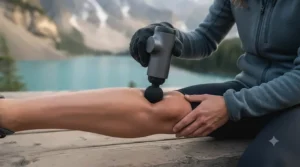
If raw power at a low price is your priority, the Sportneer Mini 3 Massage Gun is worth a serious look. With 150W of power and roughly 35 pounds of stall force, it’s genuinely stronger than several pricier rivals on this list — reviewers note it’s strong enough to make quad and glute work feel like an actual deep-tissue session rather than a surface tickle. A 12mm amplitude helps it drive deeper into sore tissue than shallower minis in its price bracket, which is impressive engineering for a budget-tier device. What most buyers overlook here is noise: at max speed it runs louder than the Theragun Mini or Hypervolt Go 2, so it’s better suited to gym bags and pre-flight stretching than late-night hotel-room sessions with thin walls. Battery life sits around two to three hours, comfortably enough for a multi-day trip between charges. At C$70-C$100, it’s arguably the best power-per-dollar on this list.
Pros:
- ✅ 35 lbs of stall force rivals pricier competitors
- ✅ 12mm amplitude for genuinely deep tissue work
- ✅ Best raw power-per-dollar of any pick here
Cons:
- ❌ Noticeably louder at max speed than premium minis
- ❌ Build quality feels less refined than name-brand rivals
Expect a price around C$70-C$100 at the time of research, subject to change.
7. ReAthlete FOLD — best foldable design
The ReAthlete FOLD takes a genuinely different approach to the travel category by literally folding down, shrinking its footprint even further than the fixed-shape minis on this list. It ships with four interchangeable attachment heads and a battery life stretching to roughly 150 minutes on a single USB-C charge — one of the more travel-friendly numbers here, especially since USB-C means you can share a charging cable with your laptop or phone instead of packing another proprietary brick. Build quality reviewers describe as notably dense rather than hollow, with motor noise sitting in a genuinely quiet 45-55 dB range that works in an office or a hotel room without disturbing anyone, and the folding hinge reportedly shows no wobble even with extended use. Based on the spec comparison, the folding hinge is the real differentiator here — it’s the only design on this list that meaningfully changes shape to save space rather than just being small to begin with. At a mid-range C$130-C$160, it’s a smart pick for minimalist packers who count every cubic centimetre of carry-on space.
Pros:
- ✅ Unique folding hinge shrinks packed size further
- ✅ USB-C charging shares a cable with other devices
- ✅ Quiet 45-55 dB motor noise even at higher speeds
Cons:
- ❌ Newer brand with a smaller review track record
- ❌ Folding hinge is one more moving part that could wear over time
Priced around C$130-C$160 at the time of research — always verify current pricing.
How to Choose a Travel Massage Gun
Picking the right one comes down to a handful of criteria that actually matter more than glossy marketing copy suggests:
- Weight and dimensions first. Anything over 1.5 pounds starts eating meaningfully into your carry-on weight allowance, especially on budget Canadian and international carriers with strict limits.
- Battery life measured in real sessions, not just minutes. A gun rated for 150 minutes sounds abstract until you realize that’s roughly 30-50 short recovery sessions — plenty for a week-long trip.
- Noise level for shared spaces. If you’re sharing a room, an Airbnb, or a hostel dorm, a 45-55 dB motor is the difference between a quick recovery session and an apologetic one.
- Attachment variety versus actual use case. Four heads sound impressive, but most travellers realistically use two: a ball head for large muscles and a bullet head for trigger points.
- Charging cable compatibility. USB-C models let you skip packing a dedicated charger, which matters more than it sounds like when your bag is already a game of Tetris.
- Warranty and battery degradation over time. Lithium batteries lose capacity with repeated charge cycles, so a longer warranty is a meaningful hedge against a device that won’t hold a charge in year two.
- Case or pouch inclusion. A dedicated case protects the motor housing during rough baggage handling and keeps attachment heads from rattling loose in your bag.
None of these criteria matter in isolation — a featherweight gun with a two-hour battery and no case is still going to frustrate you on a ten-day trip. Weigh them against your actual travel pattern rather than chasing the single “best” spec on a comparison chart.
Carry-On Massage Gun for Flights: Airline & CATSA Rules Explained
This is the part most buying guides skip entirely, and it’s arguably the most important for Canadian travellers. Every travel massage gun runs on a built-in lithium battery, and that means airline carry-on regulations apply whether you like it or not. Per CATSA’s official guidance on massage guns, devices with a lithium battery under 100 Wh are permitted in both carry-on and checked baggage, while batteries between 100 and 160 Wh are allowed in carry-on only, with airline approval. Every device on this list falls comfortably under that lower threshold, so in practice you’re not going to run into trouble at Canadian security screening.
That said, CATSA and Transport Canada both consistently recommend keeping any lithium-battery device on your person or in carry-on rather than checked luggage, since improperly packed batteries are a leading cause of items pulled from checked bags at Canadian airports each year. Practically, that means: charge your massage gun before you get to the airport (many airlines prohibit in-flight charging anyway), keep it out of the overhead bin if you can, and never pack it in checked baggage where a battery fault would be harder to detect and respond to. If you’re travelling with a spare battery pack for it, note that spares generally require carry-on placement with individually protected terminals — taped over or bagged separately — regardless of watt-hour rating.
One nuance worth flagging for anyone flying internationally: while CATSA governs Canadian departures, your return leg from another country follows that country’s rules, and airline-specific policies can be stricter than the baseline government guidance. It’s worth a thirty-second check of your specific carrier’s battery policy before a trip, especially on budget international carriers that sometimes apply tighter restrictions than CATSA’s federal minimums.
✨ Ready to travel sore-muscle-free? Compare our top 7 picks above and pack the one that fits your trip.
Battery Life Percussion Massager: How Long Should Yours Last?
“How long does a mini massage gun battery last” is one of the most common questions we see, and the honest answer is: it depends heavily on speed setting, not just battery rating. Running a device at its lowest speed for short bursts can stretch a single charge across multiple days of light use, while running it at max speed continuously — the way you might during an intense pre-flight stretch session — will drain even a strong battery in well under two hours.
Based on the specs we gathered across all seven products, expect somewhere between 120 and 180 minutes of continuous runtime at moderate speeds for most current-generation mini massage guns, with the ReAthlete FOLD and Theragun Mini (3rd Gen) both landing around the 150-minute mark on a full charge. The Ekrin Athletics Bantam stands out here specifically because reviewers report it holding a charge through hours of cumulative testing without dying — a meaningfully different claim than a manufacturer’s lab-rated runtime, since real-world use rarely matches ideal test conditions.
Two practical habits extend real-world battery life more than any spec ever will. First, avoid letting a lithium battery sit fully depleted for extended periods between trips — a partial charge before storage preserves capacity better over the long run. Second, use the lowest effective speed setting for your muscle group; jumping straight to max speed out of habit burns through charge cycles faster and, over a year or two of travel use, contributes to the gradual capacity loss all lithium batteries experience regardless of brand.
Practical Usage Guide: Getting the Most From Your Travel Massage Gun
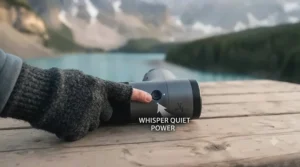
Buying the right device is half the equation — using it correctly is the other half, and it’s the part Amazon listings never actually cover. For your first 30 days, resist the urge to jump straight to the highest speed setting on your first session; start at the lowest setting for 15-20 seconds per muscle group to gauge sensitivity, then work up from there. Most mini massage guns perform best when moved slowly across a muscle rather than held static in one spot — hovering in place for too long can actually bruise tissue rather than relieve it, especially over bony areas like the shins or collarbone.
Understanding why muscles feel worse a day or two after travel-heavy activity also helps you time your sessions better — a Canadian physiotherapy overview of delayed onset muscle soreness notes that soreness typically peaks 24 to 72 hours after unfamiliar exertion, which is exactly why a quick session the evening you land often beats waiting until you’re fully stiff the next morning. A common first-time mistake is skipping the attachment swap entirely and using the default ball head for everything. Swap to a flatter or bullet-style attachment for smaller muscle groups like the forearms or feet, where the broad ball head just can’t apply targeted pressure effectively. For maintenance, wipe down the attachment heads after each use, especially after applying any massage oil or lotion, since residue buildup around the motor housing is a common cause of premature wear reported in aggregated reviews. Store your device with the battery around 50% charge if you’re not using it for an extended stretch between trips, and avoid leaving it in a hot car or checked bag exposed to cargo-hold temperature swings, which accelerates lithium battery degradation over time.
One optimization trick that doesn’t show up in any manual: run a 60-second session on your calves and feet immediately before boarding a long flight. It’s a small habit, but it primes circulation before hours of restricted movement in a cramped economy seat — arguably more useful pre-flight than post-flight, even though most people only think to use theirs after landing.
Real-World Scenarios: Which Travel Massage Gun Fits Your Trip?
Consider three different travellers and how their needs actually diverge. First, a frequent business flyer doing three short-haul trips a month, budget-conscious but time-poor: the Bob and Brad Q2 Mini fits well here — low cost, no-fuss operation, and enough charge for the two or three short sessions a business trip typically calls for. Second, a marathon runner travelling to races who needs genuine deep-tissue recovery between long flights and race day: the Sportneer Mini 3‘s stall force and amplitude make more sense than a gentler mini, even with the added noise tradeoff, because recovery quality outweighs quiet operation for this use case. Third, a family heading on a two-week overseas vacation with unpredictable outlet access and shared hotel rooms: the Ekrin Athletics Bantam‘s long-lasting battery and quieter profile solve two problems at once — nobody wants to explain why they’re percussion-massaging their calves at 11 p.m. while three kids try to sleep in the next bed.
None of these are the “best” massage gun in the abstract — they’re the best massage gun for that specific travel pattern, budget, and tolerance for noise. Matching the device to how you actually travel, rather than to a review site’s overall top pick, is the difference between a gadget that lives in your bag unused and one that earns its space every single trip.
Common Mistakes When Buying a Travel Massage Gun
The single most common mistake is buying based on stall force and amplitude alone, ignoring weight and noise entirely — specs that look impressive on paper but make a device miserable to actually pack and use quietly. A close second is assuming every massage gun with “mini” in the name is automatically carry-on compliant; while all seven products here fall under CATSA’s lower watt-hour threshold, it’s worth verifying the specific battery rating on the product page before buying, since manufacturers occasionally release variants with larger batteries under the same product name. Buyers also frequently skip checking whether a case is included, then discover after purchase that attachment heads are rattling loose in a suitcase pocket within a week.
Another overlooked issue: chasing the absolute lowest price without checking battery warranty terms. A device that’s C$30 cheaper but comes with a 90-day warranty instead of a lifetime one is a false economy if the battery degrades within a year of regular travel use — which lithium batteries subjected to frequent partial charge cycles are prone to doing. Finally, some buyers assume heat function and percussion strength are interchangeable upgrades; they solve different problems, and picking one over the other should depend on whether you’re usually dealing with cold, stiff muscles (heat helps) or deep, tight knots (raw percussion strength matters more).
Travel Massage Gun vs Full-Size Massage Gun
The obvious question is why not just pack a full-size massage gun and skip the compromise. Full-size guns generally weigh between 2 and 2.5 pounds, roughly double the mini category, and typically ship with a bulkier dedicated case that eats noticeably more carry-on space. They usually offer higher stall force and deeper amplitude, which matters if you’re a serious athlete managing chronic tightness rather than general travel stiffness — but for the vast majority of travellers, that extra power goes largely unused while the extra bulk gets felt on every single flight.
Battery life is a more even matchup than most buyers expect; several premium minis on this list actually match or exceed the runtime of older full-size models, since manufacturers have prioritized battery efficiency in the compact category specifically because travel is such a core use case. Noise is where minis pull further ahead — full-size guns’ larger motors are generally louder, which becomes a real issue in shared hotel rooms or on a red-eye flight where you might want a quick session at your seat. The honest verdict: unless you have a specific medical or athletic-performance reason to need maximum stall force, a mini travel massage gun covers 90% of what a full-size unit does, at roughly half the packed weight and often two-thirds of the price.
Flight-Friendly Wellness Gadgets: What Else Belongs In Your Carry-On
A travel massage gun rarely travels alone, and it’s worth thinking about your broader flight-friendly wellness kit rather than treating it as a standalone purchase. Compression socks address the circulation issues that come from hours of immobility, working on a completely different mechanism than percussive therapy but complementing it well — use compression during the flight, then a massage gun session once you land. A quality neck pillow with firm memory foam addresses posture-related tension that a massage gun can only treat after the fact rather than prevent.
Portable heating pads, similar in spirit to the built-in heat function on the Bob and Brad M7 Plus Mini, are worth packing separately if your chosen massage gun doesn’t include heat, since warmth before percussion consistently improves how effectively the muscle responds to treatment. A resistance band takes up almost no space and lets you do light mobility work in an airport lounge or hotel room, addressing stiffness that builds up from sitting rather than treating it after the fact. The throughline across all of these: flight-friendly wellness gear works best as a system rather than any single gadget, and a massage gun’s job is specifically post-tension relief, not prevention — pack accordingly.
Long-Term Cost & Maintenance
Sticker price is only part of the real cost of owning a travel massage gun. Attachment heads wear down with use, particularly the softer foam-tipped varieties, and most manufacturers sell replacement sets in the C$20-C$40 range — a cost worth factoring in if you’re a frequent user rather than an occasional one. Battery replacement is the bigger long-term consideration: lithium batteries in these devices typically hold meaningful capacity for 300-500 full charge cycles before noticeably degrading, which for a frequent traveller doing a session every few days could mean a battery that’s visibly weaker within two to three years.
This is where warranty terms genuinely translate into dollar value. The Ekrin Athletics Bantam‘s lifetime warranty effectively insures against exactly this failure mode, while a device with a standard one-year limited warranty leaves you exposed to a battery replacement or full unit replacement cost once that window closes. Running a simple cost-per-use calculation: a C$180 device used twice weekly over three years works out to roughly 60 cents per session, which compares favourably against even a single professional massage appointment — but only if the unit survives those three years without a battery failure, which is precisely why warranty coverage belongs in the purchase decision alongside upfront price.
Problem → Solution: Fixing Common Travel Massage Gun Headaches
Problem: the device won’t clear airport security screening smoothly. Solution: keep it in an easily accessible pocket of your carry-on rather than buried at the bottom, since screening officers may want a visual check of any battery-powered device that resembles a power tool — Transport Canada’s guidance on flying with lithium batteries is worth a quick read before any trip if you’re unsure.
Problem: battery dies partway through a trip with no outlet in sight. Solution: prioritize models like the Ekrin Athletics Bantam with strong reported real-world battery endurance, and charge fully the night before travel days rather than assuming you’ll find downtime to charge mid-trip.
Problem: it’s too loud to use in a shared hotel room without waking someone. Solution: choose a model in the 45-55 dB range, such as the ReAthlete FOLD or Theragun Mini (3rd Gen), and stick to lower speed settings during quiet hours.
Problem: attachment heads go missing or rattle loose in a suitcase. Solution: use a model that ships with a dedicated case, or buy a small zippered pouch specifically for the gun and its heads rather than tossing them loose into a packing cube.
Problem: muscles feel tenser rather than relieved after a session. Solution: check technique before blaming the device — hovering too long in one spot or using too high a speed setting on tender tissue can cause the opposite of the intended effect; move the head continuously and start at the lowest comfortable setting.
Frequently Asked Questions
❓ Can I bring a massage gun in checked luggage on an international flight?
❓ How long does a mini massage gun battery last on a single charge?
❓ Are travel massage guns actually effective compared to full-size ones?
❓ What's the best travel massage gun for a carry-on bag under airline weight limits?
❓ Do massage guns need to be declared at Canadian airport security?
Conclusion
A travel massage gun isn’t a luxury gadget so much as a small, honest fix for one of travel’s most predictable problems: your body feels every hour of that flight, and a hotel bed rarely undoes it. Across the seven products here, the right pick genuinely depends on how you travel rather than which one wins an abstract “best overall” contest — the Theragun Mini (3rd Gen) for travellers who want the most refined all-around option, the Bob and Brad Q2 Mini for anyone testing the category on a budget, and the Ekrin Athletics Bantam for frequent flyers who value battery endurance and warranty peace of mind over brand prestige.
What matters most, though, is understanding the practical realities before you buy: every device on this list clears Canadian carry-on lithium battery limits comfortably, battery life claims should be read with real-world use in mind rather than lab conditions, and technique matters just as much as the hardware itself. Pack the right one, charge it before security, and that post-flight stiffness stops being a given.
✨ Don’t Miss These Exclusive Deals!
🔍 Ready to travel lighter and recover faster? Check current pricing on any of the seven picks above and pack the one that actually fits your trip. These compact recovery tools help you land ready for whatever’s next on your itinerary!
Recommended for You
- Mini Massage Gun for Travel: 7 Best Picks Tested for 2026
- Deep Tissue Massage Gun 2026: 7 Top Picks Compared (Canada)
- Sports Recovery Gun for Athletes: 7 Top Picks for 2026 (Canada)
Disclaimer: This article contains affiliate links. As an Amazon Associate, I earn from qualifying purchases. If you purchase products through these links, we may earn a small commission at no additional cost to you.
✨ Found this helpful? Share it with your friends! 💬🤗
