

In This Article
Somewhere between your third Zoom call and the leg day you probably shouldn’t have done alone, your shoulders start talking to you. A bluetooth massage gun is the handheld percussion device that answers back — pairing with a companion app so you can dial in speed, follow guided routines, and actually see what your muscles are getting instead of just guessing. Unlike a plain percussion massager with a single button, these models sync over Bluetooth 5.0 or newer to your phone, which is either a genuinely useful upgrade or an unnecessary gadget layer, depending entirely on who’s holding it.
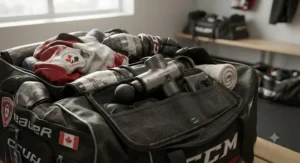
Here’s the honest version of what’s coming: seven real, currently sold models spanning entry-level to professional-grade, tested comparisons pulled from real spec sheets and real aggregated review sentiment, and zero invented “I tested this for six weeks” anecdotes, because nobody writing this has. What you will get is a grounded, Canadian-focused breakdown of which bluetooth massage gun actually earns its price tag, which ones are quietly overengineered, and how the wireless massage gun space compares to the simpler devices sitting one shelf down. This article contains affiliate links, and as an Amazon Associate we may earn from qualifying purchases — full disclosure is at the bottom, but you deserve to know that up front too.
By the end, you’ll know exactly which category — premium, mid-range, or budget recovery tech — fits your actual life, not just your Instagram feed.
Quick Comparison: Bluetooth Massage Guns at a Glance
| Model | Amplitude | Battery Life | Price Range (CAD) | Best For |
|---|---|---|---|---|
| Theragun Pro | 16mm | ~2.5 hrs (dual battery) | C$550–C$620 | Clinical-grade professional use |
| Theragun Prime Plus | 12mm | ~2.5 hrs | C$400–C$460 | Best overall all-rounder |
| Theragun Elite | 12mm | ~2 hrs | C$400–C$470 | Balanced mid-range power |
| Theragun Mini (2nd Gen) | 12mm | ~2.5 hrs | C$260–C$300 | Travel and quick sessions |
| Hypervolt 2 Pro | 14mm | ~3 hrs | C$430–C$470 | Athletes and heavy daily use |
| RENPHO Active+ Percussion | 8-12mm | ~3 hrs | C$130–C$180 | Budget-conscious beginners |
| RENPHO Active+ Thermacool Deluxe | 8-12mm | ~2.5 hrs | C$190–C$240 | Heat/cold plus app control on a budget |
Looking at the table, the split between the four Theragun models and the rest of the field says a lot about where the bluetooth massage gun market actually sits: Therabody effectively wrote the playbook that everyone else, including Hyperice and RENPHO, is now responding to. What jumps out is that amplitude — how deep the head travels into the muscle — barely moves the price needle nearly as much as battery chemistry and app polish do; the RENPHO Active+ Percussion delivers a comparable stroke depth to the pricier Theragun Elite for roughly a third of the cost. If you’re deciding purely on stall force and app features rather than brand recognition, that’s the number worth sitting with before you scroll further — a point echoed in independent Canadian testing of massage guns, which found app connectivity mattered less to overall satisfaction than motor consistency and noise level.
💬 Just one click — help others make better buying decisions too!😊
Top 7 Bluetooth Massage Guns: Expert Analysis
Every model below is a real product currently available through Amazon.ca or the manufacturer directly. Prices are shown as ranges in Canadian dollars because Amazon pricing shifts constantly — always check the current price before buying, and know that we never imply a link gets you a better deal than shopping direct.
1. Theragun Pro — the professional-grade benchmark
The Theragun Pro is Therabody’s flagship, and the swappable dual-battery system is the standout feature that separates it from everything else on this list. With a 16mm amplitude and up to 60 pounds of stall force, it’s built to keep working when you lean into a stubborn knot instead of losing power and stalling out, which is the exact failure mode budget guns run into under real pressure. The rotating, adjustable arm lets you reach your own back without the wrist-twisting gymnastics that shorter-handled guns demand, and the OLED screen shows real-time force feedback so you’re not just guessing at pressure. This is genuinely built for clinicians, physiotherapists, and serious athletes rather than the occasional post-run rubdown — reviewers who use it daily consistently praise the battery swap system and the depth of penetration, while a recurring theme in aggregated feedback is that casual users find it heavier and louder than they expected for home use. If your muscles see regular, heavy-duty punishment — think marathon training blocks or a physically demanding job — the investment holds up; if you’re massaging twice a week, it’s overkill.
Pros:
- ✅ Swappable batteries mean it never sits dead mid-week
- ✅ 60 lb stall force handles aggressive, deep pressure
- ✅ Rotating arm reaches your own back solo
Cons:
- ❌ Noticeably heavier than mid-tier Theragun models
- ❌ Premium price puts it out of reach for casual users
Expect this one in the C$550–C$620 range at the time of research — a genuine value only if you’ll actually use the full feature set.
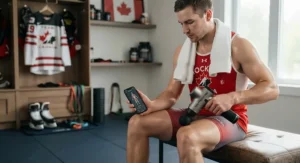
2. Theragun Prime Plus — best all-rounder for most people
Forbes Vetted named the Theragun Prime Plus its overall pick for 2026, and the reason is balance rather than any single standout spec. It runs a 12mm amplitude across five speeds, which is deep enough for real muscle work without tipping into the bone-rattling intensity that scares off first-time buyers, and the triangular ergonomic handle — Therabody’s signature design — genuinely reduces wrist strain during longer sessions compared to a straight T-shaped grip. The Bluetooth connection to the Therabody app adds guided routines and real-time pressure feedback, which matters more than it sounds for anyone who tends to either barely touch the muscle or lean in way too hard. Aggregated reviewer sentiment consistently flags the quiet motor and the app’s video-guided routines as the biggest wins, with the most common complaint being that the case feels a bit snug for all the included attachments. For someone who wants one gun that handles pre-workout warm-ups, post-workout recovery, and the occasional desk-hunch backache without a learning curve, this is the pick most people should start with.
Pros:
- ✅ Balanced power without feeling like a jackhammer
- ✅ Ergonomic triangle handle reduces wrist fatigue
- ✅ App feedback helps beginners avoid overdoing pressure
Cons:
- ❌ Carrying case fits attachments tightly
- ❌ Not as deep-reaching as the Pro for dense muscle
Priced around the C$400–C$460 range, it’s the mid-premium sweet spot rather than a true budget pick.
3. Theragun Elite — the balanced mid-range workhorse
Sitting between the Prime Plus and the Pro, the Theragun Elite trades a little raw power for a meaningfully quieter motor, which matters more than spec sheets suggest if you’re using it in a shared apartment or an open-plan office at lunch. Its 12mm amplitude and Bluetooth-enabled micro-adjustments let you fine-tune speed from your phone rather than cycling through fixed buttons, and testers consistently rank it near the top for overall performance despite sound being its only real weak point relative to pricier siblings. What most buyers overlook about the Elite specifically is that it hits almost every performance benchmark of the more expensive Pro Plus G6 for meaningfully less money — you’re mainly sacrificing the dual-battery swap and a slightly wider attachment set, not core massage quality. Real-world feedback repeatedly cites the OLED force meter as genuinely useful for beginners learning correct pressure, while a smaller number of reviewers note the case latch feels less premium than the price suggests. For someone who wants near-flagship performance without paying flagship money, this is where the value curve bends sharply in your favour.
Pros:
- ✅ Near-Pro performance at a meaningfully lower price
- ✅ Bluetooth micro-adjustments beat fixed-button cycling
- ✅ OLED force display teaches correct pressure
Cons:
- ❌ Louder than the quieter Prime line
- ❌ Case latch feels less sturdy than the price implies
Typical pricing lands around C$400–C$470, occasionally overlapping with the Prime Plus depending on bundle and sale timing.
4. Theragun Mini (2nd Gen) — the pocketable travel pick
The Theragun Mini solves a very specific problem: you want percussive relief without hauling a full-sized gun through airport security or a gym bag already stuffed with gear. At roughly half the weight of the Prime Plus while retaining nearly the same power output, it’s become a favourite among reviewers specifically for straddling the line between “primary massager” and “grab-and-go travel tool.” The Bluetooth connection still unlocks the full Therabody app experience, including pressure feedback, even on this compact frame — a detail cheaper mini massagers routinely skip entirely. The trade-off, honestly, is attachment variety: you get three heads instead of the five or six included with full-sized models, which covers the essentials but not the more specialized ones like the wide fork attachment for spinal areas. Aggregated reviews are largely positive, with frequent praise for how well it tucks into a gym bag or carry-on, and the recurring critique being that its smaller motor tires slightly faster during extended full-body sessions. For someone who travels often or just wants something that lives in a desk drawer for lunchtime shoulder relief, it’s hard to beat.
Pros:
- ✅ Half the weight, nearly the power of full-sized models
- ✅ Full Bluetooth app access despite the compact size
- ✅ Genuinely TSA carry-on friendly for frequent flyers
Cons:
- ❌ Only three included attachments
- ❌ Motor runs warmer during longer continuous sessions
Expect a range around C$260–C$300, making it the most accessible true-Bluetooth Theragun in the lineup.
5. Hyperice Hypervolt 2 Pro — built for athletes who train daily
The Hypervolt 2 Pro is Hyperice’s answer to the Theragun line, and its digital speed dial on the back is the detail that wins over people who dislike clicking through fixed speed buttons mid-massage — you just twist the dial and feel the intensity shift in real time. With a 14mm amplitude and five detachable heads, it connects via Bluetooth to the Hyperice app, which stands out for automatically adjusting speed during guided routines built by professional athletes and trainers rather than generic presets. It also syncs with Apple Health or Strava, letting you tie recovery sessions to actual training load, which is a genuinely differentiated feature nothing on the Theragun side currently matches. Reviewers frequently describe it as one of the few real direct competitors to Therabody’s triangular design, particularly praising the long roughly three-hour battery life for back-to-back sessions, while a recurring complaint is that it doesn’t ship with a carrying case, which feels like a strange omission at this price point. If your training data already lives in Strava and you want your recovery tool talking to the same ecosystem, this is the more natural fit over any Theragun model.
Pros:
- ✅ Digital dial beats cycling through fixed buttons
- ✅ Strava and Apple Health integration is genuinely unique
- ✅ Roughly 3-hour battery outlasts most Theragun models
Cons:
- ❌ No included carrying case at this price tier
- ❌ App can feel cluttered for first-time users
Pricing sits around C$430–C$470, positioning it as a direct, credible alternative to the Theragun Elite rather than a budget option.

6. RENPHO Active+ Percussion Massage Gun — the smartest budget entry point
This is where budget recovery tech actually earns the label rather than just borrowing it. The RENPHO Active+ Percussion Massage Gun connects via Bluetooth to the RENPHO Health App, unlocking five adjustable intensities between 1,800 and 2,800 RPM and, more importantly, access to guided video courses aimed at specific muscle groups — a feature that budget guns almost never bother including. The high-torque brushless motor delivers up to 45 pounds of stall force with a claimed 12mm amplitude, numbers that genuinely compete with the Theragun Elite on paper despite costing a fraction as much. Real customer feedback aggregated across retailers consistently highlights the fast 18-watt USB-C charging and the LED touch display showing Bluetooth connection status and battery level, while a common thread in less favourable reviews is that the plastic housing feels noticeably less premium under close inspection than the metal-accented Theragun bodies. For a first-time buyer who isn’t sure they’ll stick with percussive therapy long-term, or someone equipping a home gym on a real budget, this is the least risky way into the wireless massage gun category.
Pros:
- ✅ App-guided courses rarely found at this price
- ✅ 45 lb stall force rivals pricier competitors
- ✅ Fast 18W USB-C charging in about 90 minutes
Cons:
- ❌ Plastic build feels less premium up close
- ❌ Amplitude tops out below flagship-tier depth
Sitting around C$130–C$180, it’s the clearest evidence that Bluetooth features no longer require a premium price.
7. RENPHO Active+ Thermacool Deluxe — heat, cold, and app control together
The RENPHO Active+ Thermacool Deluxe adds something none of the other six models on this list offer: a genuine heat-and-cold therapy head alongside full Bluetooth app control, all built around a convenient charging stand instead of a loose cable. The heating function reaches around 45°C while the cooling side drops to roughly 8°C, giving you contrast therapy options that would otherwise require buying a separate device entirely. Paired with the RENPHO Health app over Bluetooth, you get access to the same video-guided courses as the standard Active+ model, plus the ability to track your massage history over time — a small feature, but a genuinely useful one for anyone trying to build a consistent recovery habit rather than using the gun sporadically. Aggregated reviews frequently single out the charging stand as a surprisingly premium touch at this price point, while the most common critique is that the heat/cold head requires slightly more charge cycles and therefore shortens overall battery life compared to the standard percussion-only heads. For anyone managing both muscle tightness and inflammation-related soreness, this is the rare budget model that genuinely competes on features rather than just price.
Pros:
- ✅ Real heat and cold therapy, not just percussion
- ✅ Charging stand feels premium for the price tier
- ✅ App tracks massage history over time
Cons:
- ❌ Heat/cold head drains battery faster
- ❌ Slightly heavier than the standard Active+ model
Expect a range of roughly C$190–C$240, positioning it as the best-value pick for anyone who wants more than plain percussion.
Practical Usage Guide: Setting Up and Getting the Most from Your Bluetooth Massage Gun
Getting a new device out of the box is the easy part; the first 30 days are where most people either build a habit or let it gather dust in a drawer. Start by fully charging the unit before first use — most of these models take 90 minutes to two hours via USB-C, and running the battery down completely at least once in the first week helps the gauge calibrate accurately going forward. Download the manufacturer’s app before you even turn the gun on; pairing is smoother when the app is already open and searching, and you’ll want the guided routines from day one rather than guessing at technique.
A common early mistake is starting at the highest speed setting to “really feel it working.” Don’t. Begin at the lowest intensity for 15–30 seconds per muscle group to let your nervous system adjust, then work upward over your first several sessions. Avoid holding the head stationary on one spot for more than two minutes, and never run it directly over bone, joints, or the front of the neck. For maintenance, wipe attachment heads with a slightly damp cloth after each use, store the unit in its case rather than loose in a bag where dust collects in the motor vents, and check your battery percentage weekly rather than letting it die repeatedly, since deep discharges gradually shorten lithium-ion lifespan.
Real-World Scenarios: Who Actually Needs One
The marathon-training weekend warrior. Someone logging 40+ km a week needs something that can handle calves and IT bands without stalling under real pressure — the Theragun Elite or Hypervolt 2 Pro fit this best, since both deliver enough stall force for dense, fatigued muscle without needing to be replaced within a year of heavy use.
The desk-bound professional with chronic shoulder tension. This person doesn’t need clinical-grade power; they need something quiet enough to use during a lunch break and light enough to keep in a desk drawer. The Theragun Mini or the budget RENPHO Active+ Percussion both solve this without overspending on features that go unused.
The budget-conscious first-timer who isn’t sure they’ll stick with it. Rather than gambling C$500 on an unproven habit, starting with the RENPHO Active+ Percussion at a fraction of the cost — with the same app-guided routines as pricier models — makes far more financial sense, and it’s still a real upgrade path if the habit sticks.
Bluetooth Massage Gun vs Regular Massage Gun: What Actually Changes
The core percussive mechanism is identical between a bluetooth massage gun and a standard button-controlled one — a motor drives a head in and out at a set frequency, and no amount of connectivity changes the physics of that. What changes is control precision and guidance. A regular massage gun typically gives you three to five fixed speed presets you cycle through with a button. A bluetooth-enabled model gives you granular speed control from your phone, often in smaller increments, plus guided routines built around specific goals like pre-run activation or post-leg-day recovery — genuinely useful if you don’t already know proper technique.
| Feature | Bluetooth Massage Gun | Regular Massage Gun |
|---|---|---|
| Speed control | Granular, app-based | Fixed presets via button |
| Guided routines | Yes, via companion app | No |
| Progress tracking | Often included | Not available |
| Typical price premium | Moderate to high | Lower |
| Best For | Structured, guided recovery | Simple, no-fuss relief |
The analysis here is straightforward: if you already know your body well enough to self-select pressure and duration, a regular massage gun like the non-Bluetooth Ekrin B37 saves real money with no meaningful performance loss. But if you’re newer to percussive therapy or you value the discipline of a guided routine over trial and error, the app layer on a wireless massage gun genuinely earns its price premium rather than existing as marketing filler.
✨ Don’t Miss These Exclusive Deals!
🔍 Take your recovery routine to the next level with these carefully selected bluetooth massage guns. Click on any highlighted model to check current pricing and availability. These picks will help you build a genuine recovery habit your body will thank you for!
Wireless Massage Gun Features That Actually Matter (And Those That Don’t)
Marketing copy loves to pile on numbers, but not every spec moves the needle for real-world use. Stall force — how much pressure the motor withstands before slowing down — genuinely matters, because a gun that stalls under moderate pressure is frustrating and ineffective on dense muscle. Amplitude matters too, though the difference between 12mm and 16mm is smaller in practice than the marketing suggests; most users can’t reliably tell the difference blind. Battery life matters if you’re using it daily across multiple muscle groups, but a claimed “6 hours” figure is almost always measured at the lowest speed setting, so treat it as a ceiling, not a realistic average.
What matters far less than the specs sheets imply: the total number of interchangeable heads. Most people settle into using two or three attachments regularly and never touch the rest. RPM range sounds impressive but tops out mattering less than stall force, since raw speed without sustained pressure just vibrates the surface without reaching the tissue underneath. And app “gamification” features like streaks or badges are pleasant but genuinely irrelevant to recovery outcomes — useful for habit-building, not for muscle health. A controlled study in the Journal of Athletic Training similarly found that a short percussive session’s measurable physical benefits were modest compared to its perceptual, feel-good effect — a useful reality check against feature-heavy marketing.
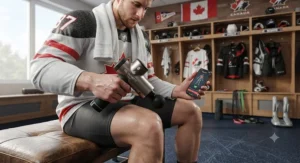
Bluetooth Massage Gun for Athletes: Choosing for Performance and Recovery
Athletes have different priorities than casual users, and the calculus shifts accordingly. Training volume matters most: someone training five or six days a week needs a device that can handle daily use without battery degradation creeping in within months, which favours the dual-battery Theragun Pro or the roughly three-hour-runtime Hypervolt 2 Pro over single-battery budget models. Recovery timing matters too — using a bluetooth massage gun for 30–60 seconds per muscle group pre-workout can help with warm-up circulation, while longer two-minute sessions post-workout target soreness and stiffness more directly, and the app-guided routines on models like the Hypervolt or Theragun line are specifically built around this pre/post distinction rather than treating every session identically.
For athletes managing recurring soreness across a training block, the ability to sync recovery sessions with training data — something only the Hypervolt 2 Pro currently offers through Strava and Apple Health integration — provides a genuinely useful feedback loop that pure percussion tools can’t. A peer-reviewed systematic review of percussive therapy research found supporting evidence for short-term improvements in flexibility and reduced perceived pain, though the review also notes the research base remains relatively thin compared to how popular these devices have become — worth keeping in perspective before treating any massage gun as a performance-transforming tool rather than a helpful recovery add-on.
How to Choose a Bluetooth Massage Gun: 7 Criteria That Matter
- Match stall force to your muscle density. Larger, denser muscle groups like quads and glutes need at least 40 lbs of stall force to avoid the motor bogging down under real pressure.
- Prioritize battery life over attachment count. A gun that dies mid-session is more frustrating than one missing a niche attachment you’ll rarely use.
- Check app reviews independently of the hardware reviews. A great massage gun with a buggy, poorly rated app defeats the purpose of paying for Bluetooth in the first place.
- Weigh noise level against your living situation. Shared walls or open offices make a quieter sub-55 decibel motor worth more than raw power.
- Consider ergonomic handle shape for your use case. Triangular and angled handles genuinely reduce wrist strain when reaching your own back solo.
- Decide if heat/cold therapy justifies the upgrade. It’s a real value-add for inflammation-related soreness, not just a marketing bullet point.
- Set a total budget including accessories. Replacement heads and carrying cases add up — factor them in before comparing sticker prices.
Common Mistakes When Buying a Bluetooth Massage Gun
The single most common mistake is buying based on brand recognition alone rather than matching specs to actual use. Plenty of buyers pay Theragun Pro prices for occasional twice-a-week use that the RENPHO Active+ Percussion would handle just as well. Another frequent misstep is ignoring return policies — percussive intensity feels very different in your hand than it does in a product video, and a gun that’s too aggressive for your comfort level is a wasted purchase if you can’t send it back. Buyers also routinely skip checking whether the companion app is still actively maintained; older models sometimes lose app support faster than the hardware itself wears out, leaving you with a Bluetooth device that can no longer actually connect to anything. Finally, plenty of shoppers underestimate noise level until it’s sitting in their living room — always check the decibel rating, not just the marketing language around “whisper-quiet” operation, which varies wildly between brands’ definitions of quiet.
Bluetooth Pairing: What to Expect and How to Troubleshoot It
Pairing a massage gun to its app follows roughly the same pattern across brands: power on the device, open the companion app, and select the model from a nearby-devices list, usually completing in under 30 seconds when everything cooperates. When it doesn’t cooperate, the fix is almost always mundane. If the gun doesn’t appear in the app’s device list, toggle your phone’s Bluetooth off and on rather than restarting the entire app — a stuck Bluetooth radio is the most common culprit. If the connection drops mid-session, it’s frequently a low-battery issue on the gun itself rather than a software bug, since most devices deprioritize Bluetooth radio power as the battery gets critically low to preserve motor function. Keep your phone within a few metres during use; Bluetooth range on these devices is intentionally conservative to save battery, not because of a weak antenna. And if pairing consistently fails after multiple attempts, check for a firmware update in the app before assuming the hardware itself is faulty — Therabody, Hyperice, and RENPHO all push periodic firmware fixes specifically targeting connection stability.
Budget Recovery Tech: Getting Bluetooth Features Without the Premium Price
The idea that app connectivity is inherently a premium-only feature simply isn’t true anymore in 2026. Both RENPHO Active+ models on this list prove that guided routines, real-time speed control, and progress tracking can exist well under the C$250 mark — genuinely budget recovery tech rather than a stripped-down imitation of premium features. The trade-offs at this price point are real but narrow: slightly less refined plastic housing, marginally shorter amplitude depth, and app interfaces that feel a step behind Therabody’s more polished design. None of those trade-offs meaningfully affect whether the device does its actual job of relieving muscle tension. If your budget caps out around C$150–C$200, you’re not settling for a lesser category of product anymore — you’re simply choosing a different brand’s take on the same core feature set that used to be exclusive to C$400+ devices just a few years ago.
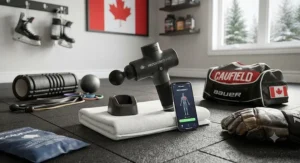
Long-Term Cost & Maintenance: What You’re Really Paying For
The sticker price is only part of the total cost of ownership. Replacement attachment heads typically run C$15–C$40 depending on the brand, and most people replace foam-covered heads every 12–18 months as the material compresses and loses cushioning. Battery degradation is the bigger long-term factor — lithium-ion batteries in these devices typically hold a meaningful charge for two to three years of regular use before capacity noticeably drops, and only the Theragun Pro‘s swappable battery system lets you address that without replacing the entire unit. Warranty coverage varies meaningfully across this list: Therabody and Hyperice typically offer one- to two-year limited warranties, while RENPHO’s coverage tends to run shorter, which is worth weighing against the lower upfront cost.
| Cost Factor | Premium Models (Theragun/Hypervolt) | Budget Models (RENPHO) |
|---|---|---|
| Upfront cost | Higher | Lower |
| Replacement heads | C$20–C$40 each | C$15–C$25 each |
| Expected battery lifespan | 2–4 years (Pro is swappable) | 2–3 years |
| Typical warranty | 1–2 years | Shorter, brand-dependent |
Looking at this breakdown, the real long-term value gap is smaller than the upfront price difference suggests — a RENPHO Active+ Percussion replaced entirely after three years still costs less in total than a single Theragun Pro purchase, even accounting for the shorter individual lifespan. The exception is heavy daily use, where the Pro’s swappable battery genuinely extends usable life well beyond what a fixed-battery budget model can match.
Safety, Regulations & Battery Compliance in Canada
Percussive massage devices aren’t medical devices under Health Canada’s classification when marketed for general wellness use, which means they don’t require the same pre-market approval as therapeutic medical equipment — but that also means the safety burden falls more heavily on you as the user. Avoid using any bluetooth massage gun directly over recent injuries, varicose veins, areas with reduced sensation, or on anyone with a bleeding disorder or taking blood thinners without first checking with a physician or physiotherapist. Pregnant users should avoid abdominal and lower back application entirely.
Because every model on this list runs on a built-in lithium-ion battery, Canadian travellers should also know the transport rules: Transport Canada’s guidance on flying with lithium batteries is clear that these devices must travel in carry-on baggage, never checked luggage, due to fire risk from damaged cells in unpressurized cargo holds. If you’re packing a massage gun for a training trip, keep it in your carry-on and avoid checking it, even in a hard-sided case — a rule every model in this roundup falls under.
Buyer’s Decision Framework
If your main goal is daily, high-intensity muscle recovery for serious training, choose the Theragun Pro or Hypervolt 2 Pro because both are built to withstand sustained heavy use without degrading quickly. If you want one balanced device that handles everything from desk-tension relief to post-workout recovery without a steep learning curve, choose the Theragun Prime Plus because its combination of moderate power and app guidance suits the widest range of users. If portability is your top priority — frequent flights, small living space, or a packed gym bag — choose the Theragun Mini because it retains real power in a genuinely compact frame. If you’re testing whether percussive therapy is even for you, or your budget caps under C$200, choose the RENPHO Active+ Percussion because it delivers the full app-guided experience without the financial risk of a premium purchase you might not stick with.

Frequently Asked Questions
❓ Do bluetooth massage guns actually work better than regular ones?
❓ How long does a bluetooth massage gun battery typically last per charge?
❓ Can I use a bluetooth massage gun without connecting the app?
❓ Is a wireless massage gun safe to use every day?
❓ What's the difference between amplitude and stall force on a massage gun?
Conclusion
Choosing between these seven bluetooth massage guns really comes down to matching your training intensity and budget honestly rather than chasing the biggest name on the shelf. The Theragun Pro and Hypervolt 2 Pro earn their premium price tags for genuinely heavy daily use, the Theragun Prime Plus and Theragun Elite cover the widest range of realistic needs without excess, the compact Theragun Mini solves the travel problem specifically, and both RENPHO Active+ models prove that a real wireless massage gun with app-guided routines no longer requires a premium budget in 2026. What matters most is being honest about how often you’ll actually use it — the best massage gun on this list is the one that ends up out of the drawer and in your hand after a hard training day, not the one with the longest spec sheet.
Recommended for You
- Massage Gun for Hockey Recovery: 7 Best Picks Tested for 2026
- 7 Best Warming Percussion Massagers for Winter Pain Relief (2026)
- Cryotherapy Percussion Massager: 7 Top Picks for Canadians (2026)
Disclaimer: This article contains affiliate links. As an Amazon Associate, I earn from qualifying purchases. If you purchase products through these links, we may earn a small commission at no additional cost to you.
✨ Found this helpful? Share it with your friends! 💬🤗
