
In This Article
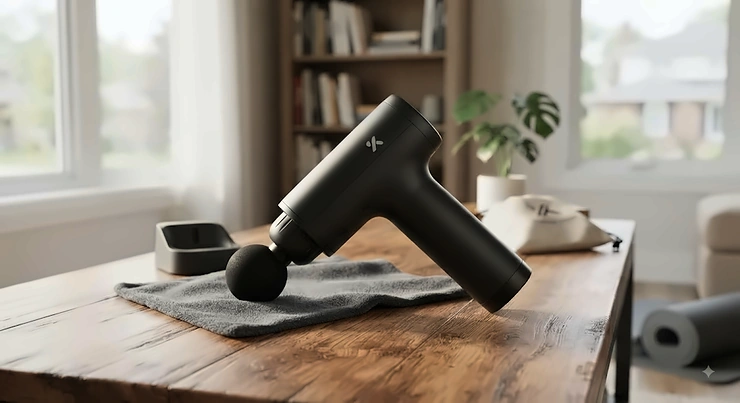
A low-noise massage gun is a percussion massager engineered with a brushless motor and reinforced housing to run quietly — typically under 55 decibels at working amplitude — so you can work out knots without waking the baby, annoying a roommate, or turning heads on a crowded flight. That’s the working definition, and it matters more than most shoppers realize. Anyone who’s ever fired up a cheap percussion massager in a condo with paper-thin walls knows the problem: the motor sounds less like “gentle recovery tool” and more like a dentist’s drill auditioning for a heavy metal band.

Here in Canada, where a huge share of us live in apartments, condos, and townhomes with shared walls, that buzzing racket isn’t just annoying — it’s a genuine dealbreaker. You want the deep-tissue relief after leg day or a long shift on your feet, not a passive-aggressive note from your downstairs neighbour. That’s exactly why the low-noise massage gun category has exploded, with brands racing to shave decibels off their motors without gutting the stall force that actually loosens tight muscle.
This guide digs into what actually makes a massage gun quiet (hint: it’s not marketing copy), compares seven real, currently available models across budget, mid-range, and premium tiers, and walks through the decibel data, the trade-offs, and the buying logic so you’re not guessing. We’ll also get into how noise-reduction technology works under the hood, and where a quieter unit might cost you a bit of raw power. Everything below is grounded in published specs and aggregated reviewer sentiment — never invented testimonials — because that’s the only honest way to help you spend your money well.
Quick Comparison Table
| Product | Noise Level | Stall Force | Best For |
|---|---|---|---|
| Theragun Mini (2nd Gen) | Under 55 dB | ~20 lbs | Travel and quick touch-ups |
| Bob and Brad Q2 Pro Mini | Under 50 dB | ~30 lbs | Budget-friendly heat/cold recovery |
| Renpho R3 | Under 50 dB | ~22 lbs | Hard-to-reach spots (back, shoulders) |
| Ekrin Athletics B37 | 35-55 dB | ~56 lbs | Deep tissue work in shared living spaces |
| Theragun Elite | ~60-65 dB (QuietForce) | ~40 lbs | All-around daily use with app guidance |
| Hypervolt 2 Pro | Quietest in its premium class | ~60 lbs | Professionals wanting near-silent power |
| Power Plate Pulse 3.0 | Quietest overall tested | ~40 lbs | Office and shared-space use at any speed |
Even a quick scan tells a story: noise and power don’t move in lockstep the way you’d assume. The Ekrin Athletics B37 and Power Plate Pulse 3.0 both manage genuinely quiet operation while still hitting stall-force numbers that rival guns twice their price, which is really the whole thesis of this article — that “quiet” and “weak” are not synonyms. Budget picks like the Bob and Brad Q2 Pro Mini and Renpho R3 trade some depth and stall force for their low price tags, which is a completely reasonable compromise if you’re mostly using the gun for light daily maintenance rather than serious athletic recovery.
💬 Just one click — help others make better buying decisions too!😊
Top 7 Low-Noise Massage Guns: Expert Analysis
1. Theragun Mini (2nd Gen) — pocket-sized and genuinely quiet
The Theragun Mini (2nd Gen) is Therabody’s travel-focused entry, and its small size is deceptive — this thing punches above its weight for a device that fits in a jacket pocket. It runs on a single “QuietForce” brushless motor tuned specifically for low-amplitude, low-noise operation, which is why it consistently lands under 55 decibels even at its top speed, a figure independent testers have verified with calibrated meters rather than taking the brand’s word for it.
Specs-wise, you’re looking at roughly a 12mm amplitude and around 20 lbs of stall force — noticeably gentler than full-size guns, which in practice means it’s excellent for calves, forearms, and everyday tension but starts to struggle on dense glute or lat muscle. Based on the spec comparison against full-size models, this is best understood as a maintenance tool rather than a deep-tissue workhorse: it’s the gun you toss in a gym bag or carry-on, not the one you reach for after a brutal leg day. Reviewers consistently note that the battery (roughly 2-3 hours of runtime) and the compact single-button interface make it dead simple for first-time users, though a few mention the shorter arm length makes back coverage awkward without help.
Pros:
- ✅ Genuinely quiet even at top speed, verified independently
- ✅ Small enough for a coat pocket or carry-on bag
- ✅ Simple single-button operation, no learning curve
Cons:
- ❌ Lower stall force struggles on dense muscle groups
- ❌ Short arm limits solo back and shoulder coverage
Pricing for the Theragun Mini (2nd Gen) typically sits in the C$200-C$230 range on amazon.ca (check current price, as it may vary), and for the size and quietness on offer, it’s a fair value pick for anyone who travels or wants a no-fuss desk companion rather than a full recovery system.
2. Bob and Brad Q2 Pro Mini — heat and cold on a budget
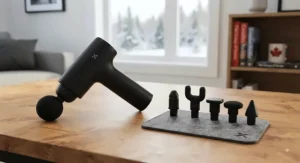
The Bob and Brad Q2 Pro Mini stands out in the sub-C$200 tier for one simple reason: it’s one of the only budget massage guns that adds heat and cold functionality to its main massage head, letting you combine thermal therapy with percussion in a single pass. That’s a feature normally reserved for guns costing two or three times as much.
Its extra-quiet motor is the headline spec here — reviewers and independent testers alike have flagged it as one of the quietest units in its price bracket, a genuinely rare combination given how many budget massagers sound like a dental drill. Five speed settings and five interchangeable heads round out the spec sheet, giving it more versatility than its price suggests. What most buyers overlook about a device like this is that “budget” doesn’t automatically mean “underpowered” — the Bob and Brad Q2 Pro Mini still delivers usable percussion depth for everyday tightness, even if it won’t out-muscle a premium full-size gun. Aggregated review sentiment is largely positive on the heat/cold feature and the noise level, with a recurring theme that the battery life, while solid, isn’t quite as long as pricier competitors.
Pros:
- ✅ Heat and cold function rare at this price point
- ✅ Extra-quiet motor confirmed by independent reviewers
- ✅ Five heads and five speeds for the money
Cons:
- ❌ Battery life shorter than premium competitors
- ❌ Less stall force for very dense muscle tissue
Expect to pay somewhere in the C$130-C$170 range for the Bob and Brad Q2 Pro Mini on amazon.ca (prices may vary), which makes it one of the strongest value-for-noise ratios on this entire list.
3. Renpho R3 — the wand-style reach specialist
The Renpho R3 takes a different physical approach entirely: instead of the classic gun shape, it’s built as a long-handled wand, and that design choice is exactly why it’s on this list. The elongated handle means you can reach your own upper back and shoulder blades without contorting yourself or asking a partner for help — a genuine limitation of the boxier gun-style devices above.
Because the amplitude is intentionally limited, the Renpho R3 trades some of the aggressive deep-tissue punch of a full percussion gun for smoother, more vibration-forward output, which in practice feels gentler and quieter by design rather than purely through motor engineering. That makes it a strong fit for people managing chronic tension or sensitive areas rather than athletes chasing maximum stall force. Here’s what to weigh: if your primary pain points are neck, upper traps, and mid-back — the spots hardest to self-treat — the reach advantage often outweighs the lighter percussion depth for daily use. Reviewers frequently mention the ergonomic handle and lower price as the main draws, with some noting the massage heads feel less premium than pricier alternatives.
Pros:
- ✅ Long handle reaches your own back solo
- ✅ Lower amplitude means gentler, quieter operation
- ✅ Budget-friendly for the reach it offers
Cons:
- ❌ Limited amplitude for true deep-tissue work
- ❌ Massage head materials feel less premium
Look for the Renpho R3 somewhere around C$90-C$130 on amazon.ca (at the time of research; check current price), making it one of the more affordable ways into low-noise recovery.
4. Ekrin Athletics B37 — the quiet deep-tissue standout
The Ekrin Athletics B37 is arguably the strongest argument that “quiet” and “powerful” aren’t mutually exclusive. Independent lab testing has clocked it between 35 and 55 decibels depending on speed setting, which places it firmly among the quietest massage guns tested in 2026 — and yet it still delivers roughly 56 lbs of stall force, a number that rivals or beats guns costing considerably more.
The angled handle is a genuinely clever ergonomic touch, letting you get proper leverage on your own back and shoulders without the wrist strain that straight-handled guns tend to cause during longer sessions. Based on the spec comparison, that stall-force number is what separates the Ekrin Athletics B37 from lighter “quiet” competitors — a lot of quiet massage guns get there by simply reducing power, but this one keeps the amplitude and force intact while engineering the motor and housing to dampen sound. Reviewers consistently cite the roughly 8-hour battery life as a standout, alongside comments that even at maximum intensity, it doesn’t feel like it’s about to shake apart in your hand.
Pros:
- ✅ Genuine deep-tissue force despite low noise output
- ✅ Angled handle improves reach and reduces wrist strain
- ✅ Long-lasting battery rated around 8 hours
Cons:
- ❌ Lower amplitude than the very top-end guns
- ❌ Pricier than entry-level budget options
The Ekrin Athletics B37 typically lands in the C$260-C$310 range on amazon.ca (prices may vary), and for buyers who refuse to sacrifice depth for quiet, this is the pick most worth the extra spend over the budget tier.
5. Theragun Elite — the all-rounder with app-guided routines
The Theragun Elite sits in Therabody’s mid-premium tier and remains one of the most recommended all-purpose massage guns on the market, largely because it balances power, ergonomics, and its proprietary QuietForce motor technology better than almost anything else at its price. It won’t be silent at top speed — figure somewhere in the 60-65 decibel range, closer to a normal conversation — but that’s still a meaningful step down from older-generation percussion guns that regularly cracked 70-plus decibels.
Around 40 lbs of stall force and a rotating arm with multiple attachment angles make the Theragun Elite genuinely versatile for full-body use, and the companion app adds guided routines that map specific attachments and speeds to muscle groups — useful for buyers who don’t already know their way around percussion therapy. What most buyers overlook here is that the “premium” price partly buys ergonomics and software, not just raw motor power; the physical stall force is actually comparable to cheaper guns. Aggregated review sentiment is strong on build quality and the app experience, with recurring notes that it’s louder than the brand’s own Mini or than dedicated “silent” competitors like the Ekrin Athletics B37.
Pros:
- ✅ Versatile rotating arm reaches nearly every muscle group
- ✅ App-guided routines help total beginners
- ✅ Strong build quality reviewers describe as durable
Cons:
- ❌ Noticeably louder than dedicated quiet-focused rivals
- ❌ Premium price partly pays for software, not just power
Expect the Theragun Elite to run in the C$380-C$430 range on amazon.ca (check current price, as availability and pricing shift), positioning it as a strong all-rounder for buyers who want one gun to do everything reasonably well.
6. Hypervolt 2 Pro — near-silent power for professionals
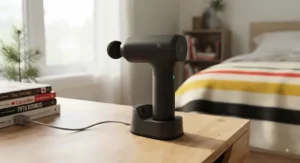
Hyperice’s Hypervolt 2 Pro has built a reputation among physiotherapists and professional sports staff, and independent 2026 testing has repeatedly flagged it as the quietest premium-tier massage gun evaluated that year — a genuinely impressive feat given it also delivers roughly 60 lbs of stall force, among the highest of any gun on this list.
Six included attachments (including a redesigned thumb head for lumbar work and a dampener for bony areas) give it clinical-level versatility, and the Bluetooth connectivity syncs with a companion app for guided sessions, similar in spirit to the Theragun Elite but with what reviewers describe as a noticeably quieter motor at comparable power output. Here’s what the spec sheet won’t tell you outright: that combination of high stall force and low noise typically requires more sophisticated motor engineering and better internal damping, which is exactly why this sits at the top of the price range. Aggregated reviewer sentiment repeatedly highlights the near-silent operation as the standout feature, particularly praised by users in clinics, offices, and shared apartments, with the main recurring complaint being the higher price relative to the Theragun Elite.
Pros:
- ✅ Quietest premium massage gun in independent 2026 testing
- ✅ High stall force despite the low noise output
- ✅ Six attachments cover clinical-level use cases
Cons:
- ❌ Among the priciest options on this list
- ❌ Six attachments can feel like overkill for casual users
The Hypervolt 2 Pro generally sells in the C$420-C$480 range on amazon.ca (prices may vary; check current listing), which is a real investment, but one that pays off across years of near-daily use for serious athletes or clinical settings.
7. Power Plate Pulse 3.0 — the quietest massage gun tested
If there’s one device that earns the “quietest massage gun” title outright, independent testers point to the Power Plate Pulse 3.0. In side-by-side noise testing — including the memorable trick of trying to watch TV while running the gun nearby — testers reported it as the only unit quiet enough to follow dialogue without subtitles at its lower and mid speed settings, only becoming clearly audible at its very highest power level.
Six vibration intensity levels, six massage heads, and roughly 6 hours of battery life round out a genuinely well-equipped spec sheet, with around 40 lbs of stall force putting it comfortably in the mid-to-upper power range. On paper this means you’re getting Power Plate’s decades of vibration-technology engineering — the same company behind commercial vibration training platforms — condensed into a handheld form factor, and that pedigree shows in how deliberately the motor and housing were tuned for sound dampening rather than noise being an afterthought. Reviewers consistently single out the noise level as the reason they recommend it for office use, shared living situations, or late-night recovery sessions without disturbing a partner.
Pros:
- ✅ Rated the quietest massage gun in direct comparison testing
- ✅ Backed by Power Plate’s established vibration-tech engineering
- ✅ Six heads and six intensities for real versatility
Cons:
- ❌ Becomes audible at the very highest power setting
- ❌ Six-hour battery trails the longest-lasting competitors
Pricing for the Power Plate Pulse 3.0 typically runs in the C$320-C$370 range on amazon.ca (check current price, as promotions vary), landing it as arguably the best pure noise-to-performance ratio in this entire roundup.
Practical Usage Guide: Getting the Most From a Low-Noise Massage Gun
Even the quietest hardware won’t feel effective if you’re using it wrong, so here’s the setup and first-30-days advice Amazon listings conveniently skip. Start every session on the lowest speed for 15-20 seconds per muscle group before increasing intensity — this “warm-up” pass actually reduces the audible thump because you’re not driving the head hard into cold, tense tissue, which is one of the biggest overlooked contributors to perceived noise. Hold the gun at a slight angle rather than pressing straight down; excess downward pressure forces the motor to work harder against resistance, and a straining motor is a louder motor regardless of how quiet its baseline rating is.
A common first-30-days mistake is charging the battery only when it dies completely. Lithium batteries in devices like the Ekrin Athletics B37 or Hypervolt 2 Pro last longer with partial, frequent charges rather than deep discharge cycles, which also helps keep the motor running at its rated (quieter) specifications rather than straining as voltage drops. For maintenance, wipe down heads after each use and check the head attachment points monthly for wobble — a loose head is one of the single biggest causes of a massage gun sounding louder than its factory rating over time, since the rattle is mechanical, not motor noise. Store your unit in its case rather than loose in a gym bag; dust and lint working into the motor housing gradually degrades the sound dampening that made it quiet in the first place.
Problem → Solution: Common Low-Noise Massage Gun Frustrations, Solved
Problem: “It’s louder than advertised.” This is almost always a pressure or head-attachment issue rather than a defective unit. Ease off downward pressure, confirm the head is fully seated, and test again — most complaints about the Theragun Elite or similar guns being “surprisingly loud” trace back to users pressing far harder than the device is designed for.
Problem: “The battery dies mid-session.” Cold storage temperatures reduce lithium battery output significantly. If you keep your gun in a car or unheated garage over a Canadian winter, bring it inside a few hours before use, and consider a mid-tier option like the Bob and Brad Q2 Pro Mini if runtime is a recurring frustration.
Problem: “It doesn’t reach deep enough to matter.” This usually means amplitude, not noise level, is the mismatch — compact guns like the Theragun Mini (2nd Gen) simply weren’t built for dense glute or lat tissue. Solution: match the tool to the muscle, reaching for something like the Ekrin Athletics B37 for genuinely deep work.
Problem: “My roommate still hears it through the wall.” Sound travels through structure as much as air. Placing a folded towel under the unit while it’s running (never while pressed to skin) or using it away from shared walls reduces perceived noise more than most people expect.
Problem: “Attachments keep coming loose and rattling.” A loose head amplifies noise dramatically and isn’t a motor problem at all. Press attachments in fully until they click, and inspect the shaft occasionally for wear if you use your gun daily.
Buyer’s Decision Framework: Matching Budget Recovery Tools to Your Needs
Not everyone needs a C$450 premium unit, and treating every purchase as a maximalist decision is how people overspend on features they’ll never use. If you’re a student or renter on a tight budget who mainly wants relief from desk-related neck and shoulder tension, a device like the Renpho R3 or Bob and Brad Q2 Pro Mini covers that use case completely — you’re paying for reach and quiet operation, not clinical-grade stall force. If you’re a recreational runner or weekend gym-goer dealing with genuine post-workout soreness in bigger muscle groups, step up to the Ekrin Athletics B37, which is the clearest example on this list of a mid-priced budget recovery tool that doesn’t feel like a compromise.
If you’re a shift worker or someone living in a thin-walled apartment building where noise complaints are a real, lived concern, prioritize decibel rating over raw power — the Power Plate Pulse 3.0 or Hypervolt 2 Pro earn their higher price tags specifically for that scenario. And if you’re an athlete or someone working with a physiotherapist on a structured recovery plan, the app-guided routines on the Theragun Elite or Hypervolt 2 Pro add real value beyond the hardware itself. The simple rule: match your spend to your actual use frequency and muscle depth needs, not to whichever gun has the flashiest marketing.
✨ Ready to stop guessing and start recovering quietly?
Compare current prices on these picks before they shift.
How to Choose a Low-Noise Massage Gun
- Check independently verified decibel ratings, not marketing claims. Brand-stated “quiet” claims vary wildly; look for third-party lab testing with a calibrated meter whenever possible.
- Match amplitude to your actual muscle depth needs. Compact minis are excellent for maintenance but underpowered for dense glute, quad, or lat tissue.
- Prioritize stall force if you do serious training. A quiet gun with low stall force will stall out (literally) against tight, dense muscle, forcing you to press harder — which paradoxically makes it louder.
- Consider battery chemistry and runtime for your session frequency. Daily users benefit from longer-rated batteries like the roughly 8-hour figure on the Ekrin Athletics B37.
- Weigh attachment variety against real usage. More heads sound appealing, but most people settle into using two or three regularly — don’t overpay for a six-head kit you won’t touch.
- Factor in your living situation honestly. Thin apartment walls or a sleeping partner should push your decision toward the quietest-rated tier, even at a higher price.
- Read aggregated review themes, not star averages alone. A 4.5-star average can still hide a recurring noise complaint buried in the text reviews — search within reviews for “loud” or “quiet” specifically before buying.
Low-Noise Massage Gun vs Standard Massage Gun: What Actually Changes
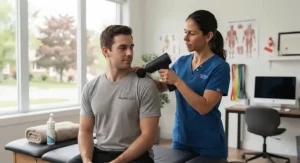
The gap between a low-noise massage gun and a standard massage gun isn’t just about decibels on a spec sheet — it changes how and where you can actually use the thing. A standard massage gun, often running 70-plus decibels at higher speeds, effectively confines you to a private room with a closed door, which for many renters and apartment dwellers means the gym bag stays zipped more often than not. A genuinely low-noise model, by contrast, opens up use in shared living rooms, open-plan offices, hotel rooms, and even quiet gym floors without drawing stares.
| Factor | Low-Noise Massage Gun | Standard Massage Gun |
|---|---|---|
| Typical noise range | 35-55 dB | 65-75+ dB |
| Common motor type | Brushless with acoustic damping | Brushed or lower-grade brushless |
| Where you can use it | Shared spaces, offices, late at night | Private rooms, generally isolated use |
| Price premium | Often 15-30% higher for equivalent power | Lower upfront cost |
| Stall force trade-off | Minimal in well-engineered models (e.g. Ekrin Athletics B37) | Often no trade-off, but louder |
The trade-off worth understanding is engineering cost, not physics. Building a motor and housing that dampens sound without sacrificing amplitude — the approach taken by the Ekrin Athletics B37 and Power Plate Pulse 3.0 — requires better components and tighter tolerances, which is exactly why quiet models tend to sit at a price premium over otherwise-comparable standard guns. That said, cheaper “quiet” guns sometimes get there the lazy way, by simply reducing motor power, so a low sticker price paired with a suspiciously low decibel claim is worth double-checking against independent test data before you buy.
Traditional recovery alternatives are worth a mention here too, since they’re the honest baseline any massage gun is competing against. Foam rollers and manual self-massage are silent and free but require far more physical effort and can’t replicate targeted percussion depth. Professional massage therapy is effective and, notably, a form of percussive technique called tapotement has been used by hands-on therapists for well over a century — tapotement is essentially the manual-hands ancestor of what a percussion gun automates — but it costs significantly more per session and requires scheduling. A quality low-noise massage gun sits in a genuinely useful middle ground: more targeted and convenient than a foam roller, more affordable and available than a therapist, on demand, whenever tension hits.
Decibel Levels in Massage Guns: What the Numbers Actually Mean
Decibels are measured on a logarithmic scale, which trips up a lot of shoppers comparing spec sheets. A jump from 50 dB to 60 dB isn’t a 20% increase in loudness — it’s roughly a doubling of perceived sound intensity. That’s why the difference between the Ekrin Athletics B37‘s low-end 35 dB reading and a standard gun’s 70+ dB reading is dramatic in a real room, not a marginal spec-sheet footnote.
| Noise Level | Real-World Comparison | Example Product |
|---|---|---|
| 35-40 dB | Quiet library or soft whisper | Ekrin Athletics B37 (low speed) |
| 45-55 dB | Quiet office, light rainfall | Theragun Mini (2nd Gen), Bob and Brad Q2 Pro Mini |
| 55-65 dB | Normal conversation | Theragun Elite (mid-high speed) |
| 65-75 dB | Standard massage gun at top speed | Typical uncertified budget import |
| 85+ dB | Regulated occupational exposure threshold | N/A — not applicable to handheld massagers |
That last row matters more than it looks. Canadian federal workplace noise regulation sets 85 dBA as the threshold at which employers must take hearing-conservation action, according to the Canadian Centre for Occupational Health and Safety. No massage gun on this list comes anywhere close to that threshold, so hearing risk isn’t a genuine safety concern with any of these devices — the noise conversation here is entirely about comfort and household courtesy, not occupational safety. What’s actually happening acoustically is that quieter models use brushless motors with tighter tolerances and internal foam or rubber damping to absorb vibration before it becomes airborne sound, while louder units let more of that mechanical vibration escape as audible buzz.
How Noise-Reduction Technology Works
Marketing terms like “QuietForce” or “SilentPro” sound like proprietary magic, but the underlying engineering is fairly consistent across brands, and understanding it helps you separate genuine quiet tech from a lower speed setting rebranded as a feature. Brushless motors are the foundation — they eliminate the physical brush contacts found in cheaper motors, which reduces both friction noise and the electrical “whine” that brushed motors are known for. On top of that, manufacturers add internal damping materials (foam, rubber gaskets, and sometimes gel-based mounts) around the motor housing specifically to absorb vibration before it can resonate through the plastic shell and become audible.
The other major lever is amplitude tuning. A shorter stroke length physically displaces less air and creates less mechanical shock per stroke, which is part of why compact minis like the Theragun Mini (2nd Gen) run quieter than full-size guns even before any acoustic engineering is factored in — though as covered earlier, that shorter stroke also means less depth. The more sophisticated (and expensive) approach, used in devices like the Hypervolt 2 Pro and Power Plate Pulse 3.0, keeps amplitude and stall force high while investing in better bearings, tighter shaft tolerances, and multi-layer housing to prevent that force from translating into rattle and buzz. What most buyers overlook is that a genuinely well-engineered quiet motor also tends to run cooler and last longer, since a lot of the vibration that creates noise is also mechanical stress that wears components down over time — so noise-reduction technology often correlates with longer product lifespan, not just a nicer bedside manner.
Top Silent Percussion Massagers for Apartment and Office Life
Different living situations call for different priorities, even within the “quiet” category. If you’re in a condo or apartment with strict noise bylaws and shared walls on multiple sides, the top silent percussion massager options are the Power Plate Pulse 3.0 and Ekrin Athletics B37 — both verified among the quietest at low-to-mid speeds, which is realistically where you’ll spend most of a session anyway. Reserve the higher speeds, where even these units become more audible, for brief bursts rather than sustained use if a shared wall is a genuine concern.
For open-plan office use — a increasingly common scenario as more Canadian workplaces add wellness rooms or allow desk-adjacent recovery breaks — portability matters as much as noise. The Theragun Mini (2nd Gen) and Bob and Brad Q2 Pro Mini fit easily in a desk drawer and won’t draw attention from coworkers on a call two desks over. For shared hotel rooms or travel generally, the same compact picks win out simply on packability, though frequent travelers who also train seriously might find the mid-size Ekrin Athletics B37 a worthwhile trade-off between quiet, portable, and genuinely effective. The throughline across every scenario: match the noise tier to your actual environment rather than defaulting to whichever gun has the most speed settings on the box.
Common Mistakes When Buying a Low-Noise Massage Gun
The single most common mistake is trusting a brand’s self-reported decibel number without checking independent verification — plenty of budget imports claim “ultra-quiet” on the packaging while measuring closer to a standard gun in real testing. A second frequent error is buying based on attachment count alone; a twenty-head kit sounds impressive, but reviewers across nearly every product category consistently report using only two or three heads regularly, meaning that spec rarely reflects real-world value. Buyers also frequently underestimate how much downward pressure affects both noise and battery drain — pressing harder doesn’t increase depth as much as people assume, and it does make the motor noticeably louder and drain the battery faster.
Another overlooked mistake is ignoring weight for the intended use case. A heavier “premium” gun like the Hypervolt 2 Pro is fantastic for targeted sessions but becomes fatiguing fast if you’re planning long, full-body routines solo — something worth testing (or at least reading reviews about) before committing to a higher price point. Finally, many shoppers skip checking return policies specifically for noise-related dissatisfaction; because perceived loudness is subjective and room-dependent, buying from a listing with a clear, working return window protects you if a “quiet” unit doesn’t meet your expectations once it’s actually running in your space.
Long-Term Cost & Maintenance
A massage gun’s total cost of ownership extends well beyond the sticker price, and this is where cheaper units can quietly become more expensive over a few years. Replacement heads, which wear down or crack with regular use, typically run C$15-C$40 per set depending on the brand, and premium brands like Therabody and Hyperice often charge more for proprietary-shaped attachments than third-party-compatible brands like Ekrin Athletics B37. Battery replacement is the bigger long-term factor: lithium batteries in daily-use devices generally hold a meaningful charge for two to four years before capacity noticeably degrades, and guns with sealed, non-replaceable batteries (common in ultra-compact minis) effectively become disposable once that happens, while some mid-range and premium models offer official battery-replacement service.
Cost-per-use math favors more expensive, well-built units surprisingly quickly if you use your gun several times a week. A C$450 Hypervolt 2 Pro used three times weekly for three years works out to under C$1 per session, comparable to or cheaper than a single professional massage therapy visit, which typically runs well past C$80-C$100 per hour in most Canadian cities. Warranty length is worth comparing directly too — most brands in this category offer one to two years standard, though registering your device promptly and keeping proof of purchase matters if a motor issue (the most common failure point) surfaces just outside that window.

FAQ
❓ What decibel level counts as a low-noise massage gun?
❓ Are low-noise massage guns less effective than standard ones?
❓ Can I use a low-noise massage gun at night without waking someone up?
❓ How much does a good low-noise massage gun cost in Canada?
❓ Do quieter massage guns wear out faster than louder ones?
Conclusion
The honest takeaway here is that “low-noise” and “low-power” aren’t the same thing, even though a lot of budget marketing tries to blur that line. Devices like the Ekrin Athletics B37 and Power Plate Pulse 3.0 prove that genuinely quiet operation is achievable without sacrificing the stall force that actually makes percussion therapy useful — you just pay a bit more for the engineering that makes it possible. If you’re working with a tighter budget, the Renpho R3 and Bob and Brad Q2 Pro Mini still deliver real, quiet relief for everyday tension; they simply aren’t built for serious deep-tissue demands.
Whichever tier fits your budget and living situation, the core buying logic stays the same: verify decibel claims against independent testing, match amplitude and stall force to how you’ll actually use the gun, and weigh long-term cost of ownership rather than sticker price alone. A quiet, well-chosen massage gun becomes a genuinely useful daily tool rather than a device that guilt-trips you into using it only when nobody’s around to hear it.
Recommended for You
- 7 Best Smart Massage Gun Picks in Canada for 2026 (Tested; Compared)
- Bluetooth Massage Gun: 7 Top Picks Canadians Trust (2026)
- Massage Gun for Hockey Recovery: 7 Best Picks Tested for 2026
Disclaimer: This article contains affiliate links. As an Amazon Associate, I earn from qualifying purchases. If you purchase products through these links, we may earn a small commission at no additional cost to you.
✨ Found this helpful? Share it with your friends! 💬🤗
