
In This Article
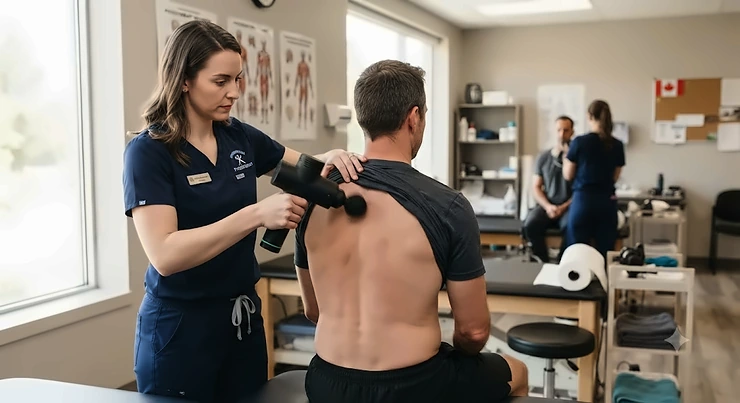
Somewhere between “gym bag gadget” and “actual clinical tool” sits the massage gun, and if you’ve spent any time in a physiotherapy clinic in the last few years, you’ve probably watched a clinician reach for one mid-session the way they’d reach for a resistance band. That’s not a coincidence. A massage gun for physiotherapy use has quietly become one of the more practical additions to a recovery toolkit, whether you’re a clinician stretching your treatment hours further or someone managing your own tight hip flexors between appointments. It isn’t magic, and it isn’t a replacement for hands-on care — but used properly, it does a specific job well: it delivers rapid, repetitive percussive pressure into muscle tissue to help ease stiffness, encourage blood flow, and make the post-exercise (or post-desk-job) ache a little more bearable.
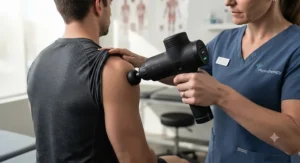
This guide skips the marketing fluff you’d get from an Amazon listing and gets into the stuff that actually matters for Canadians shopping for one: real specs, honest trade-offs, and pricing in CAD so you’re not doing currency math on your lunch break. We looked at models spanning entry-level to professional-grade, from brands physiotherapists actually mention (Therabody, Hyperice, Ekrin) down to the budget names crowding Amazon.ca’s search results (RENPHO, Bob and Brad, TOLOCO). Along the way, we’ll walk through how to choose one, what separates a mid-range unit from a premium one, and where a massage gun for physiotherapy use fits alongside foam rollers and other deep tissue therapy tools you might already own.
One quick note before we dive in: physiotherapy itself is a regulated health profession in Canada, and nothing in this article should be read as a substitute for an assessment from a licensed physiotherapist — think of a massage gun as a support tool, not a treatment plan.
Quick Comparison Table
If you’re the type who wants the short version before committing to 4,000 words about percussion massagers (fair enough), here’s the cheat sheet.
| Massage Gun | Price Range (CAD) | Stall Force | Best For |
|---|---|---|---|
| Therabody Theragun Prime (6th Gen) | C$300–C$380 | Up to 30 lbs | All-around home and light clinical use |
| Hyperice Hypervolt 2 Pro | C$450–C$530 | Up to 60 lbs | High-volume clinical settings |
| Ekrin B37S | C$400–C$480 | 56 lbs | Long-term durability, lifetime warranty |
| Bob and Brad D6 Pro | C$260–C$330 | 85 lbs | Power-per-dollar, deep tissue work |
| RENPHO R3 with Heat | C$120–C$180 | ~35 lbs | Best deep tissue pick under C$250 |
| Bob and Brad Q2 Mini | C$60–C$100 | 32 lbs | Travel and pocket portability |
| TOLOCO Black Massage Gun | C$100–C$150 | Moderate | Long battery life on a tight budget |
A glance at that table tells you something the spec sheets alone won’t: price and stall force don’t move in lockstep the way you’d expect. The Bob and Brad D6 Pro actually out-musters some units costing C$150 more, which says more about brand overhead than raw engineering. Meanwhile, the Hyperice Hypervolt 2 Pro justifies its higher price tag less through brute force and more through build quality, app integration, and the kind of quiet operation that matters when you’re running back-to-back clinic appointments. If your budget caps out under C$250, don’t assume you’re settling — the RENPHO R3 proves a genuinely usable deep tissue experience doesn’t require a four-figure(ish) spend.
💬 Found a pick you like already? Save this table and come back to it before you check out — prices shift often, so always confirm current pricing before you buy.
Top 7 Massage Guns for Physiotherapy Use: Expert Analysis
We didn’t just pull these seven names from a bestseller list. Each one earned its spot by covering a genuinely different use case — clinic-grade power, home-user simplicity, backpack portability, or rock-bottom affordability — so that whatever your situation looks like, one of these should fit it.
1. Therabody Theragun Prime (6th Gen) — best all-around balance of power and simplicity
The 6th-generation Prime dropped the gimmicks and kept what actually works: a brushless motor, a 16 mm amplitude, and a triangle-shaped handle that lets you reach your own upper back without contorting like a yoga instructor. That’s not a small thing — most people abandon their first massage gun within a month simply because they can’t comfortably reach the muscles that hurt the most.
On the spec sheet, the Prime delivers up to 30 lbs of no-stall force across five speeds, which sits comfortably in the “capable but not overwhelming” zone. In practice, that means it can push through moderate knots in the calves and glutes without stalling out mid-stroke, though it won’t match the raw torque of the pricier options further down this list. What most buyers overlook about the Prime is its Bluetooth connection to the Therabody app, which offers guided routines — genuinely useful if you’re new to percussive therapy and don’t yet have a sense of which speed or attachment suits which muscle group.
Aggregated reviewer sentiment across major retailers consistently flags two things: the durability of the impact-resistant housing, and the surprisingly quiet QuietForce motor, which matters if you’re using it in a shared space or a clinic waiting room. A recurring complaint is battery swap inconvenience on some earlier units, though the current generation addresses this with a more robust internal cell.
Pros:
- ✅ Reaches hard-to-hit spots thanks to the triangle grip
- ✅ Genuinely quiet motor for shared or clinical spaces
- ✅ App-guided routines help total beginners get started
Cons:
- ❌ 30 lbs stall force trails behind premium rivals
- ❌ App features feel unnecessary if you just want a simple gun
Prices for the Theragun Prime run in the C$300–C$380 range depending on retailer and promotions — always check current pricing before buying. At that price, it’s a strong value pick if you want a name-brand device without stepping up to Therabody’s flagship models.
2. Hyperice Hypervolt 2 Pro — best for high-volume clinical use
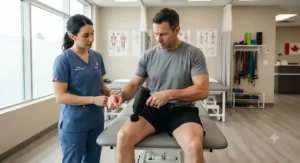
If the Theragun Prime is the reliable daily driver, the Hypervolt 2 Pro is the one built for someone running eight client sessions back to back. Hyperice designed this as its most powerful percussion device, and the numbers back that framing: a high-torque motor, five variable speeds, and a stall force that clinical retailers list at up to 60 lbs — nearly double the Prime’s ceiling.
What that extra force actually buys you, in practice, is the ability to work through denser tissue (think glutes, quads, upper traps on a heavily built client) without the head bogging down or the motor whining in protest. Reviewers and physiotherapy-focused retailers repeatedly point to the redesigned ergonomic handle and digital speed dial as meaningful upgrades over the original Hypervolt, since fumbling with tiny buttons mid-session is a real annoyance in a clinical setting. Based on the spec comparison with lower-tier Hypervolt models, the “Pro” designation here isn’t just branding — the torque difference is noticeable within the first few strokes.
The trade-off is obvious: this is the most expensive gun on our list, and its size and weight make it less appealing for casual home use or travel. If you’re a weekend athlete looking to ease post-run calf tightness, this is probably more device than you need.
Pros:
- ✅ Highest stall force on this list for dense muscle groups
- ✅ Redesigned handle reduces hand fatigue during long sessions
- ✅ Hyperice app integration for guided, repeatable routines
Cons:
- ❌ Heaviest and priciest option here
- ❌ Overkill for occasional, light home use
Canadian clinical suppliers list the Hypervolt 2 Pro in the C$450–C$530 range. If you’re a clinician or a serious home-gym owner who’ll genuinely put the extra force to use, it’s worth the premium; if not, you’re paying for headroom you may never need.
3. Ekrin B37S — best lifetime warranty and value at the premium tier
Ekrin is the brand physiotherapy-adjacent forums keep recommending, and the B37S is the reason why. It matches the Hypervolt 2 Pro’s roughly 56 lbs of stall force at a lower price point, and it backs the whole thing with a lifetime warranty — a rarity in a category where most brands offer one or two years and call it a day.
The B37S runs five speeds between roughly 2,000 and 3,200 RPM, with a reactive force sensor that adjusts output based on how much pressure you’re applying — a small but genuinely clever feature that helps prevent over-treating a sensitive area without you having to babysit the dial. Here’s what most spec sheets won’t tell you: the 12 mm amplitude is slightly shallower than some rivals, meaning it favours higher-intensity, shorter strokes over deep, slow penetration. For trigger-point work on smaller muscle groups (forearms, calves), that’s arguably an advantage. For broad lower-back coverage, you may find yourself reaching for the flat head and running it longer to compensate.
Reviewer sentiment consistently praises the roughly 8-hour battery life, which comfortably outlasts most competitors in this price bracket — genuinely useful if you’re the type who forgets to charge things until the moment you need them.
Pros:
- ✅ Lifetime warranty rare among competitors at this price
- ✅ Reactive force sensor auto-adjusts to applied pressure
- ✅ Roughly 8 hours of battery life per charge
Cons:
- ❌ 12 mm amplitude is shallower than some premium rivals
- ❌ Fewer third-party accessories available compared to Therabody
Expect the Ekrin B37S to run around C$400–C$480 in Canada. Given the warranty alone, the long-term value math tends to favour this pick if you plan to keep the device for years rather than replace it every couple of seasons.
4. Bob and Brad D6 Pro — best stall force for the money
Bob and Brad built a reputation as physical therapists on YouTube before they built a product line, and the D6 Pro reflects that background: it’s aggressively specced for the price. With a claimed 85 lbs of stall force and a 16 mm amplitude, it technically out-muscles every other gun on this list, including the Hypervolt 2 Pro, at roughly half the cost.
What most buyers overlook about a spec like “85 lbs stall force” is that raw power isn’t automatically better — it just means the head keeps moving under heavier pressure before it bogs down. For deep glute or hamstring work, that headroom is genuinely useful. For sensitive areas like the neck or IT band, it means you need more self-restraint on the lower speed settings, since the device is capable of delivering more intensity than most people should actually use in those spots. Reviewers note a real learning curve with the button layout and manual, which is a fair trade for a device offering flagship-adjacent power at a mid-range price.
Aggregated feedback consistently highlights the seven included attachment heads and the sturdy, slightly heavier build (around 1.27 kg) as strong points, with occasional notes that the extra weight becomes noticeable during longer sessions on overhead muscle groups like the upper traps.
Pros:
- ✅ Class-leading 85 lbs stall force for the price
- ✅ Seven attachment heads cover most muscle groups
- ✅ Roughly half the price of comparable-power premium guns
Cons:
- ❌ Learning curve with button controls and settings
- ❌ Noticeably heavier during extended overhead use
Canadian pricing for the D6 Pro typically sits around C$260–C$330. If your priority is raw power without a flagship price tag, this is the value pick to beat on this entire list.
5. RENPHO R3 with Heat — best deep tissue pick under C$250
This is the pick built specifically for the reader searching for a massage gun for deep tissue under 250 CAD, and it earns the spot honestly rather than by default. The R3 pairs a 16.8V brushless motor with a roughly 2,500 mAh battery rated for up to 80 minutes of continuous use, plus an added heat function on this variant that some competitors in this price tier skip entirely.
Here’s what the spec sheet won’t tell you: at this price, the R3 makes real compromises to get there, and the honest ones are worth naming. It skips Bluetooth connectivity entirely, and reviewers note that some of the five included attachment heads (ball, fork, flat, bullet, air-cushion) glide less smoothly across certain clothing fabrics than they do on bare skin. Neither is a dealbreaker, but they’re the kind of detail an Amazon listing photo won’t show you. On the upside, aggregated reviewer sentiment is unusually consistent for a budget device: people repeatedly praise the lightweight 680 g body, the quiet sub-45 dB operation, and the genuine five-speed range from 1,800 to 3,200 RPM.
For a beginner easing into percussive therapy, or someone who wants a second, lower-stakes gun to leave at the office, the R3 does the fundamentals well without asking you to spend clinic-grade money.
Pros:
- ✅ Genuinely quiet operation under roughly 45 dB
- ✅ Added heat function rare at this price point
- ✅ Lightweight 680 g body reduces hand fatigue
Cons:
- ❌ No Bluetooth or app connectivity
- ❌ Some attachment heads snag on certain fabrics
The RENPHO R3 typically lists in the C$120–C$180 range in Canada, comfortably clearing the “under C$250” bar with room to spare — making it the easiest entry point on this whole list.
6. Bob and Brad Q2 Mini — best pocket-sized option for travel
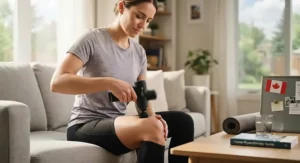
Not every situation calls for a full-sized gun, and the Q2 Mini exists for the ones that don’t. At roughly 431 g and small enough to disappear into a gym bag side pocket, it trades raw power (32 lbs stall force) for genuine portability — a trade a lot of buyers don’t realize they’re making until they’re standing in a hotel room wishing they’d packed something smaller than their full-sized Theragun.
The honest analytical take here: this isn’t a device for deep tissue work on a stiff lower back. It’s a device for a quick five-minute session on a tight calf before a run, or discreet neck relief at your desk between meetings. Reviewers consistently frame it this way too, describing it as “great for everyday aches” while noting that athletes chasing genuinely deep tissue relief will want to size up. Given its five included attachment heads and low weight, it punches above its size for what it’s actually designed to do.
Pros:
- ✅ Genuinely pocket-sized for travel or desk use
- ✅ Comes with five interchangeable attachment heads
- ✅ Simple, low learning-curve operation
Cons:
- ❌ 32 lbs stall force limits deep tissue capability
- ❌ Not built for extended, high-intensity sessions
The Q2 Mini typically runs C$60–C$100 CAD, making it one of the most affordable entries here — reasonable, given what it’s actually built to do.
7. TOLOCO Black Massage Gun — best long battery life on a tight budget
Rounding out the list is a genuinely budget-tier option that still manages to punch competently above its price. The TOLOCO Black pairs a 12 mm amplitude with speeds up to roughly 3,200 RPM, and ships with ten interchangeable heads — an unusually generous kit for this price bracket, letting you fine-tune treatment across everything from broad back coverage to pinpoint trigger-point work.
What stands out on the spec sheet, and holds up in aggregated reviewer sentiment, is battery life: TOLOCO advertises up to six hours of continuous use, which is genuinely long by category standards and means you’re unlikely to be caught with a dead battery mid-session. The trade-off shows up in build quality — reviewers note a bulkier body than comparably priced rivals, and the 40–50 dB operating noise, while not loud, is a notch above the quietest options on this list. For anyone who values “I never have to think about charging this” over “smallest possible footprint,” that trade-off is an easy one to accept.
Pros:
- ✅ Up to six hours of battery life per charge
- ✅ Ten attachment heads for varied treatment areas
- ✅ Strong value among sub-C$150 devices
Cons:
- ❌ Bulkier design than similarly priced competitors
- ❌ Slightly louder operation than premium alternatives
Pricing for the TOLOCO Black typically lands around C$100–C$150 in Canada, positioning it as a genuine alternative to the RENPHO R3 for buyers who prioritize battery life over the added heat function.
Top 7 Products: Specs, Price Range, and Ratings at a Glance
| Massage Gun | Amplitude | Stall Force | Speeds | Price Range (CAD) |
|---|---|---|---|---|
| Therabody Theragun Prime (6th Gen) | 16 mm | 30 lbs | 5 | C$300–C$380 |
| Hyperice Hypervolt 2 Pro | 14 mm | 60 lbs | 5 | C$450–C$530 |
| Ekrin B37S | 12 mm | 56 lbs | 5 | C$400–C$480 |
| Bob and Brad D6 Pro | 16 mm | 85 lbs | 5 | C$260–C$330 |
| RENPHO R3 with Heat | 10 mm | ~35 lbs | 5 | C$120–C$180 |
| Bob and Brad Q2 Mini | ~10 mm | 32 lbs | 5 | C$60–C$100 |
| TOLOCO Black Massage Gun | 12 mm | Moderate | Multiple | C$100–C$150 |
Lined up side by side, the pattern gets easier to see: amplitude and stall force don’t scale evenly with price, and the Bob and Brad D6 Pro is the clearest example of a mid-range device outperforming pricier rivals on paper. That said, paper specs aren’t the whole story — the Hyperice Hypervolt 2 Pro and Ekrin B37S justify their higher price tags through build quality, warranty terms, and ergonomic details that don’t show up in a spec table but absolutely show up after six months of daily use.
Practical Usage Guide: Getting the Most From Your Massage Gun
Buying the right device is half the equation; using it correctly is the other half, and it’s the half most Amazon listings skip entirely.
Start slow. On day one, use the lowest speed setting for no more than 15 to 30 seconds per muscle group, and pay attention to how your body responds the next day rather than chasing an immediate intense sensation. A common first-30-days mistake is cranking the intensity up too fast because the device “doesn’t feel like much” at low speeds — that feeling is deceptive, since percussive effects compound with repeated exposure to a muscle over the following hours.
For maintenance, keep the attachment heads clean with a damp cloth after each use (sweat and skin oils degrade foam heads over time), and store the unit charged to roughly 50 percent if you won’t use it for more than a month, which protects battery longevity on most lithium-ion cells. A genuinely useful optimization trick that clinics use: pair the massage gun with a brief static stretch immediately afterward, since percussive work loosens tissue temporarily and a stretch afterward tends to help that flexibility gain stick around longer.
Avoid bony areas (spine, kneecaps, ankles) entirely, and never run the device directly over a joint — 🔋 keep it on muscle bellies only. If you’re managing a diagnosed injury rather than general tightness, check with a physiotherapist before adding percussive therapy to your routine, since the appropriate settings can vary significantly by condition.
Real-World Scenarios: Matching the Right Massage Gun to Your Needs
Specs only mean so much until you see them mapped onto an actual person’s actual week, so here are three profiles that might sound familiar.
The weekend runner. Someone logging 25–40 km a week, dealing with tight calves and IT band tension but no diagnosed injury, budget around C$150. This person doesn’t need 85 lbs of stall force — they need something quiet, portable, and simple to use after a Sunday long run. The RENPHO R3 or Bob and Brad Q2 Mini covers this comfortably, and the added heat function on the R3 is a genuine bonus for cold-weather runs.
The home-based remote worker with desk-related neck and shoulder tension. Frequency of use is daily, but sessions are short — five to ten minutes between meetings. Portability and quiet operation matter more than raw power here, since this device is competing with a work-from-home environment where noise is noticeable. The Bob and Brad Q2 Mini or Theragun Prime on its lowest setting both suit this well.
The competitive athlete or physiotherapy clinic assistant doing multiple treatment sessions a day, working with clients who carry real muscular density in the glutes, quads, and traps. Here, the calculation flips: budget stretches to C$400–C$500, and the priority is stall force, battery endurance across a full day, and a warranty that reflects heavy daily use. The Hyperice Hypervolt 2 Pro or Ekrin B37S are the sensible picks in this scenario.
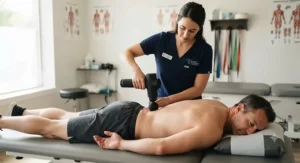
What Is a Massage Gun for Physiotherapy Use?
A massage gun for physiotherapy use is a handheld, battery-powered device that delivers rapid, repetitive percussive strokes into muscle tissue to reduce soreness, improve local blood flow, and support recovery alongside — not instead of — professional physiotherapy care. It’s the same underlying technology found in consumer recovery guns, just applied with more intentional technique and, ideally, guidance from a trained clinician.
The mechanism itself is straightforward: a motor drives an interchangeable head back and forth at anywhere from roughly 1,400 to 3,200 percussions per minute, depending on the model and speed setting. That rapid movement is thought to stimulate mechanoreceptors in the muscle, temporarily reducing the perception of pain while increasing blood flow to the treated area — mechanisms that overlap significantly with why delayed onset muscle soreness tends to respond well to movement-based interventions in the 24 to 72 hours after strenuous activity.
How to Choose a Massage Gun for Physiotherapy Use
Picking the right device comes down to matching a handful of specs to your actual use case, not to whichever model has the flashiest marketing.
- Start with stall force, not top speed. Stall force (measured in lbs) tells you how much resistance the head can push through before it bogs down — this matters more for deep tissue work than raw RPM.
- Match amplitude to your body type. A 16 mm amplitude reaches deeper into larger muscle groups; smaller frames or sensitive areas often do better with 10–12 mm.
- Weigh portability against power deliberately. If the device lives in a gym bag, a sub-1 kg mini gun beats a flagship you’ll leave at home out of sheer inconvenience.
- Check battery life against your actual session length, not the marketing headline — a clinic running back-to-back appointments needs different endurance than a once-a-day home user.
- Consider noise level if you’ll use it around others, whether that’s a shared clinic space, an office, or a sleeping household.
- Factor in warranty length as a value signal, since a lifetime warranty (like Ekrin’s) often reflects genuine confidence in long-term durability.
- Set a realistic budget band first, then shop within it — the biggest buying mistake in this category is overspending on power you’ll never actually use.
Massage Gun for Deep Tissue Under C$250: What You Actually Get
Shopping specifically for a massage gun for deep tissue under 250 CAD means accepting a few honest trade-offs rather than assuming you’re getting a lesser product across the board. At this price tier, you’re generally looking at stall forces in the 30–40 lb range rather than the 60–85 lbs found in premium models, and Bluetooth app connectivity is usually the first feature to disappear.
What you shouldn’t have to give up, based on the spec comparison across this list, is genuine multi-speed control, a decent battery (60+ minutes of runtime), and a handful of interchangeable heads. The RENPHO R3 and TOLOCO Black both clear that bar comfortably, and reviewers of both consistently report satisfaction with day-to-day muscle relief despite the lower stall force ceiling. Where budget devices most often disappoint isn’t power — it’s build longevity after 12-plus months of regular use, so if you’re buying under this price point, treat the included one-year warranty as a meaningful part of the value equation, not fine print.
Mid-Range Massage Gun vs Premium Massage Gun
The line between a mid-range massage gun and a premium massage gun isn’t always where people expect it to be. Based on the models compared in this guide, the real differentiators aren’t stall force or amplitude — the Bob and Brad D6 Pro (mid-range) actually beats both premium options on raw stall force. The differentiators are build materials, warranty terms, app ecosystem, and the kind of ergonomic refinement that only shows up after months of daily use.
| Factor | Mid-Range (e.g., Bob and Brad D6 Pro) | Premium (e.g., Hyperice Hypervolt 2 Pro) |
|---|---|---|
| Typical price (CAD) | C$260–C$330 | C$450–C$530 |
| Warranty | 1 year (varies) | 1–2 years, some lifetime options |
| App/guided routines | Rarely included | Usually included |
| Build materials | Durable plastic composite | Reinforced composite, metal accents |
| Best For | Power-per-dollar buyers | Daily clinical or high-volume use |
Reading across that table, the honest takeaway is that a mid-range unit like the D6 Pro delivers real deep-tissue performance without the premium price, but a premium pick like the Hypervolt 2 Pro earns its cost back through longevity and consistency under heavy, repeated daily use — the kind of use case where cheaper components tend to fail first. If you’re using the device a few times a week for personal recovery, mid-range covers you completely; if you’re running it for hours daily in a clinical or training environment, the premium tier’s durability becomes a real cost-of-ownership factor rather than a luxury.
Deep Tissue Therapy Tools: Massage Guns vs Traditional Alternatives
A massage gun is one of several deep tissue therapy tools available to Canadians managing muscle tightness, and it’s worth being honest about where it wins and where older tools still hold their own.
| Tool | Depth of Treatment | Convenience | Cost Over Time | Best For |
|---|---|---|---|---|
| Massage gun | Deep, targeted | High (self-administered) | One-time cost | Specific trigger points, post-workout recovery |
| Foam roller | Moderate, broad | High | Very low | Large muscle groups, fascia release |
| Manual massage therapy | Deep, comprehensive | Low (requires appointment) | Ongoing, per session | Complex or chronic issues needing hands-on assessment |
| Vibrating roller | Shallow to moderate | High | Low | Warm-up, light circulation support |
The analysis here is straightforward: a massage gun for physiotherapy use wins on precision and convenience — you can target a specific knot in your upper trap in a way a foam roller simply can’t replicate. What it can’t replace is the assessment and hands-on judgment a manual physiotherapist or registered massage therapist brings to a genuinely complex issue, and the existing research on percussive therapy is fairly consistent on this point: it’s a solid tool for short-term muscle performance and pain perception, but the evidence base is still younger than that for manual therapy techniques.
Clinical Recovery Equipment: What Physiotherapists Actually Look For
When a massage gun crosses over from “gym bag gadget” to genuine clinical recovery equipment, the priorities shift noticeably from what a casual consumer cares about. Clinicians running multiple sessions a day tend to weigh three things heavily: consistent output across a full shift (which is really a battery and motor durability question), quiet operation that doesn’t disrupt a shared treatment space, and a range of attachment heads precise enough for targeted trigger-point work rather than broad, general strokes.
Based on the spec comparison across our list, the Hyperice Hypervolt 2 Pro and Ekrin B37S both lean into this use case specifically — high stall force paired with battery life rated in hours rather than minutes, and attachment kits built around precision rather than variety for its own sake. What most home shoppers overlook is that a device marketed toward athletes and a device genuinely suited to clinical recovery equipment standards often overlap, but the deciding factor tends to be daily duty cycle: a device that’s excellent for 20 minutes a day may show its limits at three hours a day.
Physiotherapy Accessories That Pair Well With Your Massage Gun
A massage gun rarely operates in isolation, and pairing it with the right physiotherapy accessories tends to improve results more than upgrading the gun itself. A quality foam roller handles the broad-strokes fascia work a percussion device isn’t built for, while resistance bands support the active rehabilitation exercises a physiotherapist might prescribe alongside passive recovery tools.
A few pairings worth calling out specifically: a lacrosse ball or firm massage ball for pinpoint glute and shoulder trigger points the gun’s attachments can’t quite reach at certain angles; a compression sleeve or wrap for lower-leg recovery after a percussion session, since the temporary increase in local blood flow pairs well with graduated compression; and a simple stretching strap, which extends the flexibility gains from a massage gun session in a way that passive percussion alone can’t. None of these need to be expensive — the point isn’t to build a home clinic, it’s to round out what the massage gun does well with tools that cover its actual gaps.

Common Mistakes When Buying a Massage Gun for Physiotherapy Use
The most common mistake, by a wide margin, is buying based on stall force alone without considering how you’ll actually use the device day to day. An 85 lb stall force sounds impressive on a spec sheet, but if you’re a smaller-framed user managing tension headaches from desk work, that much force is more likely to cause discomfort than relief.
The second common mistake is ignoring noise level entirely, then discovering the device is too loud to use around a sleeping partner or in a shared apartment — a detail almost no Amazon listing highlights prominently. Third, buyers frequently underestimate attachment head importance, treating it as an afterthought rather than recognizing that the wrong head shape on a sensitive area (bony wrist, thin calf) can genuinely cause bruising if used carelessly. Finally, many shoppers skip checking warranty terms altogether, which becomes a costly oversight the moment a battery starts degrading around the one-year mark — a point at which some cheaper devices are already showing real performance decline.
Safety, Regulations, and Compliance for Massage Guns in Canada
Massage guns sold in Canada fall under general consumer electrical appliance safety rules, and household massage appliances specifically are covered by CSA safety standards that address electrical safety for devices in this category. That’s worth checking for before you buy from a lesser-known brand — a CSA or equivalent certification mark on the packaging is a reasonable baseline signal that the electrical components have been independently tested.
Safety-wise, the more relevant considerations are usage-based rather than regulatory. Avoid bony prominences, joints, and areas with known circulation issues, varicose veins, or recent injuries. If you’re pregnant, managing a blood clotting condition, or recovering from recent surgery, check with a physician or physiotherapist before adding percussive therapy to your routine — this isn’t boilerplate caution, since improper use of these devices has been documented in case studies as a rare but real source of injury when used aggressively over sensitive tissue or joints. Used sensibly, on muscle bellies, at appropriate speeds, the risk profile is low; used carelessly at maximum intensity on the wrong area, it isn’t zero.
Long-Term Cost and Maintenance
The sticker price is only part of what a massage gun for physiotherapy use actually costs you over its lifespan. Battery replacement (or the need to replace the entire unit once a battery degrades, since most models don’t offer user-replaceable cells) is the biggest hidden cost, typically becoming relevant somewhere between 18 and 36 months of regular use depending on charge habits.
Running a rough cost-per-use comparison: a C$130 RENPHO R3 used three times a week for two years works out to roughly C$0.42 per session, assuming no major issues — genuinely competitive against even a single massage therapy appointment. A C$470 Ekrin B37S, backed by its lifetime warranty, changes that math further since a warranty claim on a failing motor or battery doesn’t reset your investment to zero the way it would with a standard one-year warranty. The practical takeaway: total cost of ownership favours either the cheapest reasonable option (low upfront risk) or the longest-warrantied option (low long-term risk) — it’s the mid-tier devices with short warranties that tend to offer the weakest long-term value.
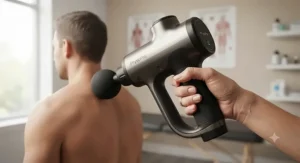
Frequently Asked Questions
❓ Is a massage gun the same as physiotherapy?
❓ How often can you use a massage gun for physiotherapy use safely?
❓ What is the best massage gun for deep tissue under 250 CAD?
❓ Can a massage gun help with sciatica or nerve pain?
❓ What's the difference between a mid-range massage gun and a premium massage gun?
Conclusion
If there’s one thing this whole comparison makes clear, it’s that “best” depends entirely on what you’re actually going to do with the thing. A physiotherapy clinic running eight appointments a day needs the durability and stall force of something like the Hyperice Hypervolt 2 Pro or Ekrin B37S; a weekend runner icing sore calves needs none of that firepower and would be genuinely happier with a RENPHO R3 or Bob and Brad Q2 Mini that’s quieter, lighter, and a fraction of the cost.
What matters more than the brand name on the handle is matching the device’s stall force, amplitude, and battery life to your real usage pattern — and being honest with yourself about whether you need clinic-grade power or just consistent, quiet relief a few times a week. Every option on this list does its core job competently; the differences show up in the details that only matter once you’ve owned the thing for six months. Wherever your budget lands, check current pricing before you buy, since promotions on percussion massagers shift constantly across Canadian retailers.
✨ Ready to add percussive therapy to your recovery routine? Compare the picks above, match one to your actual weekly use, and give your muscles the head start they’ve been asking for! 💪🔋
Recommended for You
- Best Massage Gun for Athletes Under $300 CAD: 7 Top Picks for 2026
- Value Massage Gun for Beginners: 7 Surprisingly Great Picks (2026)
- Massage Gun Under $50 CAD: 7 Picks That Won’t Wreck Your Wallet (2026)
Disclaimer: This article contains affiliate links. As an Amazon Associate, I earn from qualifying purchases. If you purchase products through these links, we may earn a small commission at no additional cost to you.
✨ Found this helpful? Share it with your friends! 💬🤗
