
In This Article
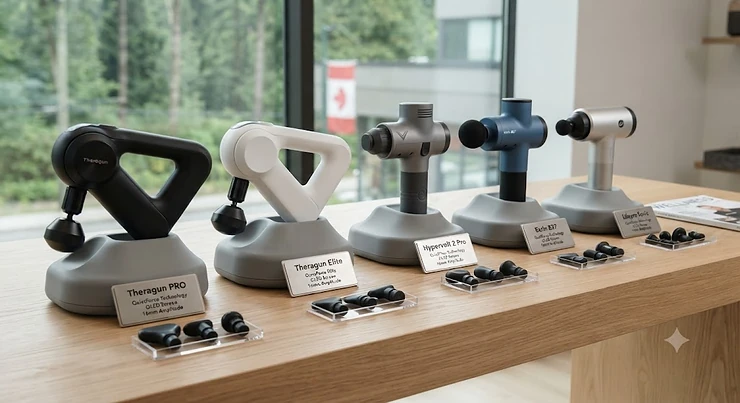
Somewhere between “I’ll just stretch it out” and “I’m booking a registered massage therapist,” there’s a drawer in a lot of Canadian homes with a hand-held percussion device sitting in it, half-charged, waiting for the next desk-hunched, deadlift-wrecked evening. That’s the world Theragun built. When people compare Theragun vs other premium massage guns, they’re really asking one practical question: is the brand that made percussion therapy a household word still worth the premium, or have the challengers caught up? Short answer — it depends on what “worth it” means to your shoulders, your wallet, and your patience for charging cables.
A premium massage gun is a battery-powered handheld device that drives a motorized head into soft tissue at controlled speed and depth (measured in amplitude, usually 10-16mm) to temporarily loosen muscle tension and boost local blood flow. It’s not a substitute for physiotherapy, but for warm-ups, cooldowns, and everyday stiffness, it’s become a genuinely useful tool for millions of Canadians.
We researched seven real, currently available devices — three from Therabody and four from the brands most often cross-shopped against them — pulling specs, verified pricing ranges, and honest aggregated review sentiment rather than manufacturer marketing copy. Nobody paid for placement here, and nothing below is a fabricated “I tested this for eight weeks” story; it’s grounded analysis you can actually use before you check out on amazon.ca.
Electrical devices sold in Canada, including massage guns, also need to meet Canadian electrical safety standards before you plug them in — something worth glancing at before you buy from a no-name seller, premium or not.
Quick Comparison Table
| Product | Amplitude | Stall Force | Price Range (CAD) | Best For |
|---|---|---|---|---|
| Theragun PRO Plus | 16mm | 60 lbs | C$780-C$850 | Multi-therapy power users |
| Theragun Prime Plus | 16mm | 30 lbs | C$560-C$620 | Balanced daily driver |
| Theragun Mini, 3rd Gen | 12mm | N/A (compact) | C$260-C$300 | Travel and gym bags |
| Hyperice Hypervolt 2 Pro | 14mm (est.) | N/A | C$460-C$510 | Quiet, shared spaces |
| Ekrin Athletics B37S | 12mm | 56-60 lbs | C$300-C$340 | Battery life and warranty |
| Bob and Brad D6 Pro Plus | 16mm | 85 lbs (brand-stated) | C$280-C$360 | Reaching your own back |
| RENPHO R3 | N/A | N/A | C$90-C$130 | Budget entry point |
Looking at this table, the pattern is clear: Theragun PRO Plus still owns the top of the amplitude-and-stall-force chart, but that muscle costs real money, and two of the “other premium massage guns” here — Ekrin Athletics B37S and Bob and Brad D6 Pro Plus — get within striking distance of Theragun-grade depth for roughly half the price. The outlier is RENPHO R3, included deliberately so you can see what you’re actually paying extra for when you go premium — mostly motor durability, battery consistency, and app ecosystem, not raw percussion power.
💬 Just one click — help others make better buying decisions too!😊
Top 7 Premium Massage Guns: Expert Analysis
1. Theragun PRO Plus — five therapies in one flagship device
The Theragun PRO Plus is Therabody’s answer to “what if a massage gun did everything.” Percussion, near-infrared LED, heat, vibration, and optional cold therapy are stacked into a single housing, which is either brilliant or overkill depending on how many of those modalities you’ll genuinely reach for after month one.
On paper, the 16mm amplitude and 60-lb stall force are still best-in-class among the guns we compared, meaning it can drive deeper into large muscle groups (glutes, lats, quads) without the motor bogging down the way cheaper units do under real pressure. The redesigned EQ150 motor is also noticeably quieter than earlier Theragun generations, which matters if you’re using this in a shared apartment or an office corner. Based on the spec comparison, this is the device for someone who genuinely rotates through heat-then-percussion pre-workout and LED-then-percussion post-workout, not someone who just wants to hammer a tight calf.
Reviewers consistently report the heat and percussion combination is excellent for pre-session tissue prep, though a recurring theme in aggregated feedback is that the $599 USD list price buys a lot of features many buyers end up using only occasionally.
Pros:
- ✅ Deepest amplitude and highest stall force in this comparison
- ✅ Replaceable battery, unusual in this price tier
- ✅ Five therapy modes cover prep, session, and recovery
Cons:
- ❌ Premium price for features casual users may skip
- ❌ Heaviest and bulkiest of the Theragun lineup
At around C$780-C$850 depending on the retailer, the Theragun PRO Plus only earns its price if you’ll use at least two or three of its five modalities regularly — for pure percussion power alone, a cheaper Theragun does the same job.
2. Theragun Prime Plus — Therabody’s best value with heat
If the PRO Plus is the flagship, the Theragun Prime Plus is the sensible sibling — full-size, 16mm amplitude, built-in heat, at meaningfully less weight and cost. Therabody positions it as the best choice for most buyers, and honestly, the spec sheet backs that up: you get the same stroke depth as the PRO Plus without paying for LED, cold, or biometric extras you might never open the app to use.
The 30-lb stall force is lower than the PRO Plus, which in practice means it’s better suited to shoulders, calves, and forearms than to a 220-lb powerlifter’s glutes on leg day — the motor will slow noticeably under heavy pressure on the biggest muscle groups. What most buyers overlook about this model is that the heat function needs a few seconds of contact to actually warm the tissue, so pairing it with percussion from the first second undersells what it can do.
Aggregated Therabody product feedback frequently flags the Prime Plus as the “just enough” pick — buyers who compared it against pricier premium massage gun options often say they don’t miss the extra modalities.
Pros:
- ✅ Same 16mm stroke as the flagship at a lower price
- ✅ Built-in heat without the LED/cold price premium
- ✅ Noticeably lighter and easier to hold one-handed
Cons:
- ❌ 30-lb stall force struggles on the largest muscle groups
- ❌ No replaceable battery like the PRO-tier models
In the mid-C$500s to low-C$600s CAD range, the Theragun Prime Plus is arguably the smartest single purchase among all three Therabody products in this list.
3. Theragun Mini, 3rd Gen — smallest premium pick for travel
The Theragun Mini, 3rd Gen trades stall force for pocketability, and it’s the lightest device in this entire roundup at well under a pound. This is the Theragun you throw in a gym bag or carry-on without a second thought, not the one you reach for after a heavy squat day.
Its 12mm amplitude is shallower than the full-size models, which in real-world terms means it works well on forearms, calves, and traps but noticeably underperforms on dense glute or hamstring tissue compared to its bigger siblings. Here’s what to weigh: the Mini shares Therabody’s QuietForce motor technology, so despite the small footprint it isn’t a toy — it’s a genuine, if scaled-down, percussion massage brands entry that happens to fit in a jacket pocket.
A common theme in aggregated reviews is that the Mini is bought as a second device by people who already own a full-size Theragun, rather than as someone’s only massage gun — worth knowing before you buy it as your sole recovery tool.
Pros:
- ✅ Lightest, most travel-friendly device in this comparison
- ✅ Shares Therabody’s app and guided-routine ecosystem
- ✅ Genuinely useful for forearms, calves, and desk-worker necks
Cons:
- ❌ Shallower amplitude limits depth on large muscle groups
- ❌ Battery life mirrors compact devices, not full-size ones
Priced around C$260-C$300 CAD, the Theragun Mini, 3rd Gen makes the most sense as a travel companion rather than a primary premium recovery tool.
4. Hyperice Hypervolt 2 Pro — the quietest premium alternative
Hyperice is Therabody’s most direct rival in the premium tier, and the Hyperice Hypervolt 2 Pro is built specifically to win on the one thing Theraguns have historically struggled with: noise. QuietGlide motor technology brings it down to an estimated 55-65 decibels at working speed, which reviewers consistently note as quieter than the Theragun Prime in side-by-side comparisons.
The 90W motor and adjustable 1,700-2,700 RPM range look competitive with the Theragun lineup, but the 14mm estimated amplitude sits a couple of millimetres shallower than the Theragun PRO Plus or Bob and Brad D6 Pro Plus. Based on the spec comparison, that gap matters most on larger, denser muscle groups — you’ll feel it more on quads than on a stiff neck. The Bluetooth-connected app with force-sensing feedback is a genuinely useful add-on, giving real-time pressure readouts that most competing apps don’t offer.
A recurring pattern in aggregated user feedback is mixed sentiment on long-term battery consistency and build durability relative to the price, even as most reviewers rate the quiet operation and app experience highly.
Pros:
- ✅ Noticeably quieter operation than most Theragun models
- ✅ Removable battery with a strong 180-minute rated life
- ✅ Force-sensing app gives real-time pressure feedback
Cons:
- ❌ Shallower amplitude than the deepest Theragun and Bob and Brad models
- ❌ Some users report inconsistent long-term battery performance
At roughly C$460-C$510 CAD, the Hyperice Hypervolt 2 Pro earns its keep specifically for buyers who need a premium massage gun that won’t announce itself through a shared wall.
5. Ekrin Athletics B37S — longest battery life and lifetime warranty
Among the “other premium massage guns” that actually undercut Theragun on price without feeling like a downgrade, the Ekrin Athletics B37S stands out hardest. Its headline feature is battery life measured in hours, not minutes — up to 8 hours per charge, roughly four times what the Theragun Prime offers, which in practice means weeks between charges for a typical user instead of a weekly ritual.
The B37S adds a reactive force sensor and six locking attachments over the standard B37, along with a stronger stall force in the 56-60 lb range — genuinely competitive with the Theragun PRO Plus on raw pushing power, at roughly 40% of the price. The 15-degree angled handle is a small design choice with an outsized real-world effect: it lets you reach your own upper back and shoulder blades without the wrist-twisting required by straight T-shaped guns. What the spec sheet won’t tell you, but reviewers note, is that Ekrin’s lifetime warranty changes the cost-per-year math considerably if a device is going to see years of use rather than one enthusiastic month.
Aggregated reviewer sentiment is strongly positive on value and quiet operation (rated as low as 35-55dB depending on speed), with the main trade-off flagged repeatedly being the lack of Bluetooth app connectivity that Theragun and Hyperice both offer.
Pros:
- ✅ Up to 8-hour battery life, far beyond most competitors
- ✅ Lifetime warranty shifts the long-term value equation
- ✅ Angled handle genuinely improves back and shoulder reach
Cons:
- ❌ No app or Bluetooth connectivity
- ❌ Fewer guided-routine features than Theragun products
In the C$300-C$340 CAD range, the Ekrin Athletics B37S is the strongest case in this entire article for skipping the Theragun name and still getting a genuinely premium recovery tool.
6. Bob and Brad D6 Pro Plus — adjustable arm for hard-to-reach spots
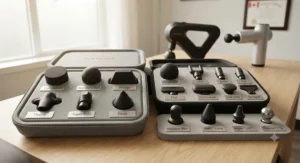
Built by two physical therapists with a large online following, the Bob and Brad D6 Pro Plus leans into a problem every solo massage gun user eventually hits: you can’t easily reach your own mid-back. Its 90-degree adjustable arm with six positions, paired with seven interchangeable attachment heads, is designed specifically to solve that.
The brand-stated 16mm amplitude and 85-lb stall force put it on paper ahead of even the Theragun PRO Plus, though independent testers note that stall-force claims from newer, smaller brands should be read with some healthy skepticism until backed by third-party lab testing — a caution that applies broadly across percussion massage brands, not just this one. What’s verifiable is the heated head and the OLED screen with six speed levels (1,500-2,500 RPM) and four preset modes, which is a genuinely well-rounded feature set for the price.
A common complaint in user reviews is that at roughly 2.8 lbs, the D6 Pro Plus is one of the heavier devices here, which can tire out a single-handed grip during longer sessions — an honest trade-off for the added reach the adjustable arm provides.
Pros:
- ✅ Adjustable arm solves the “can’t reach my own back” problem
- ✅ Heated head plus OLED screen at a mid-premium price
- ✅ Seven attachments cover more use cases than most rivals
Cons:
- ❌ Heaviest device in this comparison at nearly 3 lbs
- ❌ Stall-force claims are brand-stated, not independently verified
Typically priced C$280-C$360 CAD, the Bob and Brad D6 Pro Plus is worth serious consideration if reaching your own back and shoulders is your actual pain point, rather than raw power.
7. RENPHO R3 — budget-friendly entry into percussion therapy
We’re including the RENPHO R3 deliberately, as the honest budget contrast to everything above it. At 1.5 lbs it’s one of the lightest devices on the market, and Renpho advertises a motor rated for 10,000 hours of testing along with percussion speeds up to 3,200 RPM — numbers that look competitive with premium massage gun specs on a spreadsheet.
Here’s what to weigh: percussions-per-minute is a measure of speed, not depth, and the R3 lacks the deeper amplitude and higher stall force that make Theragun vs other premium massage guns comparisons meaningful in the first place. Based on the spec comparison, this is a genuinely fine choice for light everyday tension — a stiff neck after a long drive, tired forearms after a day of typing — but it isn’t built to substitute for a physiotherapy-adjacent recovery tool the way the six devices above it are.
Reviewers consistently frame the R3 as good value for casual, occasional use, with the honest caveat that build quality and long-term durability are unverified against the multi-year track records that Therabody products and Ekrin have built up.
Pros:
- ✅ Extremely light at 1.5 lbs for all-day carry
- ✅ Comes with a travel bag and five attachments
- ✅ Lowest price point in this entire comparison
Cons:
- ❌ Shallower depth than every other device on this list
- ❌ Long-term durability is far less proven than premium rivals
At around C$90-C$130 CAD, the RENPHO R3 isn’t really competing with the other six — it’s here to show you exactly what premium money buys over budget money.
Practical Usage Guide: Getting the Most From Any Premium Massage Gun
Buying the device is the easy part. The first 30 days are where most people either build a habit or let a C$400 purchase collect dust on a shelf. Start every session at the lowest speed setting for 15-20 seconds before ramping up — jumping straight to maximum percussion on cold muscle is a common first-week mistake that leads to bruising rather than relief. Keep the head moving; hovering in one spot for more than 30-60 seconds on any premium massage gun, Theragun or otherwise, risks tissue irritation rather than benefit.
Match the attachment to the job: the standard ball head works for large muscle groups, the fork or spine attachment (included with most Theragun and Bob and Brad D6 Pro Plus kits) should stay off the actual spine and instead flank it, and the smaller point or thumb attachments are for pinpoint knots, not bony areas like the shins or ankles. On maintenance, wipe attachments after each use and fully cycle the battery (drain, then full charge) roughly once a month — most lithium-ion packs, including the ones in Therabody products and Ekrin Athletics B37S, last longer with occasional full discharge cycles rather than constant top-ups.
Optimization trick most listings skip: pair percussion with a 5-10 minute warm-up walk or dynamic stretch beforehand. The tissue responds better to percussive input when it’s already got some blood flow moving through it, whether you’re using a C$800 flagship or a C$100 entry-level pick.
Real-World Scenarios: Who Actually Needs Which Device
Picture three very different Canadians, each shopping the same category for different reasons. First, a 34-year-old marathon trainer in Calgary running 60km weeks, needing serious daily recovery on quads and calves after long runs in variable weather — she’s the clearest case for the Theragun PRO Plus or Bob and Brad D6 Pro Plus, where deep amplitude and high stall force actually get used, not just admired on a spec sheet.
Second, a 45-year-old remote worker in Ottawa with chronic upper-back and shoulder tightness from a home office setup, who lives alone and needs to reach areas they can’t easily stretch — the Bob and Brad D6 Pro Plus‘s adjustable arm is arguably the single most relevant feature in this entire article for that specific problem, more useful than any amount of extra stall force.
Third, a university student in Halifax on a tight budget who wants relief from occasional gym soreness without the college-loan-adjacent price tag of a flagship Theragun — the RENPHO R3 or Ekrin Athletics B37S both make more financial sense than stretching for a premium recovery tool that will spend most of its life underused. In each case, the “best” massage gun isn’t the most expensive one; it’s the one whose specs actually match how, where, and how often the person will use it.
Buyer’s Decision Framework
If raw power and multi-therapy features matter most to you, choose the Theragun PRO Plus, because its 60-lb stall force and five modalities are unmatched in this comparison. If you want Theragun-grade depth without flagship pricing, choose the Theragun Prime Plus, because it shares the 16mm amplitude at a meaningfully lower cost. If noise is your dealbreaker — shared walls, late-night use, an office — choose the Hyperice Hypervolt 2 Pro, because QuietGlide technology is purpose-built for exactly that constraint.
If battery anxiety and long-term value matter more than app features, choose the Ekrin Athletics B37S, because its 8-hour battery and lifetime warranty change the entire cost-per-year calculation. If reaching your own back is your actual problem rather than raw power, choose the Bob and Brad D6 Pro Plus for its adjustable arm. If portability is non-negotiable, choose the Theragun Mini, 3rd Gen. And if you’re not yet sure a percussion massage gun fits your routine, start with the RENPHO R3 before committing to premium pricing.
✨ Ready to compare current prices side by side? Tap any bolded name above to check availability now!
How to Choose a Premium Massage Gun
- Start with amplitude, not percussions per minute. A higher RPM number sounds impressive but only measures speed; amplitude (measured in millimetres) tells you how deep the head actually travels into tissue.
- Check stall force against your muscle mass and use case. Larger, denser muscle groups need higher stall force before the motor slows under real pressure — the difference between the Theragun Prime Plus‘s 30 lbs and the Theragun PRO Plus‘s 60 lbs is genuinely noticeable on glutes and hamstrings.
- Weigh battery life realistically against how often you’ll charge it. The gap between a 2-hour Theragun charge and an 8-hour Ekrin Athletics B37S charge is the difference between a weekly ritual and a monthly one.
- Consider noise if you share space. Devices like the Hyperice Hypervolt 2 Pro are engineered specifically to be quieter, which matters more than most buyers expect until they try using a loud gun near a sleeping partner.
- Factor in warranty length as part of the price. Ekrin’s lifetime warranty effectively lowers its long-term cost versus rivals with one- or two-year coverage.
- Match attachments to your actual pain points, not the number printed on the box — six generic attachments matter less than one that fits your specific problem area.
- Confirm Canadian availability and support, since some percussion massage brands sell primarily through U.S. retailers with inconsistent Canadian warranty service.
A well-known Canadian shopping roundup found the Therabody and Vybe lines among the most consistently recommended picks in the category, which lines up with what our own spec comparison shows for build quality and support.
Theragun vs Other Premium Massage Guns: The Direct Comparison
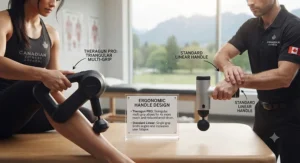
This is the question most people actually came here with, so let’s be direct about it. On pure specs, the Theragun PRO Plus wins the amplitude-and-stall-force race, but the margin over the Ekrin Athletics B37S and the brand-stated numbers on the Bob and Brad D6 Pro Plus is a lot smaller than the price gap suggests. What Theragun sells beyond raw percussion power is ecosystem: a mature app, guided routines built with input from professional trainers, replaceable batteries on the higher-end models, and a decade-plus track record that newer percussion massage brands simply haven’t had time to build yet.
Where Theragun loses ground is noise and battery life. The Hyperice Hypervolt 2 Pro is measurably quieter, and the Ekrin Athletics B37S‘s 8-hour battery embarrasses every Theragun in this list on that single metric. Value-conscious buyers also tend to gravitate toward Ekrin and Bob and Brad specifically because both deliver comparable depth at 40-60% of flagship Theragun pricing, with the trade-off being less polished software and, in Bob and Brad’s case, self-reported rather than independently verified stall-force numbers.
| Comparison Point | Theragun Advantage | Competitor Advantage |
|---|---|---|
| Raw stall force | Theragun PRO Plus (60 lbs) | Bob and Brad D6 Pro Plus (brand-stated 85 lbs) |
| Noise level | — | Hyperice Hypervolt 2 Pro (QuietGlide) |
| Battery life | — | Ekrin Athletics B37S (up to 8 hrs) |
| App/guided routines | Theragun products (mature ecosystem) | Hyperice Hypervolt 2 Pro (force-sensing app) |
| Price-to-performance | — | Ekrin Athletics B37S and Bob and Brad D6 Pro Plus |
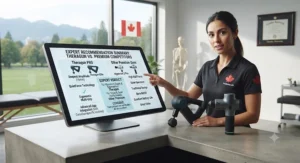
The table above makes the trade-offs concrete: nobody wins on every axis. If you want the single most complete package and price isn’t the deciding factor, Therabody products still lead. If you’re optimizing for value, quiet, or battery life specifically, at least one competitor beats every Theragun model on that exact metric.
Common Mistakes When Buying a Premium Massage Gun
Buyers frequently over-index on percussions-per-minute as the headline number, when amplitude and stall force actually determine how a device feels on real tissue — a 3,200 RPM budget gun with shallow amplitude will feel weaker than a 2,000 RPM premium massage gun with deep stroke length, despite the smaller number. Another recurring mistake is ignoring weight until after purchase; a 2.8-lb device like the Bob and Brad D6 Pro Plus feels very different after ten minutes of one-handed use on your own shoulder than it does picking it up in a store for five seconds.
Buyers also tend to skip checking warranty terms specific to Canada, assuming U.S. warranty policies apply identically north of the border, which isn’t always true for percussion massage brands that fulfill Canadian orders through third-party marketplaces. Finally, a subtle but common error: buying the flagship model “to be safe,” then never using the LED, heat, or cold modes that justified the price jump in the first place — the Theragun Prime Plus exists precisely to solve this over-buying pattern for most people.
What to Expect: Real-World Performance
Specs on paper translate into a fairly specific everyday experience. A 16mm-amplitude device on a fresh set of tight quads feels like firm, rhythmic pressure that noticeably loosens the area within 30-90 seconds — not painful if used correctly, but definitely intense at higher speeds. Lower-amplitude devices like the RENPHO R3 or Theragun Mini, 3rd Gen feel more like a strong vibration than a deep percussive strike, which is exactly right for smaller muscle groups but underwhelming on something like a locked-up lower back.
The evidence base here is honestly still developing. A qualitative research review of consumer experiences with home-based percussive massage devices published via PubMed Central found genuine perceived benefit for everyday users and athletes alike, while also noting that indications and contraindications remain under-studied compared to more established therapies like manual massage or vibration therapy. Translated for shoppers: expect real, if modest and short-term, improvements in perceived stiffness and range of motion — not a miracle cure, and not a replacement for seeing a registered massage therapist or physiotherapist for anything beyond everyday muscle tension.
Noise is also part of the real-world experience buyers underestimate. At full speed, most premium massage guns land somewhere between 50-68 decibels — roughly a vacuum cleaner’s range — with the Hyperice Hypervolt 2 Pro and Ekrin Athletics B37S sitting toward the quieter end and the flagship Theragun PRO Plus toward the louder end despite its “20% quieter” redesign.
Long-Term Cost & Maintenance
The sticker price is only part of the ownership cost. Batteries in any lithium-ion massage gun degrade over roughly 300-500 full charge cycles, meaning a daily user might notice reduced runtime within 18-24 months regardless of brand. This is where warranty length becomes a real financial variable rather than fine print: the Ekrin Athletics B37S‘s lifetime warranty effectively insures against exactly this failure mode, while most Theragun products carry a standard limited warranty measured in months or a couple of years, after which battery replacement or repair becomes an out-of-pocket cost.
Doing simple cost-per-year math helps here. A C$800 Theragun PRO Plus used daily for three years works out to roughly 73 cents a day — genuinely reasonable if you’re actually using all five therapy modes. A C$320 Ekrin Athletics B37S used for the same three years, backed by a lifetime warranty against defects, works out to about 29 cents a day, with less risk of an unreplaceable dead battery ending its useful life early. Neither number is “wrong” — they just reflect different bets on how much you value the extra features versus the lower ongoing risk.
Replacement attachment heads, when needed, typically run C$20-C$50 CAD per set across most percussion massage brands, so factor that into a multi-year ownership estimate regardless of which device you choose.
Safety, Regulations & Compliance in Canada
Any electrical massage device sold in Canada, premium massage gun or budget alternative alike, needs to meet baseline safety requirements under the Canada Consumer Product Safety Act, which prohibits selling products that pose an unreasonable danger to health or safety and requires accurate, non-misleading safety claims on packaging. Look for a recognized certification mark — CSA, cUL, or cETL — on the device or its charger before buying, particularly from third-party or grey-market sellers where counterfeit chargers have been a documented issue in the Canadian massage-device market. You can review the full requirements of the Canada Consumer Product Safety Act directly through Health Canada if you want the source material rather than a summary.
On the usage side, percussion devices generally aren’t recommended directly over the spine, varicose veins, recent injuries, areas with reduced sensation, or for anyone with a bleeding disorder or on blood thinners without first checking with a physician or registered massage therapist. Pregnant users and anyone managing a chronic musculoskeletal condition should treat a premium massage gun as a maintenance tool at most, not a treatment plan, and loop in a healthcare provider before adding percussive therapy to a routine involving existing injuries.
Benefits vs Traditional Recovery Alternatives
| Method | Setup Time | Cost Over 3 Years | Depth of Effect |
|---|---|---|---|
| Premium massage gun (e.g. Theragun, Ekrin) | Under 1 minute | C$300-C$850 one-time | Deep, targeted |
| Foam roller | Minimal | C$30-C$80 one-time | Moderate, broad |
| Registered massage therapy | Requires booking | C$1,500-C$4,000+ (recurring) | Deep, professionally assessed |
| Manual self-massage | None | C$0 | Shallow to moderate |
Reading this table honestly: a premium massage gun sits in a genuinely useful middle ground — far more targeted and consistent than a foam roller, far cheaper over three years than regular registered massage therapy, but without the trained hands and diagnostic eye a professional brings to an actual injury. For everyday maintenance and warm-up/cooldown routines, the upfront cost of even a flagship Theragun PRO Plus pays for itself against RMT visits within roughly a year of regular use; for diagnosing or treating a real injury, it’s a complement to professional care, not a replacement for it.
FAQ
❓ Is Theragun better than other premium massage guns?
❓ What is the quietest premium massage gun?
❓ Are premium massage guns worth the extra cost over budget options?
❓ How long should a premium massage gun's battery actually last?
❓ Can I use a premium massage gun directly on my spine?
Conclusion
If there’s one honest takeaway from putting Theragun vs other premium massage guns side by side, it’s that “best” splits into several different answers depending on what you actually need. The Theragun PRO Plus remains the most complete, most powerful single device in this comparison, and for someone who’ll genuinely use its five therapy modes, that completeness is worth the premium price. But the Ekrin Athletics B37S makes a genuinely compelling value case with its battery life and lifetime warranty, the Hyperice Hypervolt 2 Pro solves the noise problem better than any Theragun does, and the Bob and Brad D6 Pro Plus solves the “I can’t reach my own back” problem that no amount of stall force fixes.
None of these seven devices is a bad choice within its intended use case — the mistake isn’t picking the “wrong” brand, it’s picking a device whose specs don’t match how, where, and how often you’ll actually use it. Match the device to the problem, check for CSA-equivalent certification before you buy from an unfamiliar seller, and treat any percussion massage gun as a maintenance tool that complements, rather than replaces, professional care when something actually hurts.
✨ Ready to stop guessing and start recovering smarter? Check current prices on your top pick from this list today — your shoulders will thank you tomorrow morning! 🔋💪
Recommended for You
- Massage Gun for Physiotherapy Use
- Best Massage Gun for Athletes Under $300 CAD: 7 Top Picks for 2026
- Value Massage Gun for Beginners: 7 Surprisingly Great Picks (2026)
Disclaimer: This article contains affiliate links. As an Amazon Associate, I earn from qualifying purchases. If you purchase products through these links, we may earn a small commission at no additional cost to you.
✨ Found this helpful? Share it with your friends! 💬🤗
