
In This Article
Picture this: you’ve just finished a long day hunched over your laptop, or maybe you crushed leg day at the gym. Now your shoulders feel like concrete, and there’s a knot in your calf that makes you wince every time you move. Sound familiar?
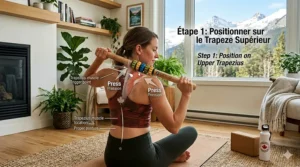
Myofascial trigger points are hyperirritable spots in skeletal muscle associated with palpable nodules in taut bands of muscle fibres, and they’re incredibly common in Canadians dealing with muscle pain. Whether you’re a desk warrior in Toronto battling neck tension, a Vancouver runner with tight IT bands, or a trades worker in Calgary managing chronic back pain, trigger point sticks offer a practical, affordable solution that puts professional-grade muscle therapy right in your hands.
Here’s the thing about muscle knots: they’re stubborn. These focal points of tenderness can cause chronic pain and restricted range of motion, and according to Health Canada, nearly 8 million Canadians live with chronic pain conditions. But with the right trigger point stick and proper technique, you can interrupt that pain cycle without booking expensive massage appointments or relying solely on medication.
This guide cuts through the marketing noise to deliver what actually matters: which trigger point sticks work best for Canadian buyers, what you should expect to pay in CAD, and how to choose the right tool for your specific needs. We’ve researched real products available on Amazon.ca, analyzed Canadian customer feedback, and consulted authoritative medical sources to bring you evidence-based recommendations.
Quick Comparison Table
| Product | Type | Price Range (CAD) | Best For | Rating |
|---|---|---|---|---|
| TriggerPoint GRID STK | Textured Roller | $45-$55 | Deep tissue massage, athletes | 4.5/5 |
| TriggerPoint STK Contour | Flexible hourglass | $35-$45 | Calves, hamstrings, adaptable fit | 4.4/5 |
| TriggerPoint STK Fusion | Modular system | $90-$100 | Customizable recovery, serious athletes | 4.6/5 |
| The Stick Travel Stick | Flexible spindle | $25-$35 | Portability, budget-friendly | 4.3/5 |
| Gaiam Restore Massage Stick | Basic roller | $15-$25 | Beginners, general use | 4.0/5 |
| Tiger Tail Bendy | Flexible design | $30-$40 | Hard-to-reach areas, versatility | 4.2/5 |
| BackJoy Trigger Point Massager | Collapsible hook | $20-$30 | Travel, targeted pressure points | 4.1/5 |
💬 Just one click – help others make better buying decisions too!😊
Top 7 Trigger Point Sticks: Expert Analysis
1. TriggerPoint GRID STK Handheld Foam Roller
If you’re serious about muscle recovery, the TriggerPoint GRID STK is the tool that bridges the gap between foam rolling and massage therapy. This isn’t your basic massage stick.
Key Specifications:
- 21 inches long, weighs 1 lb
- Patented AcuGRIP handles
- 3-dimensional GRID surface pattern
- Available on Amazon.ca: $45-$55 CAD
The standout feature? That textured GRID surface isn’t just for looks. The pattern channels blood and oxygen to muscle tissue while providing variable density compression. Canadian buyers particularly appreciate the solid construction – this stick withstands serious pressure without feeling flimsy. The AcuGRIP handles genuinely make a difference when you’re working deep into tight spots, giving you leverage without hand fatigue.
Canadian Customer Feedback: Users in Canada report this works exceptionally well for IT band tightness and calf knots. One Calgary runner mentioned using it post-marathon for years without any degradation in performance.
✅ Pros:
- Durable construction built to last
- GRID pattern provides professional-level tissue work
- Comfortable ergonomic handles
❌ Cons:
- Higher price point
- Heavier than ultra-compact travel options
2. TriggerPoint STK Contour Massage Stick
The STK Contour brings an innovative hourglass design that literally wraps around your muscles. Think of it as the massage stick that adapts to you, not the other way around.
Key Specifications:
- 19.5 inches long, 0.75 lbs
- Flexible hourglass design
- 9 independent foam spindles
- Available on Amazon.ca: $35-$45 CAD
This flexibility means you can compress and roll muscles simultaneously – particularly effective on calves and hamstrings. The foam spindles roll independently, creating a smoother, more comfortable massage compared to rigid sticks. Canadian physiotherapists have recommended this to patients who find traditional foam rollers too intense.
Canadian Customer Feedback: Edmonton fitness enthusiasts mention this being gentler than the GRID STK while still providing effective relief. Popular among those recovering from injuries.
✅ Pros:
- Unique wraparound compression
- Gentler than firm rollers
- Lightweight and easy to control
❌ Cons:
- May be too soft for deep tissue work
- Hourglass shape limits use on some body parts
3. TriggerPoint STK Fusion Recovery System
The STK Fusion is basically the Swiss Army knife of muscle recovery tools. It’s modular, customizable, and comes with stands for hands-free rolling.
Key Specifications:
- Includes massage stick + 2 stands
- 7 interchangeable roller components
- Green massage balls + blue CHARGE rollers
- Available on Amazon.ca: $90-$100 CAD
You’re getting multiple tools in one package. Use it handheld for targeted work, or place it in the stands and use your body weight for deeper pressure. The interchangeable components let you customize firmness and texture. The grey spacer specifically targets tendons like the Achilles – clever design thinking.
Canadian Customer Feedback: Serious athletes and CrossFit enthusiasts in Canada appreciate the versatility. Some mention the initial setup being confusing, but once you understand the system, it becomes indispensable.
✅ Pros:
- Highly customizable recovery system
- Hands-free option with stands
- Multiple tools for different needs
❌ Cons:
- Expensive investment
- Takes up more storage space
- Learning curve for optimal use
4. The Stick Travel Stick
Don’t let the simplicity fool you – The Stick has been a therapy staple for decades. It’s the reliable workhorse that just works.
Key Specifications:
- 17 inches long with 8 spindles
- Flexible core design
- Lightweight portable construction
- Available on Amazon.ca: $25-$35 CAD
This stick bends to conform to your body contours, making it surprisingly effective despite the basic appearance. The spindles roll independently, and the flexible design means you can tackle awkward angles. Canadian physio clinics often stock these for patient use – that’s not an accident.
Canadian Customer Feedback: Buyers across Canada praise the portability. It fits easily in gym bags, carry-on luggage, and desk drawers. Multiple reviews mention using it for years without issues.
✅ Pros:
- Excellent value for money
- Truly portable design
- Proven track record
❌ Cons:
- Basic functionality only
- May lack intensity for very tight muscles
- No textured surface options
5. Gaiam Restore Massage Roller Stick
For those just dipping their toes into trigger point therapy, the Gaiam Restore offers an accessible entry point without breaking the bank.
Key Specifications:
- 14 inches compact length
- Textured surface for stimulation
- Sealed ball bearings
- Available at Canadian Tire and Amazon.ca: $15-$25 CAD
Being 3-4 inches shorter than standard sticks, this is genuinely compact. The textured surface provides some grip and stimulation, while the sealed ball bearings keep things rolling smoothly. It’s simpler than premium options, but simplicity has its place.
Canadian Customer Feedback: Canadian Tire shoppers appreciate the price point for trying self-massage therapy. Good for light maintenance work, though serious athletes often upgrade.
✅ Pros:
- Budget-friendly entry option
- Available at Canadian retailers
- Compact for easy storage
❌ Cons:
- Less durable than premium options
- Limited deep tissue capability
- Basic feature set

6. Tiger Tail The Bendy Flexible Muscle Roller
The Tiger Tail Bendy lives up to its name – this 18-inch stick flexes and bends to reach spots that straight rollers simply can’t access.
Key Specifications:
- 18 inches with bendable core
- Deep tissue massage capability
- Made in USA quality
- Available on Amazon.ca: $30-$40 CAD
That bendable core is the secret weapon here. You can wrap it around your shoulder, curve it along your spine, or bend it to match your body’s contours. It maintains enough rigidity for deep pressure while offering flexibility other sticks can’t match.
Canadian Customer Feedback: Popular among Canadians dealing with upper back and shoulder tension. Several reviews mention effectiveness for hard-to-reach spots between shoulder blades.
✅ Pros:
- Exceptional flexibility for hard-to-reach areas
- Quality construction
- Versatile application angles
❌ Cons:
- Mid-range pricing
- Can be too flexible for some users
- Learning curve for optimal technique
7. BackJoy Trigger Point Massager Tool
The BackJoy Trigger Point Massager takes a different approach with its collapsible hook design and seven trigger point knobs.
Key Specifications:
- Collapsible two-piece design
- 7 specialized trigger point knobs
- Handheld massage stick format
- Available on Amazon.ca: $20-$30 CAD
Unlike rolling sticks, this tool uses targeted pressure through its knobs that simulate a massage therapist’s thumb. The collapsible design means it breaks down for travel. Those seven knobs provide different pressure points for pinpointing exact trouble spots.
Canadian Customer Feedback: Canadian buyers find it particularly useful for specific trigger points rather than general muscle rolling. Feedback suggests starting with lighter pressure to avoid bruising.
✅ Pros:
- Targeted trigger point pressure
- Travel-friendly collapsible design
- Budget-conscious pricing
❌ Cons:
- Can be too intense if not used carefully
- Different technique than rolling sticks
- Not ideal for large muscle groups
Understanding Trigger Points: The Science Behind the Knots
Before you start rolling away, understanding what you’re actually treating makes the therapy more effective.
What Exactly Are Trigger Points?
Trigger points are described as hyperirritable spots in skeletal muscle associated with palpable nodules in taut bands of muscle fibres. Think of them as tiny areas where muscle fibres have contracted and won’t release. They’re not just regular muscle soreness – they’re specific focal points that, when pressed, can send referred pain to other parts of your body.
The phenomenon is well-documented in medical literature, though there is ongoing debate in the scientific community about their exact mechanism. What practitioners agree on is the clinical reality: pressing on these spots hurts, and treating them often provides relief.
The Canadian Pain Context
According to Canada’s official health resources, nearly 8 million Canadians live with chronic pain. The Canadian Pain Task Force, established to guide federal policy on pain management, recognizes that chronic pain is when pain lasts longer than 3 months and is now recognized by the World Health Organization as a disease, not just a symptom.
Why Trigger Points Form
Several factors contribute to trigger point development:
Repetitive strain: Office workers spending 8+ hours at keyboards develop upper trapezius trigger points. Trades workers lifting heavy materials develop lower back patterns.
Poor posture: That forward head position from phone scrolling? It’s creating trigger points in your neck extensors.
Overuse without recovery: Running a marathon without proper cooldown and recovery creates trigger points in your calves and IT bands.
Injury compensation: When you injure one area, other muscles overwork to compensate, developing their own trigger points.
How to Choose Your Trigger Point Stick in Canada
Not all trigger point sticks are created equal, and your ideal choice depends on several factors unique to you.
Consider Your Pain Level & Experience
Beginners: Start with medium-density options like The Stick or Gaiam Restore. These provide relief without overwhelming sensitive muscles.
Intermediate users: The TriggerPoint STK Contour or Tiger Tail Bendy offer more intensity with flexibility.
Advanced/Athletes: The TriggerPoint GRID STK or STK Fusion deliver professional-level deep tissue work.
Match the Tool to Your Problem Areas
Large muscle groups (quads, hamstrings, back): Longer sticks (18-21 inches) with rolling surfaces work best.
Specific trigger points (shoulder knots, neck tension): Hook-style tools like the BackJoy or shorter targeted sticks.
Hard-to-reach spots (upper back, between shoulders): Flexible designs like the Tiger Tail Bendy.
Budget Considerations
Under $30 CAD: Gaiam Restore, BackJoy, basic options for trying trigger point therapy.
$30-$50 CAD: The Stick, Tiger Tail, TriggerPoint STK Contour – solid middle ground.
$50-$100+ CAD: TriggerPoint GRID STK, STK Fusion – premium tools for serious users.
Canadian Shipping & Availability
Most products on this list ship within Canada through Amazon.ca with Prime eligibility. Some are also available at:
- Canadian Tire (Gaiam products)
- Fitness Depot locations across Canada
- Specialty fitness retailers
Check for Canadian warehouse stock to avoid customs fees and long shipping times from the US.
Proper Trigger Point Stick Technique
Owning the stick is only half the equation – technique matters significantly for both safety and effectiveness.
The Basic Rolling Method
- Start slowly: Begin with gentle pressure and gradually increase. Your muscles need time to adapt.
- Roll, don’t jab: Move the stick in smooth, controlled motions along the muscle. Quick, jerky movements can cause bruising.
- Spend time on knots: When you find a trigger point, hold pressure for 30-60 seconds. You might feel the knot release.
- Follow the muscle path: Roll along the direction of muscle fibres for best results.
Frequency & Duration
Pre-workout: 20-30 seconds per muscle group for activation and warm-up.
Post-workout: 30-60 seconds per area for recovery and soreness prevention.
Daily maintenance: 5-10 minutes total on problem areas.
Safety Considerations
❌ Avoid: Direct rolling on bones, joints, or injured areas. Never roll the lower back directly on the spine.
❌ Don’t overdo it: More pressure and longer sessions aren’t always better. You can actually irritate muscles.
❌ Skip if: You have blood clotting disorders, are pregnant, or have acute injuries without medical clearance.
Combining Trigger Point Therapy with Other Approaches
For optimal results, integrate your trigger point stick into a broader muscle care routine.
The Complete Recovery Stack
Heat before rolling: Apply a heating pad for 10 minutes to warm tissues before trigger point work.
Trigger point therapy: Use your stick on identified problem areas.
Stretching after rolling: Released muscles stretch more effectively. Hold stretches for 30-45 seconds.
Hydration: Drinking water helps flush metabolic waste released during massage.
When to See a Professional
Trigger point sticks are excellent self-care tools, but they’re not replacements for professional treatment in some cases:
- Pain lasting more than 2 weeks despite home treatment
- Severe pain that limits daily function
- Numbness, tingling, or weakness accompanying muscle pain
- Pain following acute injury
Canadian provinces have different coverage for physiotherapy and massage therapy. Check your provincial health plan and private insurance benefits.
Trigger Point Sticks vs. Other Tools
Understanding how trigger point sticks compare to alternatives helps you make informed choices.
Trigger Point Stick vs. Foam Roller
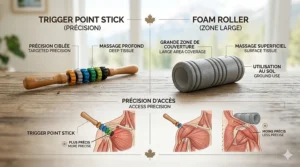
Foam rollers: Better for large muscle groups, use body weight for pressure, require floor space.
Trigger point sticks: More portable, user-controlled pressure, can target specific spots, work while seated.
Verdict: Sticks offer more versatility and precision. Foam rollers provide different mechanical advantages for certain applications.
Trigger Point Stick vs. Massage Gun
Massage guns: Percussive therapy, electronic, variable speeds, higher price point ($150-$500 CAD).
Trigger point sticks: Manual control, no charging needed, lower cost, quieter operation.
Verdict: Massage guns offer different therapy mechanisms. Sticks are more affordable and reliable for basic trigger point work.
Trigger Point Stick vs. Professional Massage
Professional massage: Comprehensive treatment, expert diagnosis, passive experience, expensive ($80-$150+ per hour in Canadian cities).
Trigger point stick: Self-administered, free after initial purchase, convenient, requires learning.
Verdict: Sticks are excellent between professional sessions or when budget/time is limited. They complement rather than replace professional care.
Real Canadian User Scenarios
The Remote Worker: Sarah’s Neck Tension Solution
Sarah, a graphic designer in Halifax, developed severe upper trapezius trigger points from long design sessions. After trying the TriggerPoint GRID STK, she now spends 5 minutes every 2 hours rolling her shoulders and neck. Her tension headaches decreased from 4-5 weekly to occasional flare-ups.
The Runner: Mike’s IT Band Recovery
Mike runs year-round in Vancouver, dealing with brutal IT band tightness. He added the TriggerPoint STK Contour to his post-run routine, spending 2-3 minutes per leg. Within three weeks, his persistent lateral knee pain reduced significantly.
The Trades Worker: Jean-François’s Back Maintenance
Jean-François, a Montreal carpenter, battles chronic lower back tightness from lifting and awkward positions. The Tiger Tail Bendy became his go-to tool, letting him reach his back muscles without assistance. Combined with morning stretching, his pain management improved noticeably.

Maintaining Your Trigger Point Stick
Cleaning & Care
After each use: Wipe down with a damp cloth to remove sweat and oils.
Weekly deep clean: Use mild soap and water. Avoid harsh chemicals that can degrade foam or rubber.
Dry completely: Moisture trapped in components can lead to odours or material breakdown.
Storage Tips
- Keep out of direct sunlight and extreme temperatures (especially important in Canadian winters and summers)
- Store in a dry place to prevent mold or mildew
- Avoid crushing under heavy objects
When to Replace
- Foam showing significant wear or flaking
- Spindles no longer rolling smoothly
- Handles becoming loose or damaged
- Generally: 2-5 years depending on usage frequency and care
✨ Don’t Miss These Exclusive Deals!
🔍 Take your muscle recovery to the next level with these carefully selected products available in Canada. Click on any highlighted item to check current pricing and availability on Amazon.ca. These tools will help you create authentic pain relief your body will thank you for!
Common Mistakes to Avoid
Rolling Too Aggressively
Beginners often think “more pain = more gain.” This leads to bruising and muscle guarding. Start gentle and increase gradually.
Skipping Warm-Up
Cold muscles don’t respond as well to trigger point therapy. Five minutes of light movement or heat application makes a huge difference.
Inconsistent Practice
Using your stick once when you’re desperate, then forgetting about it until the next crisis isn’t effective. Regular maintenance prevents severe knots from forming.
Ignoring Body Signals
Sharp, shooting pain is your body saying “stop.” Dull, releasing pressure is normal. Learn the difference.
Using on Inappropriate Areas
Never roll directly on your spine, knee joints, or any area with acute inflammation.
❓ FAQ
❓ Can trigger point sticks help with chronic pain conditions in Canada?
❓ How much should I spend on a trigger point stick in Canada?
❓ Are there any Canadian regulations or certifications for massage tools?
❓ How often should I use a trigger point stick for best results?
❓ Can I use a trigger point stick if I have fibromyalgia or other pain conditions?
Conclusion
Finding the right trigger point stick transforms how you manage muscle pain and recovery. Whether you’re dealing with desk job tension, athletic recovery needs, or chronic pain management, there’s a tool on this list that fits your requirements and budget.
For most Canadians, the TriggerPoint STK Contour ($35-$45 CAD) offers the sweet spot of effectiveness, durability, and value. Athletes serious about recovery should consider the TriggerPoint GRID STK ($45-$55 CAD) for its superior deep tissue capabilities. Budget-conscious buyers will find The Stick Travel Stick ($25-$35 CAD) delivers reliable results without premium pricing.
Remember: the best trigger point stick is the one you’ll actually use consistently. Start with proper technique, listen to your body’s signals, and integrate trigger point therapy into a holistic approach that includes stretching, proper ergonomics, and professional care when needed.
Your muscles have been asking for relief – now you have the tools and knowledge to provide it.
Recommended for You
- 7 Best Muscle Roller Sticks for Cyclists Canada 2026
- 7 Best Massage Sticks for Muscle Recovery Canada 2026
- 7 Best Muscle Roller Stick for Runners Canada 2026
Disclaimer: This article contains affiliate links to Amazon.ca. If you purchase products through these links, we may earn a small commission at no additional cost to you.
✨ Found this helpful? Share it with your friends! 💬🤗
