
In This Article
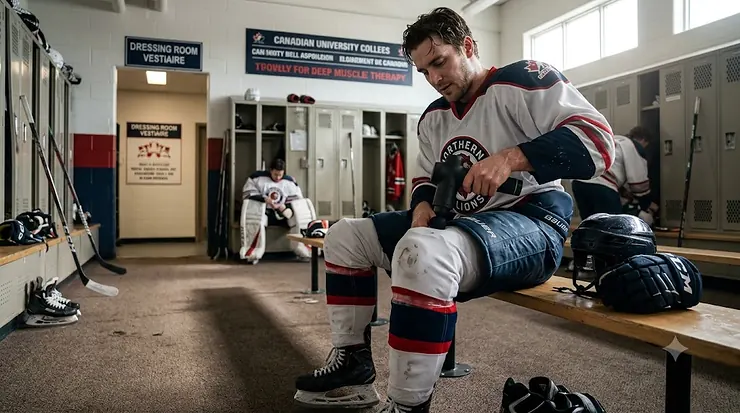
If you’ve ever peeled off your gear after a Saturday tournament and felt your calves lock up like two blocks of arena ice, you already know why hockey player recovery massager searches spike every winter across Canada. Between back-to-back games, dryland training, and long drives to away rinks in places like Sudbury or Red Deer, hockey puts a specific kind of strain on the calves, quads, and hip flexors — repetitive skating strides, sudden stops, and the crouched “ready position” all add up.
A hockey recovery massager — whether a percussion “massage gun” or an air-compression leg sleeve — won’t replace a physiotherapist, but it can help loosen tight muscle tissue between games and speed up the everyday soreness that comes with a full hockey schedule. This guide compares seven real, Amazon.ca-available options across budget tiers, explains what the specs actually mean for a Canadian player’s week, and walks through how to pick the right one for your situation — whether that’s a minor hockey parent, a beer-league grinder, or a junior player managing a packed schedule.
All prices below are in CAD and shown as ranges, since Amazon.ca pricing shifts often — always check the current price on the listing before buying. As an Amazon Associate, this article may earn from qualifying purchases.
What Is a Hockey Recovery Massager?
A hockey recovery massager is a handheld or wearable device that uses rapid percussion (a “massage gun”) or air compression (a wearable sleeve) to increase local blood flow and temporarily ease muscle tightness in the legs after skating, training, or games. Most players use them on calves, quads, and glutes — the muscle groups that take the most repetitive load in hockey.
Quick Comparison Table
| Product | Type | Noise Level | Best For | Price Range (CAD) |
|---|---|---|---|---|
| RENPHO Active Massage Gun | Percussion | Moderate | First-time buyers, teens | $60–$90 |
| Theragun Relief | Percussion | Very quiet | Gentle daily use | $160–$190 |
| BOB AND BRAD D6 Pro | Percussion | Moderate-loud | Value-focused power users | $200–$260 |
| Hyperice Hypervolt 2 | Percussion | Quiet | Shared household use | $260–$310 |
| Theragun Prime (6th Gen) | Percussion | Quiet | Serious in-season players | $300–$350 |
| Hyperice Hypervolt 2 Pro | Percussion | Quiet | Bigger bodies, deep tissue | $440–$500 |
| Hyperice Normatec Go Calf | Air compression | Silent-ish | Passive recovery while travelling | $280–$350 |
Looking at the spread, there’s a clear split between percussion devices, which actively dig into a specific tight spot, and the Normatec Go Calf, which passively squeezes the whole calf while you do something else — like the drive home from the rink. Budget buyers shouldn’t assume cheaper means worse: the RENPHO unit covers the basics fine for occasional use, but it lacks the brushless motor and stall-force engineering that lets the Theragun and Hypervolt lines push through a genuinely tight calf without bogging down.
💬 Just one click — help others make better buying decisions too! 😊
✨ Don’t Miss These Exclusive Deals!
🏒 Take your recovery routine to the next level with the picks below. Click through to check current pricing and availability on Amazon.ca before your next tournament weekend!
Top 7 Hockey Recovery Massagers — Expert Analysis
1. RENPHO Active Massage Gun
The RENPHO Active Massage Gun is the entry point most Canadian families land on first, and for good reason — it covers the shoulders-to-calves basics without the price tag of the bigger brands.
It runs five speed settings and ships with five interchangeable heads, including a curved attachment meant for arms and legs. In practice, the lower speed range is fine for a teenager’s calves after a single practice, but it doesn’t have the stall force to push through a genuinely knotted quad after a tournament weekend — that’s the trade-off you make at this price point. The plastic housing is also noticeably lighter-duty than the metal-bodied options further down this list, which matters if it’s getting tossed into a hockey bag between rinks.
Canadian buyers should know RENPHO ships from Amazon.ca with regular Prime eligibility, so there’s no cross-border shipping concern here.
✅ Affordable entry point
✅ Lightweight for a teen’s hockey bag
✅ Five heads cover most muscle groups
❌ Stall force struggles on deep tissue
❌ Plastic housing feels less durable long-term
Price: around $60–$90 CAD.
Best for: parents buying a first massager for a minor hockey player, or anyone testing whether they’ll actually use one regularly before spending more.
2. Theragun Relief by Therabody
Theragun Relief is Therabody’s simplified, quiet-running model, and it’s the one to consider if a player shares a dressing room or bedroom and doesn’t want to wake anyone up after a late game.
It runs three speeds with one-button control and includes three foam attachments (dampener, standard ball, and thumb). What that means practically: this isn’t built for grinding through a locked-up glute after triple overtime — it’s built for a five-minute nightly routine that keeps things from getting tight in the first place. Therabody’s own patented triangle grip is genuinely useful here, since it lets a player reach their own calf or lower back without contorting.
Canadian reviewers consistently note this is the quietest Theragun in the lineup, which lines up with feedback we found in online forums about the line generally — several Canadian buyers specifically chose the Relief model after comparing it against pricier siblings for exactly this reason.
✅ Whisper-quiet for shared spaces
✅ Simple one-button operation
✅ Ergonomic triangle grip reaches awkward spots solo
❌ Only 3 speeds — limited for deep tissue work
❌ Less powerful motor than Prime/Elite tiers
Price: around $160–$190 CAD.
Best for: players who want a gentle nightly routine rather than an aggressive post-game tool, or households where noise matters.
3. BOB AND BRAD D6 Pro
The BOB AND BRAD D6 Pro is built by two physical therapists, and it shows in the small details — a 90-degree rotating arm, three grip options, and a printed soft-tissue guide in the case that’s genuinely more useful than most massage gun manuals.
The headline specs are a 16mm amplitude and 85 lbs of stall force, which in plain terms means it keeps pulsing at full strength even when you press it into a genuinely tight muscle — cheaper guns bog down or stall under that same pressure. That stall resistance is exactly what a hockey player needs on a tight IT band or glute after a heavy practice. The trade-off, based on the feedback we reviewed, is that it runs noticeably louder than the quieter Hyperice and Theragun models, so it’s better suited to a basement or a quiet house than a shared dressing room.
✅ Strong stall force for deep tissue work
✅ Includes a genuinely useful stretching/technique guide
✅ USB-C charging, no proprietary cable
❌ Louder than most competitors in this guide
❌ Battery life is shorter than the older C2 model in the same lineup
Price: around $200–$260 CAD.
Best for: budget-conscious players or parents who want pro-level stall force without paying Theragun Elite money.
4. Hyperice Hypervolt 2
The Hyperice Hypervolt 2 is the brand’s everyday model — lighter and more ergonomic than the original Hypervolt, with three speeds and five head attachments.
What stands out for a hockey household is the Bluetooth-connected Hyperice app, which can walk a player through a guided warm-up or recovery routine rather than just leaving them to guess at technique. For Canadian winters specifically, a quick warm-up routine on cold legs before a 6 a.m. practice is genuinely more useful than most players realize — cold muscle tissue is stiffer and more strain-prone, and a two-minute percussion warm-up can help offset that before stepping onto frigid arena ice.
✅ Quiet “QuietGlide” motor
✅ App-guided routines remove the guesswork
✅ Five heads cover most muscle groups
❌ Only 3 speeds — the Pro tier offers more range
❌ App requires a phone nearby to get full value
Price: around $260–$310 CAD.
Best for: a household sharing one massager among multiple family members or teammates, since the app-guided routines help less-experienced users get it right.
5. Theragun Prime (6th Generation)
The Theragun Prime sits in the middle of Therabody’s lineup and is the one most often recommended for serious in-season players, based on the Canadian deal-forum discussion we reviewed during research.
It’s built around a rugged, simplified design that keeps the brand’s signature deep-tissue power while trimming some of the smart-sensor extras found on the Elite and Pro models. For a player managing a real in-season schedule — two practices and a game most weeks — that’s a reasonable trade: you get Therabody’s percussion depth without paying for biometric tracking you may never check. One Canadian buyer we found discussing the line mentioned considering this exact model as a step up from the Relief once they wanted more power for tournament weekends.
✅ Strong percussion depth without premium pricing
✅ Rugged build suited to a hockey bag
✅ Quiet enough for shared spaces
❌ No heat attachment (available on Prime Plus instead)
❌ Step up in price from entry-level models
Price: around $300–$350 CAD.
Best for: players in a full competitive season who want genuine deep-tissue power on a weekly basis, not just occasional use.
6. Hyperice Hypervolt 2 Pro
The Hyperice Hypervolt 2 Pro is Hyperice’s strongest percussion device, built around a 90-watt high-torque motor with five speed settings and five head attachments.
In practical terms, that motor strength matters most for bigger-bodied players — adult rec-league defencemen, taller junior players — where a smaller gun’s amplitude gets absorbed by more muscle mass before it actually does anything. The digital speed dial and pressure sensor also mean less guesswork about how hard you’re actually pressing, which matters because over-pressing on a calf or hamstring can leave bruising the next day.
✅ Most powerful percussion in this guide
✅ Pressure sensor reduces over-pressing risk
✅ App-guided routines from professional athletes
❌ Premium price relative to the rest of the lineup
❌ Heavier in hand during longer sessions
Price: around $440–$500 CAD.
Best for: larger-framed players or anyone who has found smaller guns simply don’t penetrate deeply enough on quads and glutes.
7. Hyperice Normatec Go Calf
The Hyperice Normatec Go Calf is the odd one out on this list — it’s not a massage gun at all, but a wearable air-compression sleeve that squeezes the calf in sequential pulses rather than punching into one spot.
That distinction matters practically: a percussion gun needs your active attention for five to ten minutes, while the Go Calf can run during the drive home from the rink or while doing homework. It uses the same patented Pulse technology as Hyperice’s full-leg Normatec systems, just scaled down to a single calf sleeve, which keeps the price meaningfully lower than the full-leg boots. For Canadian players who travel for tournaments — long bus rides to provincial championships, multi-hour drives between rural rinks — passive compression during transit is arguably more practical than a massage gun you’d need to actively use.
✅ Hands-free, passive recovery
✅ Genuinely portable for travel hockey
✅ Same compression tech as premium full-leg systems
❌ Targets only the calf, not quads or glutes
❌ Pricing generally lands above the percussion mid-tier for a single-muscle-group device
Price: typically in the $280–$350 CAD range, though always verify current Amazon.ca pricing, since compression devices shift in price more than massage guns.
Best for: travel hockey families and anyone who wants recovery to happen passively during a commute rather than as an active five-minute session.
Top 7 Products Comparison
| Product | Amplitude/Tech | Speeds | Weight Class | Noise |
|---|---|---|---|---|
| RENPHO Active | Percussion | 5 | Light | Moderate |
| Theragun Relief | Percussion | 3 | Light | Very quiet |
| BOB AND BRAD D6 Pro | 16mm amplitude | 6 | Medium | Louder |
| Hyperice Hypervolt 2 | Percussion | 3 | Medium | Quiet |
| Theragun Prime | Percussion | Multiple | Medium | Quiet |
| Hyperice Hypervolt 2 Pro | 90W motor | 5 | Heavier | Quiet |
| Normatec Go Calf | Air compression | N/A | Wearable | Near-silent |
The pattern across this table is that noise and power tend to trade off against each other below the Hypervolt 2 tier, but the better-engineered mid-range and premium units — Hypervolt 2, Theragun Prime, Hypervolt 2 Pro — manage to stay quiet while still delivering real stall resistance. That’s the gap between a $70 gun and a $300 one: it’s not really about speed count, it’s about whether the motor keeps its strength when you actually press it into a tight muscle.
Percussion Massagers vs. Traditional Recovery Alternatives
| Method | Time Needed | Cost Over Time | Best Use Case |
|---|---|---|---|
| Massage gun | 5–10 min | One-time purchase | At-home, post-practice |
| Foam roller | 10–15 min | Very low | Pre-game warm-up |
| Registered massage therapist | 30–60 min | Ongoing, per session | Deep injury management |
| Air compression sleeve | 20–30 min (passive) | One-time purchase | Travel, passive recovery |
A massage gun isn’t a replacement for a registered massage therapist, and it shouldn’t be treated as one if a player has a genuine injury rather than routine tightness. What it does well is fill the gap between games when a $90-an-hour RMT session isn’t practical every single week — a few minutes with a percussion device on tight calves after practice covers a real need that foam rolling alone often doesn’t fully address for hockey-specific muscle groups.
Practical Usage Guide for Canadian Players
Getting real value out of any of these devices comes down to a few habits more than the device itself:
- Use it within the first hour after activity, when blood flow to the area is already elevated — this is when percussion massage tends to have the most noticeable effect on stiffness.
- Never use it directly over a joint, the spine, or a known injury — every manufacturer in this guide explicitly warns against this, and it’s not a place to improvise.
- Start on the lowest speed for the first few sessions, especially on calves, which bruise more easily than larger muscle groups like quads.
- Cold Canadian rinks add a layer most guides skip: a device left in a cold car overnight will have a noticeably weaker battery the next morning — lithium batteries lose efficiency in the cold — so bring it inside rather than leaving it in the trunk through a Prairie or Northern Ontario winter.
- Clean the foam attachments regularly. Hockey bags are not clean environments, and porous foam heads pick up odour fast.
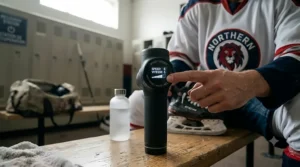
Real-World Scenario: Matching the Right Device to Your Situation
The minor hockey parent in Mississauga managing two kids’ practice schedules a week probably doesn’t need anything beyond the RENPHO or Theragun Relief — the goal is just keeping growing legs from getting unnecessarily tight, not deep tissue work.
The competitive AAA player in Calgary training five days a week with games on weekends is the clearest case for the Theragun Prime or Hypervolt 2 — enough power to matter, quiet enough to use in a shared house, and durable enough for a real season’s wear.
The travel hockey family doing tournament weekends across Ontario or the Maritimes benefits most from the Normatec Go Calf specifically because it works during the drive — passive recovery on a four-hour trip to a tournament is more realistic than asking a tired 16-year-old to actively use a massage gun in the back seat.
How to Choose a Hockey Recovery Massager in Canada
- Match power to body size. A smaller player’s calves don’t need a 90-watt motor; a bigger adult rec-league player’s glutes might.
- Weigh noise against where it’ll actually be used. Shared bedrooms and dressing rooms favour the Theragun Relief or Hypervolt line over the louder BOB AND BRAD.
- Decide if passive compression fits your schedule better than active percussion. Long travel-hockey drives favour the Normatec Go Calf.
- Check Amazon.ca availability and Prime shipping, since not every accessory bundle sold on Amazon.com ships the same way to Canada.
- Budget for the whole season, not just game day. A $90 device used inconsistently is worse value than a $250 device used every week.
- Look for genuine stall-force specs, not just speed counts, if deep tissue work on quads or glutes is the goal.
- Consider whether a Health Canada–regulated category matters to you. Most consumer massage guns fall under lower-risk device categories; Canadians can check Health Canada’s Medical Devices Active Licence Listing if a specific product makes therapeutic claims.
Common Mistakes When Buying a Hockey Recovery Massager
- Buying based on speed count alone. A gun with 20 speed settings and weak stall force will still bog down on a tight muscle — amplitude and stall force matter more than the number on the box.
- Ignoring battery behaviour in cold Canadian conditions. A device that’s always left in a cold car or unheated garage will underperform versus the manufacturer’s stated battery life.
- Skipping the warranty fine print. Cross-border warranty support can be inconsistent for accessories ordered through third-party sellers rather than the brand’s official Amazon.ca storefront.
- Assuming bigger always means better. A teenager doesn’t need a 90-watt Hypervolt 2 Pro any more than a daily driver needs a pickup truck’s towing capacity.
- Overusing it on the same spot. Manufacturers consistently cap recommended session time per muscle group at a few minutes for a reason — more isn’t automatically better recovery.
What the Research Actually Says
It’s worth being honest about the evidence here rather than overselling it, since the science is more mixed than marketing copy usually suggests. A peer-reviewed systematic review published on PMC found that massage guns can meaningfully help with short-term flexibility, range of motion, and stiffness reduction after a fatigue protocol — but showed no consistent benefit for strength, balance, or explosive movement, and didn’t move the needle on perceived exertion or lactate levels. A separate randomized controlled trial on delayed-onset muscle soreness found percussion massage outperformed static stretching for soreness recovery, with longer sessions providing greater benefit than shorter ones. In short: these devices are genuinely useful for everyday stiffness and soreness, but they’re not a performance-enhancing shortcut, and the research doesn’t support replacing a proper warm-up or a physiotherapist for actual injuries.
Hockey Canada’s own safety materials reinforce the basics that matter more than any gadget: a proper cool-down and stretching routine after activity to help dissipate waste product and prevent blood pooling in the legs. A massage gun is a complement to that routine, not a substitute for it.
Frequently Asked Questions
❓ Do hockey massage guns actually help with calf soreness?
❓ Can I use a massage gun every day during hockey season?
❓ Is it safe to use a massage gun on a hockey injury?
❓ Will products ordered through Amazon.ca ship the same as Amazon.com versions?
❓ Do massage guns work in cold Canadian arenas or unheated garages?
Conclusion
A hockey recovery massager isn’t going to turn a tired Tuesday-night beer leaguer into a fresh-legged pro, but the right one genuinely helps with the everyday tightness that comes from a real Canadian hockey schedule — back-to-back practices, weekend tournaments, and long drives between rinks. For most families, the Theragun Relief or RENPHO Active covers the basics without overspending. Players in a full competitive season get the most out of the Theragun Prime or Hyperice Hypervolt 2, and travel hockey families should seriously consider the Normatec Go Calf for passive recovery during long drives. Whichever you pick, treat it as one piece of a recovery routine that still includes a proper warm-up, a cool-down, and — when something actually hurts — an actual physiotherapist rather than a gadget.
Recommended for You
- 7 Best Calf Massagers in Canada (2026): Tested for Runners & Recovery
- Best Recovery Boots for Athletes in Canada 2026: Top 7 Picks
- Are Compression Leg Massagers Worth It? 7 Picks for Canada (2026)
Disclaimer: This article contains affiliate links. As an Amazon Associate, I earn from qualifying purchases. If you purchase products through these links, we may earn a small commission at no additional cost to you.
✨ Found this helpful? Share it with your fellow hockey parents and teammates! 💬🤗
