
In This Article
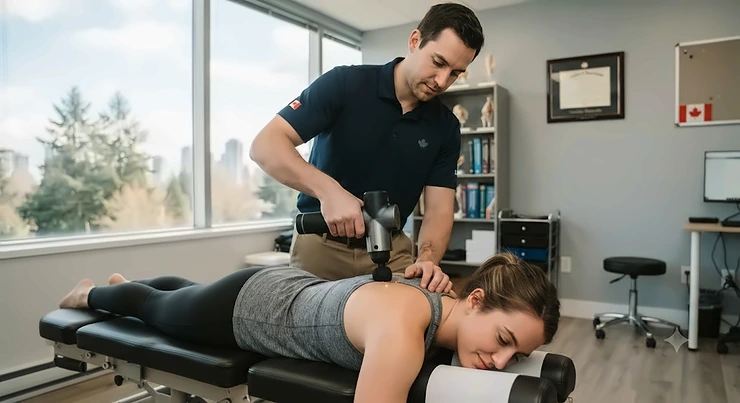
If you’ve ever watched a chiropractor reach for a percussive tool before an adjustment, you already know it isn’t a gimmick anymore — it’s a warm-up act for the spine. A genuine high-end massage gun for chiropractors has to survive something a home user’s device never faces: back-to-back patients, all day, five or six days a week, with zero tolerance for a stalling motor mid-treatment. That’s a completely different job than loosening up your calves after a Sunday run.
This guide breaks down seven real, currently available devices that hold up to clinical use, based on published specifications, manufacturer documentation, and aggregated customer and practitioner review sentiment gathered during research. We’re not going to pretend every spec sheet number translates directly into patient outcomes — stall force and amplitude matter, but so does how a device survives its four-hundredth charge cycle. Whether you’re outfitting a single-chiropractor office or a multi-practitioner physical therapy clinic, you’ll find genuine trade-offs here, not marketing copy dressed up as advice. According to Health Canada’s guidance on medical devices, equipment used by chiropractors and physiotherapists falls under a wide regulatory umbrella — something worth understanding before you swipe your clinic’s credit card.
What is a high-end massage gun for chiropractors? It’s a commercial-grade percussive therapy device — typically offering 45+ lbs of no-stall force, 12-16mm amplitude, and swappable or long-life batteries — built to withstand repeated daily use across multiple patients rather than occasional personal recovery sessions.
Quick Comparison Table: Top High-End Massage Guns for Chiropractors
| Massage Gun | Stall Force | Amplitude | Best For |
|---|---|---|---|
| Theragun Pro (Gen 5) | 27 kg (60 lb) | 16mm | Deepest tissue penetration, multi-practitioner offices |
| Hypervolt 3 Pro | 32 kg (70 lb) | 14mm | Whisper-quiet treatment rooms |
| Bob and Brad D6 Pro Plus | 38 kg (85 lb) | 16mm | Best value on raw power |
| TimTam Power Massager Pro v3 | Moderate (torque-focused) | 32mm stroke | Combat and sports-medicine style clinics |
| Ekrin Athletics B37S | 25-27 kg (56-60 lb) | 12mm | Longest battery life, lifetime warranty |
| Achedaway Pro | 27-36 kg (60-80 lb claimed) | 16mm | Budget-conscious deep tissue work |
| Bob and Brad C2 Pro Heat and Ice | Light-to-moderate | 10mm | Secondary treatment rooms, heat/cold combo |
Looking at the table above, the Theragun Pro (Gen 5) and Bob and Brad D6 Pro Plus sit at opposite ends of the value spectrum but land in a similar performance tier — the former banks on brand-backed consistency and app-guided routines, the latter on raw stall force per dollar. Clinics running multiple treatment rooms often mix tiers: a flagship unit for the primary treatment room, and something like the Bob and Brad C2 Pro Heat and Ice or Achedaway Pro for secondary stations where footfall is lower.
💬 Just one click — help others make better buying decisions too!😊
Top 7 Professional-Grade Massage Guns for Chiropractors: Expert Analysis
1. Theragun Pro (Gen 5) — deepest no-stall force in the mainstream lineup
The fifth-generation Theragun Pro is Therabody’s flagship, and it earns that spot by simply refusing to bog down under pressure. Its commercial-grade brushless motor delivers up to 27 kg (60 lb) of no-stall force at a 16mm amplitude — the deepest stroke length in this entire roundup, tied only with a couple of the D6-series competitors. In practice, that means a chiropractor can lean into a stubborn thoracic muscle group with real body weight behind the device and the motor simply won’t quit, which matters enormously when you’re treating a 220-pound former athlete versus a petite office worker in the same afternoon.
Two swappable 150-minute batteries mean the unit essentially never needs to sit charging between patients — you rotate one out, keep working, and recharge later. The OLED screen and Bluetooth-guided routines through the Therabody app are genuinely useful for training newer associates on pressure thresholds, not just a gimmick bolted on for the box copy.
Based on the spec comparison, the Theragun Pro trades some portability for that power ceiling — at roughly 1.3 kg (2.9 lb), it’s noticeably heavier in-hand than the Ekrin or Achedaway options, which matters over a ten-hour clinic shift. Reviewers consistently note that noise output, while improved from earlier generations, still runs louder than the Hypervolt line at comparable settings — something to weigh if your treatment rooms share thin walls.
Pros:
- ✅ Highest verified no-stall force in this roundup at 16mm amplitude
- ✅ Dual swappable batteries eliminate mid-shift charging downtime
- ✅ App-guided routines help standardize training across associates
Cons:
- ❌ Heaviest device tested, which adds fatigue on long shifts
- ❌ Noticeably louder than the Hypervolt 3 Pro at similar settings
At the time of research, the Theragun Pro sits in the C$750-C$850 range, making it the priciest device on this list — but for a primary treatment room seeing 15+ patients daily, the redundant battery system alone often justifies the premium.
2. Hypervolt 3 Pro — whisper-quiet power that won’t disturb the next room
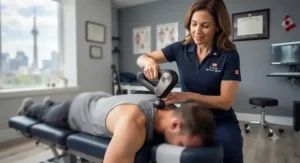
Hyperice’s newest flagship flips the usual trade-off on its head: instead of sacrificing power for quiet operation, the Hypervolt 3 Pro claims 32 kg (70 lb) of stall force while running at a genuinely low 51 dB — quiet enough to hold a normal conversation with a patient mid-treatment. That’s a meaningful advantage in a shared-wall clinic layout where the adjustment room next door doesn’t need to hear a jet engine through the drywall.
The 14mm amplitude is slightly shallower than the 16mm clinical benchmark set by Theragun and the D6-series, meaning it won’t dig quite as deep into dense glute or lat tissue, but the included heated attachment head (up to roughly 49°C/120°F) partially compensates by pre-softening tissue before percussion begins. Here’s what to weigh: for chiropractors who pair percussive work with manual adjustment in the same session, a slightly shallower amplitude paired with heat therapy can actually produce a more comfortable pre-adjustment warm-up than raw depth alone.
Aggregated review sentiment consistently praises the four-hour battery life and the pressure-sensor LED feedback, which helps newer staff avoid over-pressuring a patient. A recurring complaint in user reviews is that the 1.1 kg (2.5 lb) body, while lighter than Theragun’s Pro, still feels front-heavy during extended one-handed use on a treatment table.
Pros:
- ✅ Quietest high-power option tested at just 51 dB
- ✅ Included heated head attachment aids pre-treatment tissue prep
- ✅ Four-hour battery outlasts most single-day clinic shifts
Cons:
- ❌ 14mm amplitude falls short of the 16mm clinical benchmark
- ❌ Front-heavy grip reported during prolonged one-handed sessions
Pricing sits around C$450-C$500 at the time of research, positioning it as a strong mid-to-premium pick for clinics prioritizing patient comfort over maximum depth.
3. Bob and Brad D6 Pro Plus — physical-therapist-designed power at a fraction of flagship pricing
Developed by two practicing physical therapists, the Bob and Brad D6 Pro Plus leads the entire field on paper with a claimed 38 kg (85 lb) of stall force and a 16mm amplitude — specs that match or exceed devices costing two to three times as much. What most buyers overlook about this model is that its D-shaped, dual-grip frame was specifically engineered around the actual hand positions therapists use during trigger-point work, rather than adapted from a general-consumer ergonomic template.
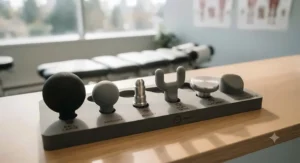
The built-in heated head and 180-minute battery life make it a legitimate all-day clinic tool, and the six-speed range (1500-2500 RPM) with four preset modes gives enough granularity to move from gentle warm-up to deep tissue work without switching devices. Reviewers consistently report that independent stall-force testing lands closer to 27 kg (60 lb) in real-world conditions rather than the marketed 38 kg (85 lb) — still competitive, just worth knowing the marketing number and lab-tested number diverge somewhat, as they do across most brands in this category.
A common complaint in user reviews is that operational noise runs louder than Bob and Brad’s own marketing suggests, and louder than the Hypervolt 3 Pro at comparable speeds — a real consideration for clinics with open floor plans.
Pros:
- ✅ Among the highest stall-force ratings in the category
- ✅ Built-in heat therapy included at no extra attachment cost
- ✅ Ergonomic grip specifically designed around therapist hand positions
Cons:
- ❌ Real-world stall force tests lower than the marketed rating
- ❌ Louder in practice than several premium competitors
Expect a price in the C$290-C$370 range depending on bundle, which places genuinely clinical-grade specs well under half of Theragun Pro pricing — arguably the single best value proposition in this roundup.
4. TimTam Power Massager Pro v3 — the training-room workhorse with a longer stroke
The TimTam Power Massager Pro takes a different engineering approach entirely: rather than chasing the highest stall-force number, it leans on a longer 32mm stroke length combined with a heated and cooling interchangeable tip system. Originally built for combat-sport training rooms and physical therapy tables, it comes with dual batteries and a temperature sensor that reads skin surface heat during treatment — a small but genuinely clinical touch most consumer massage guns skip entirely.
On paper this means the TimTam trades raw punching power for a longer, more sweeping percussive stroke, which some practitioners find better suited to larger muscle groups like the quadriceps or lats, while others prefer the shorter, punchier strokes of the 16mm Theragun-style devices for precise trigger-point work. Aggregated customer sentiment frequently mentions the antimicrobial plastic housing as a genuine differentiator for multi-patient clinical settings, where surface hygiene between sessions is a real operational concern rather than a nice-to-have.
Reviewers consistently flag the higher price relative to raw percussion power as the main hesitation, since devices like the D6 Pro Plus deliver comparable or greater stall force for meaningfully less money.
Pros:
- ✅ Antimicrobial housing genuinely useful for multi-patient hygiene
- ✅ Heated and cooling tip options built into the design
- ✅ Longer stroke length suits larger muscle group treatment
Cons:
- ❌ Higher price relative to raw percussion specs versus rivals
- ❌ Fewer speed increments than most competitors on this list
At the time of research, pricing runs C$520-C$580, making it a niche premium pick best suited to sports-medicine-adjacent chiropractic practices rather than a general-purpose first purchase.
5. Ekrin Athletics B37S — the longest battery life backed by a lifetime warranty
The Ekrin Athletics B37S doesn’t try to out-muscle the Theragun Pro or D6 Pro Plus on raw stall force — instead, it leans hard into reliability and support. With roughly 25-27 kg (56-60 lb) of stall force and a 12mm amplitude, it’s noticeably gentler than the deep-tissue specialists on this list, which reviewers consistently frame as an advantage rather than a drawback for sensitive areas like the neck and upper trapezius.
What most buyers overlook about the B37S is the lifetime warranty policy, which is genuinely rare in this category and speaks to a brand confident in long-term component durability — a meaningful consideration when a device is running eight-plus hours daily rather than the occasional weekend session it was arguably designed around. The advertised eight-hour battery life, drawn from a 2,550mAh cell, is among the longest tested here, meaning a single charge can realistically cover an entire clinic day for lighter-touch practices.
A recurring theme in aggregated review sentiment, drawn from over a decade of real-world clinical use documented by practitioners, is that the B37S performs reliably as a daily adjunct tool but lacks the outright depth needed for very dense muscle groups on larger-bodied patients.
Pros:
- ✅ Lifetime warranty rare among competitors in this price tier
- ✅ Longest advertised battery life in the entire roundup
- ✅ Quiet enough for conversation-friendly treatment rooms
Cons:
- ❌ Shallower 12mm amplitude limits very deep tissue work
- ❌ Less stall force than the D6 Pro Plus or Theragun Pro
Pricing sits in the C$310-C$340 range at the time of research, positioning it as the safer long-term bet for clinics that prioritize warranty support over maximum raw power.
6. Achedaway Pro — a genuine budget alternative to the flagship deep-tissue guns
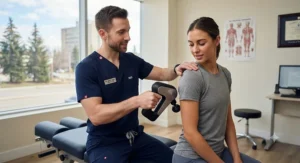
The Achedaway Pro occupies an interesting niche: it markets a claimed 36 kg (80 lb) of stall force at a full 16mm amplitude — numbers that would put it in flagship territory on paper — while pricing itself well below the Theragun Pro and Hypervolt 3 Pro. Independent testing consistently finds the real-world stall force closer to 27-29 kg (60-65 lb), which is still a strong result, just a reminder that manufacturer-claimed numbers in this category deserve a healthy grain of salt across the board, not just for this brand.
Reviewers consistently note that it runs quieter than the Theragun Pro and is noticeably lighter at roughly 1.2 kg (2.65 lb), making it a genuinely comfortable option for longer one-handed treatment sessions. The removable 3,200mAh battery is a practical touch for clinics that want a spare on hand rather than waiting out a full charge cycle mid-shift.
What the spec sheet won’t tell you, but reviewers note, is that the four included attachment heads cover the basics well but lack the variety of the six-to-seven-head kits bundled with the D6 Pro Plus and Theragun Pro, which may matter for practices doing highly varied trigger-point protocols.
Pros:
- ✅ Strong 16mm amplitude at a genuinely budget-friendly price point
- ✅ Quieter and lighter in hand than the Theragun Pro
- ✅ Removable battery simplifies swapping during a busy shift
Cons:
- ❌ Real-world stall force runs below the marketed claim
- ❌ Fewer attachment heads than the pricier flagship competitors
At the time of research, expect a price in the C$260-C$300 range, making this arguably the best entry point for a solo chiropractor upgrading from a basic consumer-grade unit.
7. Bob and Brad C2 Pro Heat and Ice — the smart pick for secondary treatment rooms
Not every treatment room in a busy clinic needs a flagship device, and that’s exactly the gap the Bob and Brad C2 Pro Heat and Ice fills. With a shallower 10mm amplitude and lighter overall power, it’s clearly positioned below the deep-tissue specialists on this list — but its standout feature, a separately-charging heated and cooled attachment head, adds genuine clinical versatility that none of the pricier options bundle in as standard.
Here’s what to weigh: for chiropractors layering percussive therapy with contrast temperature treatment — heat before mobilization, cold after an acute flare-up — the C2 Pro effectively replaces two separate pieces of equipment with one, at a fraction of the cost of any device higher on this list. Reviewers consistently point to the LED pressure-feedback display as unusually thoughtful for a device at this price tier, helping newer front-desk staff or assistants avoid over-pressuring a sensitive area.
A common complaint in aggregated review sentiment is that the shallow 10mm amplitude and roughly three-hour battery life make it unsuitable as a clinic’s sole or primary device — it’s best understood as a satellite tool rather than a flagship replacement.
Pros:
- ✅ Built-in heat and cold attachment adds real clinical versatility
- ✅ LED pressure feedback helps prevent over-treatment by staff
- ✅ Lowest price point of any device in this roundup
Cons:
- ❌ Shallow 10mm amplitude limits deep tissue applications
- ❌ Shorter roughly three-hour battery life than flagship rivals
Pricing typically runs under C$150 at the time of research, making it an easy secondary-room or backup-unit purchase rather than a primary clinical investment.
How to Choose a High-End Massage Gun for Chiropractic Practice
Choosing clinical-grade equipment isn’t the same exercise as picking a gift for a gym-going nephew. Here’s a practical framework:
- Match stall force to your patient population. Practices treating larger-bodied athletes or manual labourers generally need 60+ lb of no-stall force; a general wellness practice can often get by with less.
- Prioritize amplitude for depth-dependent work. A 16mm stroke reaches noticeably deeper than a 10-12mm stroke — important for glutes, lats, and quads, less critical for necks and forearms.
- Calculate real daily runtime, not marketed runtime. Multiply your average treatment length by daily patient volume, then compare against battery life with a buffer for charging gaps.
- Weigh noise tolerance against your floor plan. Open-concept clinics benefit enormously from quieter units like the Hypervolt line.
- Check warranty terms against expected duty cycle. A device running eight hours daily wears out faster than one used twice a week — a longer or lifetime warranty meaningfully reduces long-term risk.
- Confirm attachment variety matches your protocols. Clinics running varied trigger-point and myofascial protocols benefit from six-plus head options.
- Budget for a second unit before your first one dies. Most successful multi-room clinics stagger purchases across a flagship and a budget-tier device rather than buying seven identical units.
Practical Usage Guide: Setting Up Percussive Therapy in Your Clinic
Getting a new device onto the treatment room floor is only half the job — the first thirty days determine whether it becomes a trusted tool or a drawer ornament. Start by fully charging the unit before its first clinical use, even if the box shows a partial charge; lithium-ion batteries calibrate more accurately after a complete first cycle, extending long-term capacity.
Establish a simple sanitation protocol between patients: wipe down attachment heads with an appropriate disinfectant wipe rated for the plastic or metal material in question, since not every cleaner is safe for every head material. Train associates on the general rule of two to five minutes per muscle group, never exceeding ten minutes continuously on one area, and to start new staff at the lowest speed setting regardless of the device’s maximum rating — muscle guarding responses vary wildly between patients, and a defensive tightening response is a common and avoidable first-week mistake.
A frequent maintenance oversight is letting batteries fully drain repeatedly rather than topping up during natural gaps in the schedule; most modern lithium-ion cells actually prefer partial-charge cycling over full drain-and-recharge patterns. Schedule a monthly inspection of attachment head wear and charging port integrity — the fastest way to shorten a clinical device’s lifespan is ignoring small mechanical warning signs until they become a mid-treatment failure.
Real-World Scenarios: Matching the Right Massage Gun to Your Practice
Consider a solo chiropractor running a single treatment room in a strip-mall clinic, seeing twelve to fifteen patients daily with a fairly general wellness-focused caseload. For this profile, the Ekrin Athletics B37S or Achedaway Pro makes practical sense — moderate power, strong battery life, and a price point that doesn’t strain a new practice’s equipment budget in year one.
Now picture a multi-practitioner sports medicine clinic treating competitive athletes and post-surgical rehab patients across three treatment rooms simultaneously. That environment calls for a tiered approach: a Theragun Pro (Gen 5) or Bob and Brad D6 Pro Plus in the primary room handling the most demanding cases, paired with a Bob and Brad C2 Pro Heat and Ice in secondary rooms where heat-and-cold contrast therapy sees regular use alongside lighter percussive work.
Finally, think about a physical therapy clinic in a shared medical building with thin walls and patients in adjoining rooms trying to relax during other treatments. Here, the Hypervolt 3 Pro‘s 51 dB operation becomes a genuine clinical asset rather than a nice-to-have footnote, letting staff run percussive therapy without disrupting a neighbouring acupuncture or massage session through the wall.
Problem → Solution: Common Clinical Pain Points Percussive Therapy Solves
Problem: Patients arrive with guarded, tense muscles that resist manual adjustment. Five minutes of pre-treatment percussive work at a moderate speed, using a device like the Bob and Brad D6 Pro Plus with its built-in heat, softens tissue enough that spinal manipulation becomes noticeably easier and more comfortable for the patient.
Problem: Staff burnout from manually massaging every patient before adjustments. Delegating warm-up work to a reliable device like the Ekrin Athletics B37S frees practitioner hands for the higher-skill manipulation work insurance actually reimburses at a meaningful rate.
Problem: Cross-contamination concerns in high-volume clinics. Devices with antimicrobial or easily wipeable housings, such as the TimTam Power Massager Pro, reduce the hygiene burden between back-to-back patients.
Problem: Battery downtime interrupting a fully booked schedule. Dual-battery systems like those found on the Theragun Pro (Gen 5) eliminate the awkward mid-afternoon scramble to find an outlet.
Problem: Budget constraints in a new or growing practice. Starting with a single Achedaway Pro or Bob and Brad C2 Pro Heat and Ice and scaling up as patient volume grows avoids over-investing before revenue justifies it.
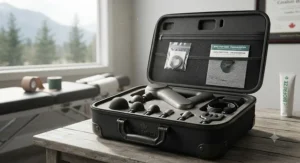
Professional-Grade Massage Gun vs Standard Consumer Massage Gun: What Actually Changes
The gap between a professional-grade massage gun for therapists and a big-box consumer model isn’t marketing spin — it shows up in three measurable places. First, duty cycle: consumer devices are typically rated for intermittent personal use, while clinical units like the Theragun Pro and Bob and Brad D6 Pro Plus use commercial-grade brushless motors explicitly engineered for sustained daily operation across dozens of patients rather than one person’s weekly recovery routine.
Second, stall force consistency under real pressure matters more in a clinical context, where a practitioner is actively leaning body weight into dense tissue rather than lightly grazing a sore calf after a jog. A consumer-grade device stalling out mid-treatment isn’t just an inconvenience — it interrupts a paid clinical session and can undermine patient confidence in the practice’s professionalism.
Third, warranty and support structures diverge sharply. Consumer massage guns sold through general retail often carry ninety-day or one-year coverage assuming light personal use, while clinical-grade options like the Ekrin Athletics B37S back their equipment with lifetime coverage precisely because they’re engineered — and priced — for heavier duty cycles. The trade-off, unsurprisingly, is cost: expect to pay roughly two to four times more for genuine commercial-grade specifications than for a comparable-looking consumer model at a big-box retailer.
Massage Guns for Physical Therapy Clinics vs Solo Chiropractic Offices
A professional massage gun for physical therapy clinics faces a different daily reality than one sitting in a solo chiropractor’s single treatment room. Multi-practitioner PT clinics typically run several devices simultaneously across concurrent patients, which shifts the buying calculus toward standardization — picking one or two models across all rooms simplifies staff training, attachment-head inventory, and battery management considerably compared to a mismatched fleet of five different brands.
Solo chiropractic offices, by contrast, can lean into a single flagship purchase since only one room needs equipping, freeing up budget to invest in the single best-specced unit rather than spreading dollars thin. Based on the spec comparison throughout this guide, PT clinics running higher patient throughput tend to gravitate toward the Bob and Brad D6 Pro Plus for its aggressive price-to-power ratio across multiple units, while solo practices more often justify the Theragun Pro (Gen 5)‘s premium pricing since it’s serving as the practice’s sole percussive therapy investment.
Physical therapy accessories purchasing also tends to follow stricter procurement cycles in larger clinics — group practices frequently negotiate multi-unit pricing directly with manufacturers or through Canadian medical supply distributors, an option less available to independent chiropractors buying a single device through standard retail channels.
What to Expect: Real-World Performance in a Busy Clinical Setting
Specs on a page rarely translate directly into what a Tuesday afternoon actually feels like. In practice, a 60 lb stall-force device like the Theragun Pro genuinely does maintain consistent percussion even under firm manual pressure on a muscular patient’s glute or lat — you’ll feel the motor working, but it won’t bog down or stutter mid-stroke the way a 20-30 lb consumer device typically does under the same pressure.
Noise becomes far more noticeable in a real clinical environment than in a quiet product-testing room; a device rated at 55-60 dB sounds meaningfully louder bouncing off tile floors and drywall in an active treatment room than the same number suggests on a spec sheet. Battery anxiety, somewhat surprisingly, tends to fade quickly in real-world use — most modern high-end units comfortably clear a full clinic day, and the dual-battery systems on devices like the Theragun Pro essentially eliminate the concern entirely.
What most buyers overlook about real-world clinical performance is attachment head wear: the softer foam and silicone heads on any device, regardless of brand, degrade faster under daily multi-patient use than they would under occasional personal use, and budgeting for replacement heads every six to twelve months is a realistic expectation across this entire category.
Long-Term Cost & Maintenance: The True ROI of Clinical-Grade Equipment
Evaluating clinical-grade equipment purely on sticker price misses the more important number: cost per treatment day over the device’s realistic lifespan. A Theragun Pro at roughly C$800 that reliably serves a clinic for four to five years of daily use amortizes to a genuinely modest daily cost, especially when weighed against even a single missed appointment caused by equipment failure.
Compare that against a budget consumer-grade unit purchased for a fraction of the price but rated for occasional personal use — pushed into daily commercial service, it may fail within twelve to eighteen months, at which point the “savings” evaporate once replacement cost and potential treatment disruption enter the equation. The Bob and Brad D6 Pro Plus and Ekrin Athletics B37S occupy an attractive middle ground here: genuinely commercial-rated components at meaningfully lower upfront cost than the flagship Theragun and Hypervolt options.
Maintenance costs beyond the initial purchase are modest but real: replacement batteries typically run a fraction of the original device cost, attachment head sets add a smaller ongoing expense, and most manufacturers in this roundup offer at least a one-year warranty covering the motor itself, with the Ekrin Athletics B37S standing out for its lifetime coverage on the core device.
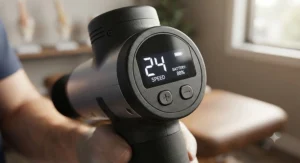
Common Mistakes When Buying a Professional-Grade Massage Gun for Therapists
The single most common mistake clinics make is buying based on the highest advertised stall-force number without verifying it against independent testing — as this guide has shown repeatedly, marketed figures and real-world tested figures frequently diverge by fifteen to twenty percent across nearly every brand. A second frequent error is underestimating noise tolerance needs; a device that sounds perfectly reasonable in a showroom can feel disruptive in a thin-walled multi-room clinic layout.
Practices also commonly overlook battery logistics, assuming a single device and charger will comfortably cover a full patient roster without accounting for actual runtime under continuous daily use rather than the manufacturer’s best-case testing conditions. According to guidance discussed by Canadian chiropractic practitioners writing about percussive therapy use in clinical settings, incorrect or excessive application — not equipment choice alone — is a genuine contributor to poor outcomes, underscoring that even the best device still requires proper staff training.
Finally, many clinics skip verifying warranty terms before purchase, only discovering post-purchase that “lifetime warranty” language sometimes excludes batteries or attachment heads — always read the fine print on what’s actually covered, for how long, and under what use conditions.
Features That Actually Matter (And Those That Don’t)
Stall force and amplitude genuinely matter — they’re the two specs most directly tied to whether a device can do meaningful clinical work rather than surface-level vibration. Battery capacity and swappability matter enormously for daily commercial use, arguably more than any single power spec, since a device sitting on a charger is a device not generating revenue.
App connectivity and Bluetooth-guided routines, by contrast, matter far less in a clinical context than in consumer marketing — a trained chiropractor doesn’t need an app suggesting treatment protocols the way a home user learning self-massage might. Similarly, an extensive parade of attachment heads sounds impressive on a retail box, but most clinical protocols realistically rotate through three or four core heads regularly, with the rest gathering dust in a drawer.
Aesthetic touches like colour options or premium carrying cases add essentially nothing to clinical outcomes, though a genuinely sturdy case does matter practically if the device travels between treatment rooms or gets tossed in a bag for home-visit chiropractors.
Safety, Regulations & Compliance: What Canadian Chiropractors Need to Know
Percussive massage devices occupy an interesting regulatory position in Canada. Under the framework maintained through the Medical Devices Active Licence Listing, products marketed with therapeutic claims can fall under Health Canada’s classification system depending on how manufacturers position their intended use and marketing claims — a distinction that has real enforcement consequences, as demonstrated by a documented Health Canada recall of unlicensed massage gun models distributed without the required Class II medical device licence.
Practically speaking, this means chiropractors should favour established manufacturers with a demonstrated compliance history over obscure imported brands making aggressive therapeutic claims without regulatory backing. It’s also worth confirming that any device used in a clinical billing context aligns with your provincial college’s equipment guidelines, since chiropractic regulatory colleges vary province to province on what modalities and adjunct tools qualify for specific billing codes.
From a general safety standpoint, percussive devices are contraindicated over recently injured, inflamed, or fractured areas, near varicose veins, and directly over major arteries or the anterior neck — standard precautions any trained practitioner already applies to manual soft-tissue work, but worth explicitly documenting in a clinic’s equipment use policy for newer staff and any patients using devices for home follow-up care.

FAQ
❓ How much does a professional-grade massage gun cost in Canada?
❓ Can chiropractors bill for percussive therapy in Canada?
❓ What stall force do I actually need for clinical use?
❓ Are massage guns regulated by Health Canada?
❓ How long do professional massage guns last with daily clinic use?
Conclusion
There’s no single “best” high-end massage gun for chiropractors — there’s only the best fit for your specific patient volume, treatment room layout, and budget stage. A solo practitioner just starting out reasonably lands on the Ekrin Athletics B37S or Achedaway Pro for their balance of dependable specs and approachable pricing, while a busy multi-room clinic likely needs the raw power and battery redundancy of the Theragun Pro (Gen 5) or the value-driven muscle of the Bob and Brad D6 Pro Plus.
What matters more than any single spec is matching the device’s duty cycle rating to your actual daily patient volume, verifying real-world stall force against manufacturer claims where independent testing exists, and building a sensible maintenance and hygiene protocol around whichever unit you choose. Clinical-grade equipment is an investment in both patient experience and staff efficiency — treated well, any of the seven devices covered here should earn their keep for years of daily clinical service.
✨ Don’t Miss These Exclusive Deals!
Take your clinic’s recovery toolkit to the next level with these carefully selected professional-grade massage guns. Click on any highlighted item to check current pricing and availability. These tools will help your patients feel genuine, lasting relief they’ll keep coming back for!
Recommended for You
- Theragun vs Other Premium Massage Guns: 7 Honest Picks
- Massage Gun for Physiotherapy Use
- Best Massage Gun for Athletes Under $300 CAD: 7 Top Picks for 2026
Disclaimer: This article contains affiliate links. As an Amazon Associate, I earn from qualifying purchases. If you purchase products through these links, we may earn a small commission at no additional cost to you.
✨ Found this helpful? Share it with your friends! 💬🤗
