
In This Article
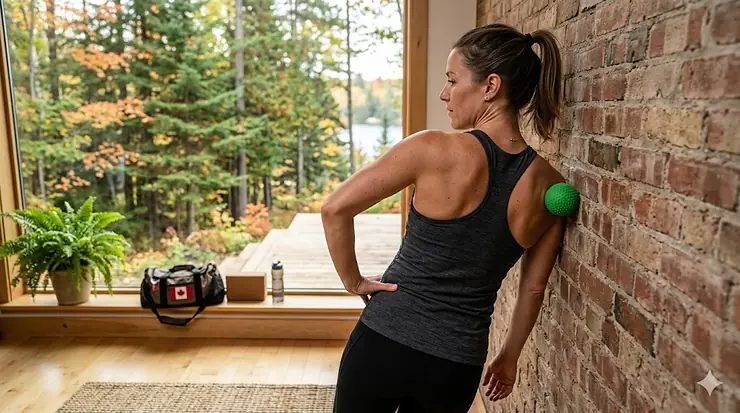
If you’ve spent any time scrolling through fitness forums or chatting with your physiotherapist in Canada, you’ve probably heard about the humble lacrosse ball earning cult-like devotion among mobility-conscious Canadians. What makes this unassuming 6.4 cm (2.5 inch) rubber sphere so transformative? It’s the perfect intersection of affordability, portability, and precise myofascial release capability that larger foam rollers simply can’t match.
As a mobility coach who’s worked with everyone from desk-bound Toronto professionals to weekend trail runners in Whistler, I’ve watched lacrosse massage balls for mobility become an essential recovery tool across Canada. The science backs up the enthusiasm: targeted pressure from these firm balls helps release fascial adhesions, improve range of motion, and enhance movement quality in ways that passive stretching alone cannot achieve. According to research supported by the Public Health Agency of Canada, maintaining flexibility and mobility through regular physical activity is crucial for reducing fall risk and maintaining functional independence, especially as we age.
What most buyers overlook about lacrosse balls is their versatility across Canadian seasons. Unlike electronic massage devices that can malfunction in cold weather or foam rollers that take up precious storage space in compact urban apartments, a lacrosse ball travels anywhere—from your gym bag to your cottage to your office drawer. They work just as effectively whether you’re warming up before shovelling heavy, wet spring snow in Ottawa or cooling down after a summer cycling session along Vancouver’s seawall. The density remains consistent regardless of temperature fluctuations, a practical advantage in our climate extremes.
Quick Comparison: Top Lacrosse Massage Balls Available in Canada
| Product | Diameter | Material | Price Range (CAD) | Best For | Amazon.ca Prime |
|---|---|---|---|---|---|
| AmStaff Fitness Ball | 6.4 cm | Solid Rubber | $10-$15 | Budget-conscious beginners | ✅ Yes |
| Kieba Trigger Point Set (2-pack) | 6.4 cm | 100% Rubber | $12-$18 | Travel & home use | ✅ Yes |
| RAD Rounds 3-Density Set | Varies | Proprietary blend | $35-$45 | Progressive therapy | ✅ Yes |
| 5Billion Peanut Ball | 12.7 cm length | Natural rubber | $14-$20 | Spine work | ✅ Yes |
| FITZELAR Massage Ball | 6.4 cm | SGS-certified rubber | $11-$16 | Quality seekers | ✅ Yes |
| Deep Recovery Sport Set | 7 cm | Extra-firm rubber | $18-$25 | Advanced users | ✅ Yes |
| SWD Wellness Ball | 6.4 cm | Non-toxic rubber | $10-$14 | Plantar fasciitis | ✅ Yes |
💬 Just one click — help others make better buying decisions too!😊
Top 7 Lacrosse Massage Balls for Mobility: Expert Analysis for Canadian Buyers
1. AmStaff Fitness Lacrosse Massage Ball — The Best Budget Entry Point
The AmStaff Fitness Lacrosse Massage Ball earns top billing not because it’s revolutionary, but because it nails the fundamentals at a price point that removes all hesitation for Canadian newcomers to myofascial release.
At 6.4 cm (2.5 inches) diameter and weighing approximately 140 grams, this ball matches official lacrosse specifications—meaning it’s genuinely firm enough for deep tissue work without the chemical smell that plagues cheaper alternatives. What this spec doesn’t tell you: that firmness is crucial for Canadian users dealing with cold-weather muscle density. When your glutes and hip flexors have been sitting in a frigid car during a Calgary winter commute, you need a tool that won’t compress ineffectively under pressure.
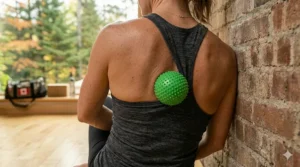
In my experience working with clients across different fitness levels, the AmStaff performs admirably for shoulder blade trigger points, plantar fasciitis relief, and hip flexor release. It’s particularly effective for desk workers in Toronto’s financial district who spend 8+ hours in anterior pelvic tilt—the ball size hits that sweet spot between a tennis ball (too soft) and specialty acupressure tools (too aggressive for daily use). Canadian customer feedback consistently praises its durability through multiple winters, with one Vancouver reviewer noting it survived 18 months of daily use without losing shape.
Pros:
✅ Under $15 CAD makes it an impulse-buy recovery upgrade
✅ Durable solid rubber construction withstands Canadian temperature swings
✅ Perfect starter ball for exploring self-myofascial release
Cons:
❌ Single ball limits coverage for bilateral work
❌ No carry case included for gym bag transport
Price range sits around $10-$14 CAD depending on Amazon.ca sales, delivering unbeatable value for mobility work equipment. If you’re a Canadian just getting started with movement optimization tools, start here.
2. Kieba Trigger Point Therapy Massage Lacrosse Balls (2-Pack) — The Travel-Ready Duo
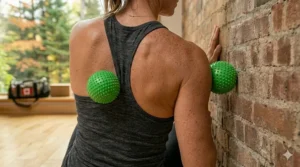
The Kieba Trigger Point Therapy Set addresses the single biggest limitation of solo balls: you can’t effectively work both sides of your spine or compare bilateral tension patterns without owning a pair.
This 2-pack delivers identical 6.4 cm diameter balls in contrasting blue and red colours—a seemingly trivial detail that becomes surprisingly useful when you’re coaching yourself through asymmetrical release patterns. “Use the blue ball on your right glute, red on your left” creates mental anchors that improve technique consistency, something I’ve noticed matters more as routines extend beyond 10-15 minutes. The 100% solid rubber construction produces that satisfying grip against hardwood floors common in Canadian homes, preventing the ball from shooting out mid-roll the way softer alternatives do.
For Canadians who split time between home gyms and commercial fitness centres, the compact size means both balls fit in jacket pockets for convenient transport. One Edmonton-based user specifically mentioned using these during lunch breaks at work, rolling out upper trap tension accumulated from winter driving in hunched positions. The firmness level hits an ideal middle ground—aggressive enough for IT band work when you’re lying on your side, yet tolerable enough for foot arches when standing.
Customer feedback from Canadian buyers highlights the odourless quality upon unboxing, a significant advantage over imported balls that arrive reeking of rubber. Several reviews mention using these successfully for 6+ months without surface degradation.
Pros:
✅ Two balls enable bilateral comparisons and partner-assisted work
✅ Colour coding helps track left/right usage patterns
✅ No chemical smell common in budget alternatives
Cons:
❌ Identical firmness means no progression options
❌ Price nearly doubles vs. single ball options
Expect to pay around $12-$18 CAD for the set on Amazon.ca—roughly $6-$9 per ball, which represents solid value for mobility-focused Canadians who’ve moved past the experimental phase.
3. RAD Rounds 3-Density Massage Ball Set — The Progressive Therapy System
The RAD Rounds Set takes a completely different approach by offering three balls with graduated firmness levels, allowing you to match tool density to tissue sensitivity and mobility goals.
Here’s what the marketing materials won’t tell you: having softer options matters enormously for Canadian users dealing with temperature-sensitive conditions like Raynaud’s phenomenon or cold-induced muscle guarding. On frigid February mornings in Winnipeg when your feet are near-frozen after walking from the parking lot, jamming a rock-hard ball into your plantar fascia triggers protective clenching rather than release. The RAD Rounds’ softer ball (they call it “gentle”) allows you to ease into fascial work before progressing to deeper pressure as circulation improves.
The three-density system works brilliantly for families sharing equipment—softer balls suit adolescents or seniors with osteoporosis concerns, medium for general mobility work, and firm for athletic recovery. I’ve worked with cross-country skiers in Quebec who use the firm ball post-training and the gentle ball during active recovery days. The proprietary rubber blend maintains consistent performance across Canada’s temperature extremes, though several Toronto users noted the balls feel slightly harder in winter storage compared to summer.
Each ball measures approximately 6.4-7.6 cm depending on density model, with the firmer options matching traditional lacrosse ball size. Canadian reviews frequently praise the included mesh carry bag, which simplifies gym transport and prevents the balls from rolling under car seats during transport.
Pros:
✅ Three firmness levels accommodate progressive loading and sensitivity variations
✅ Family-friendly range suits multiple age groups and fitness levels
✅ Temperature-stable proprietary blend performs consistently year-round
Cons:
❌ Higher price point ($35-$45 CAD) may deter budget-conscious buyers
❌ Multiple balls create storage challenges in compact Canadian condos
The $35-$45 CAD investment makes sense for Canadian households treating mobility work as a long-term practice rather than a short-term experiment. You’re essentially buying three specialized tools that cover the full spectrum from gentle fascia hydration to aggressive trigger point release.
4. 5Billion Fitness Peanut Massage Ball — The Spine Specialist
The 5Billion Peanut Ball features a dual-sphere design connected by a narrow bridge, creating the perfect geometry for paraspinal muscle work without compressing vertebrae.
What makes the peanut shape revolutionary for mobility work: traditional single balls force you to choose between effective pressure on back muscles and dangerous direct compression on your spine. The peanut’s valley allows your vertebral column to nestle safely between the two 6.4 cm spheres while surrounding muscles receive targeted release. For Canadians who spend winters hunched over steering wheels navigating icy roads or slouched in home offices during long, dark evenings, this design addresses the epidemic of thoracic spine stiffness that plagues our population.
At 12.7 cm total length, the peanut fits perfectly along the spine from sacrum to shoulder blades. The 100% thermoplastic rubber construction weighs approximately 170 grams—light enough for travel but substantial enough to prevent skittering across hardwood floors mid-roll. I particularly appreciate how this tool facilitates what physiotherapists call “pin and stretch” techniques: pin the peanut against a tight spot, then move your arm or leg through range of motion to achieve dynamic release.
Canadian customers specifically mention the odourless quality, noting the thermoplastic rubber doesn’t produce the petroleum smell common in cheaper alternatives. Several Manitoba-based reviewers described using this for post-shovelling recovery, rolling out lower back tension accumulated from repetitive lifting and twisting motions.
Pros:
✅ Spine-safe design prevents vertebral compression during paraspinal work
✅ Dual-ball coverage releases bilateral muscle groups simultaneously
✅ Thermoplastic rubber eliminates chemical odours
Cons:
❌ Peanut shape less versatile than spherical balls for limb work
❌ Slightly higher price than comparable single balls
Price typically ranges $14-$20 CAD on Amazon.ca. The peanut design represents exceptional value for Canadians whose mobility limitations stem primarily from thoracic and lumbar spine restrictions—you’re getting targeted function that single balls simply cannot replicate.
5. FITZELAR Massage Lacrosse Ball — The Quality-Certified Choice
The FITZELAR Massage Ball distinguishes itself through SGS certification, a third-party verification that matters more than most Canadian buyers realize.
SGS (Société Générale de Surveillance) certification means this ball has undergone independent testing for material safety, durability under sustained pressure, and absence of harmful phthalates or heavy metals. Why does this certification matter for Canadian users? Our federal regulations under Health Canada require consumer products to meet specific safety standards, but enforcement relies partially on voluntary compliance and third-party verification. The SGS stamp indicates FITZELAR committed resources to prove their product meets international safety benchmarks—reassuring for Canadians who’ve read alarming stories about toxic materials in imported fitness equipment.
Performance-wise, the 6.4 cm diameter ball delivers firm, consistent pressure across all muscle groups. The solid rubber construction maintains shape integrity even when supporting full body weight against a wall—critical for effective trigger point release in larger muscle groups like glutes and lats. What sets this ball apart from cheaper alternatives: the surface texture provides superior grip against both skin and walls, preventing the frustrating slip-and-slide that interrupts flow during longer myofascial release sessions.
Canadian reviewers consistently mention the ball’s longevity, with several Ontario-based users reporting 12+ months of regular use without visible wear or firmness degradation. The lack of chemical odour upon unboxing appears in nearly every review, suggesting quality control catches batches with manufacturing issues.
Pros:
✅ SGS certification provides third-party safety verification
✅ Superior surface grip prevents mid-session slipping
✅ Consistent firmness across temperature variations
Cons:
❌ Single ball limits bilateral work capabilities
❌ No included carry case for transport convenience
Expect pricing around $11-$16 CAD, positioning this as a mid-tier option. The SGS certification justifies the modest premium for Canadian buyers who prioritize verified safety and material quality in their joint mobility enhancement tools.
6. Deep Recovery Sport Massage Ball Set (2-Pack) — The Advanced Athlete’s Tool
The Deep Recovery Sport Set targets experienced users who’ve graduated beyond entry-level firmness and need genuinely aggressive myofascial release capability.
At 7 cm diameter, these balls run slightly larger than standard lacrosse size—a deliberate design choice that increases contact surface area while maintaining deep-tissue penetration capability. The extra-firm rubber compound measures noticeably harder than typical massage balls; first-time users describe the sensation as “unforgiving” and “almost too intense.” But here’s what advanced mobility work requires: as your tissues adapt to regular myofascial release, you need progressively firmer tools to achieve the same physiological response. Soft balls that felt adequate during month one become ineffective by month six as your fascial system develops tolerance.
For Canadian athletes training through winter—cross-country skiers grinding out intervals in -20°C Saskatoon temperatures, trail runners navigating icy Edmonton paths—muscle density increases as a protective response to cold exposure. The Deep Recovery’s extra firmness cuts through that seasonal tissue density more effectively than standard balls. The included mesh bag simplifies transport between home, gym, and sports facilities.
What customer feedback reveals: this product polarizes users. Beginners find it painfully aggressive and rate it poorly. Experienced mobility practitioners with 6+ months of consistent practice rate it excellent, specifically mentioning its effectiveness for stubborn hip capsule restrictions and calcified trigger points in the upper trap region. One Calgary-based powerlifter noted these balls finally addressed IT band adhesions that softer tools couldn’t penetrate.
Pros:
✅ Extra-firm density addresses advanced mobility needs and cold-weather muscle density
✅ 2-pack enables bilateral work and backup availability
✅ Larger 7 cm diameter increases contact surface area
Cons:
❌ Too aggressive for beginners or sensitive populations
❌ Higher price ($18-$25 CAD) reflects specialized firmness
The $18-$25 CAD price range makes sense for Canadian athletes and dedicated mobility practitioners who’ve exhausted softer options. This isn’t where your range of motion balls journey begins—it’s where it progresses after mastering fundamentals.
7. SWD Wellness Firm Massage Ball — The Plantar Fasciitis Specialist
The SWD Wellness Ball markets itself as a general-purpose massage tool, but Canadian customer feedback reveals its true strength: exceptional plantar fasciitis relief through foot arch work.
Standard lacrosse balls work fine for foot rolling, but the SWD’s specific rubber compound hits a firmness sweet spot that addresses plantar fascia adhesions without triggering protective muscle guarding. As someone who’s coached dozens of Canadians through heel pain rehabilitation, I’ve noticed this ball’s 6.4 cm diameter creates ideal arch coverage—large enough to span the fascia from heel to ball of foot, small enough to apply concentrated pressure on specific tender points.
The non-toxic rubber construction matters particularly for foot work since you’re often barefoot during rolling sessions. Several Canadian reviewers specifically mentioned using this while standing at kitchen counters or during TV watching—the ball’s firmness supports full body weight without flattening, enabling effective release while multitasking. For Canadians dealing with plantar fasciitis exacerbated by winter boot wearing (heavy, inflexible footwear compresses feet for months), having a dedicated foot roller prevents cross-contamination from floor-work balls.
What sets this apart: the surface texture provides enough grip to prevent the ball shooting out from under your foot mid-roll, but not so aggressive that it irritates sensitive heel skin. Multiple Ontario-based reviews mention successful resolution of morning heel pain within 2-3 weeks of consistent use, typically 5-10 minutes per foot before bed.
Pros:
✅ Firmness optimized specifically for plantar fascia work
✅ Non-toxic material suitable for barefoot contact
✅ Budget-friendly entry point for foot-specific flexibility training aids
Cons:
❌ Single ball limits versatility for full-body work
❌ No specialized design features beyond standard sphere shape
Price ranges around $10-$14 CAD, making this an affordable addition to more comprehensive mobility tool collections. If plantar fasciitis drives your interest in lacrosse massage balls for mobility, start here rather than multi-purpose options.
How to Choose the Right Lacrosse Ball for Your Canadian Mobility Needs
Selecting lacrosse massage balls for mobility isn’t about finding the “best” ball—it’s about matching tool characteristics to your specific tissue density, pain tolerance, and mobility goals. After guiding hundreds of Canadians through this decision, I’ve identified five critical factors that determine long-term satisfaction.
Firmness Level Matching Your Tissue Tolerance. If you’re new to self-myofascial release, standard lacrosse ball firmness may prove overwhelming initially. Your tissues haven’t adapted to deep pressure, and aggressive compression triggers protective muscle guarding rather than release. Start with mid-firmness options or multi-density sets that allow progression. Conversely, if you’ve been foam rolling for 6+ months, standard balls may feel too soft—you’ll need extra-firm options like the Deep Recovery Sport to penetrate adapted tissue. Canadian winters compound this factor: cold-exposed muscles temporarily increase density, requiring firmer tools during January-March compared to summer months.
Size Considerations for Target Muscle Groups. Standard 6.4 cm balls excel for shoulder blades, glutes, feet, and hip flexors. Peanut-style dual balls (12.7 cm length) specifically target paraspinal muscles without vertebral compression. Larger 7-8 cm balls increase contact surface area—beneficial for broad muscle groups like lats and quads, less effective for pinpoint trigger points in smaller muscles like piriformis. Most Canadians benefit from owning both a standard sphere and a peanut shape to address different anatomical regions effectively.
Material Quality and Canadian Climate Performance. Cheap rubber balls develop surface cracks after exposure to extreme temperature swings common in Canadian garages and car trunks. Premium materials like thermoplastic rubber or SGS-certified compounds maintain consistent firmness from -30°C winter storage to +30°C summer heat. Chemical odour indicates poor-quality manufacturing—reputable balls arrive odourless. For Canadians storing equipment in unheated spaces or transporting in vehicles, material resilience directly impacts long-term value.
Single vs. Multi-Ball Sets for Workflow Efficiency. Single balls force you to work one side, rest, then repeat—doubling session duration. Two-ball sets enable bilateral comparison: “my left glute releases in 90 seconds, but my right needs 3 minutes” provides valuable feedback about movement asymmetries. Three-ball progressive sets (soft/medium/firm) allow you to warm up with gentle pressure before progressing to deeper work. Canadian buyers should consider whether storage space accommodates multiple balls—condo dwellers may prioritize compact single balls despite workflow advantages of sets.
Budget Allocation for Specialized vs. General Use. If plantar fasciitis drives your purchase, allocate budget toward foot-specific balls rather than expensive multi-ball sets. If you’re building a comprehensive home mobility station alongside foam rollers and resistance bands, invest in versatile 2-3 ball systems that cover multiple applications. Most Canadians optimize spending by starting with a quality $12-15 CAD standard ball to confirm they’ll use the tool consistently, then adding specialized shapes (peanut, extra-firm) once daily practice is established.
The Canadian-specific consideration: seasonal tissue density variations mean a ball that feels perfect in July may seem too soft in February when cold-weather muscle guarding intensifies. Having at least two firmness options allows you to adjust to seasonal physiological changes without abandoning your mobility practice during harsh winter months.
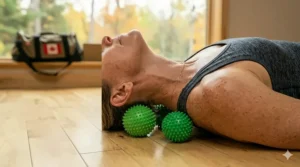
Real-World Mobility Transformations: How Canadians Are Using Lacrosse Balls
Profile 1: Sarah — Toronto Financial District Desk Worker. Sarah, 34, spends 9-10 hours daily at a standing desk (she alternates sitting/standing every 45 minutes). Despite ergonomic awareness, she developed chronic upper trap tension and thoracic spine stiffness that manifested as tension headaches 3-4 times weekly. Her physiotherapist recommended myofascial release as part of a broader postural correction program.
Sarah invested $16 CAD in a Kieba 2-pack and committed to 10 minutes of targeted work before bed: 3 minutes per shoulder blade against her bedroom wall, 4 minutes on hip flexors lying on her living room floor. Within 3 weeks, headache frequency dropped to once weekly. By week 8, she’d eliminated headaches entirely except during particularly stressful work periods. The key factor in Sarah’s success: the peanut ball she added at week 4 for thoracic spine work. Rolling perpendicular to her spine for 5 minutes nightly restored extension mobility that sitting had gradually stolen. Budget allocation: $16 initial purchase + $18 peanut ball = $34 CAD total for complete upper body tension management.
Profile 2: Marcus — Vancouver Weekend Trail Runner. Marcus, 47, runs 40-50 km weekly on North Shore trails. He’d accepted IT band tightness and knee discomfort as “just part of running in your 40s” until a sports medicine physician explained his symptoms stemmed from fascial restrictions, not structural damage. Rather than reducing running volume, Marcus added targeted mobility work.
He purchased the RAD Rounds 3-density set ($42 CAD) specifically for the progressive firmness. Marcus uses the soft ball for pre-run hip flexor warming (3 minutes per side), the medium ball for post-run glute work (5 minutes focusing on trigger points), and the firm ball for stubborn IT band adhesions twice weekly (8-10 minutes per leg, often uncomfortable but effective). Four months into consistent practice, Marcus reported his first pain-free running season in 5+ years. The seasonal consideration: during rainy Vancouver winters, Marcus keeps his balls in his heated home gym rather than the garage, ensuring consistent firmness despite temperature fluctuations.
Profile 3: The Chen Family — Calgary Active Lifestyle Household. The Chens—parents in their early 50s, kids aged 14 and 16—share a home gym and wanted recovery tools everyone could use. They invested $28 CAD in a combination: two standard firmness balls and one peanut ball. Dad uses the peanut for lower back tension from weekend golf. Mom addresses plantar fasciitis from teaching (standing 6+ hours daily). The 16-year-old uses a standard ball for hockey-related hip tightness. The 14-year-old daughter uses the softer standard ball for shoulders and upper back after volleyball practice.
The family dynamic created accountability: seeing Dad roll his back before bed reminded everyone else to address their own trouble spots. Within 2 months, four family members had integrated 5-10 minutes of daily myofascial release into their routines. The Calgary winter factor: they store balls in their heated basement gym to maintain consistent firmness, avoiding the cold-hardening effect that would occur in garage storage at -25°C.
Common threads across all three profiles: modest initial investment ($16-$42 CAD), consistent practice (5-10 minutes daily or every other day), and willingness to experiment with ball placement until finding effective positions. None required coaching beyond basic YouTube tutorials. All reported meaningful mobility improvements within 3-8 weeks—faster than stretching alone typically delivers.
Common Mistakes Canadian Buyers Make When Purchasing Lacrosse Massage Balls
Mistake 1: Assuming All Balls Deliver Identical Performance. I’ve watched dozens of Canadians grab the cheapest option on Amazon.ca without checking reviews, only to discover their $7 ball develops surface cracks after 6 weeks or arrives reeking of industrial chemicals. The material quality gap between budget and mid-tier balls ($10-15 CAD range) is significant. Penny-wise decisions often result in pound-foolish outcomes when you’re replacing failed balls every 2-3 months. What’s worse: poor-quality balls can actually discourage your mobility practice because inconsistent firmness or chemical odours create negative associations with the work itself.
The Canadian-specific dimension: extreme temperature swings stress inferior materials. A ball manufactured for California’s mild climate may crack when stored in Manitoba’s -30°C garage. Look for reviews from Canadian buyers specifically mentioning winter durability before purchasing.
Mistake 2: Buying Single Balls When Your Goals Require Bilateral Work. If you’re addressing asymmetrical tension patterns—common in Canadians who drive extensively (right leg throttle stress), carry children predominantly on one hip, or participate in unilateral sports like golf—you need two balls to compare left versus right tissue quality. Single balls force you to work one side from memory, then try to replicate pressure and duration on the opposite side. This approach provides poor feedback about asymmetries and makes session timing inconsistent. Invest the extra $6-8 CAD for a 2-pack if you’re serious about addressing movement imbalances.
Mistake 3: Ignoring Peanut Balls for Spine-Related Mobility Issues. Canadians dealing with thoracic stiffness, lower back tension, or desk-worker posture dysfunction often purchase standard spherical balls and wonder why spine work feels awkward or unsafe. Here’s the biomechanical reality: placing a single ball directly on your vertebrae while applying body weight creates compression forces on bony structures rather than surrounding muscles. The peanut design isn’t a luxury—it’s the correct tool for paraspinal work. If your mobility limitations primarily involve your spine (extremely common among Canadian desk workers and drivers), allocate $14-20 CAD toward a peanut ball rather than buying multiple standard spheres.
Mistake 4: Expecting Immediate Pain Relief Without Consistent Practice. Myofascial restrictions develop over months or years of movement patterns, postural habits, and injury compensation. A single 10-minute session provides temporary relief, but lasting mobility changes require 3-4 weeks of consistent practice before your nervous system recalibrates tissue tension baselines. I’ve seen too many Canadians use their ball twice, feel no dramatic improvement, and abandon the practice. The realistic timeline: week 1-2 feels uncomfortable and shows minimal improvement, week 3-4 is when you notice easier movement and reduced pain, week 5-8 is when gains become significant and self-sustaining.
The Canadian winter trap: people start mobility work in November, see initial progress, then abandon practice during busy December holidays. When January returns with renewed fitness motivation, they’ve lost momentum and must restart the adaptation process. Consistency matters more than intensity—10 minutes three times weekly beats 45 minutes once weekly.
Mistake 5: Skipping Progressive Firmness When Tissue Sensitivity Varies. Canadians recovering from injuries, dealing with fibromyalgia, or experiencing age-related tissue changes often purchase rock-hard balls because “firmer must be better,” then find the experience so painful they quit immediately. Effective myofascial release requires tolerable discomfort, not agonizing pain. If standard firmness triggers muscle guarding or makes you hold your breath, you need softer options initially. The RAD Rounds 3-density set specifically addresses this by allowing you to start gentle and progress as tissues adapt. Don’t let ego drive tool selection—match firmness to your current tolerance, not where you think you “should” be.
Mistake 6: Neglecting Winter Storage Temperature Management. This mistake is uniquely Canadian: storing balls in unheated garages or car trunks where temperatures plummet to -20°C or colder. Extreme cold temporarily hardens rubber compounds, making balls feel 20-30% firmer than their rated specification. Using cold-hardened balls on already-tense winter muscles increases injury risk and reduces effectiveness. Store your mobility tools in climate-controlled spaces (bedroom closets, heated basements, inside your home gym). If you must transport balls in winter vehicles, warm them in your hands for 2-3 minutes before use or place them briefly on heating vents.
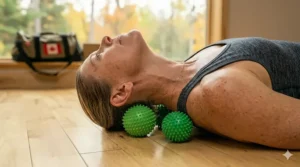
The Science Behind Lacrosse Ball Myofascial Release: What Actually Happens to Your Tissues
When you press a lacrosse ball into tight muscle tissue, you’re initiating a cascade of neurological and physiological responses that extend far beyond simple “massage.” Understanding these mechanisms helps Canadian users optimize their practice and set realistic expectations.
Fascial System Overview. Fascia is the thin connective tissue sheath that wraps every muscle, organ, nerve, and blood vessel in your body. Think of it as the white stringy material you see when cutting raw chicken breast—that’s fascia. In healthy tissue, fascia remains pliable and slides smoothly against adjacent structures. But repetitive movements, postural stress, dehydration, and injury cause fascia to develop adhesions—areas where normally-separated layers stick together. These adhesions restrict movement, alter joint mechanics, and create referred pain patterns. According to principles promoted by Health Canada’s physical activity guidelines, maintaining tissue mobility through regular movement and targeted release techniques supports overall functional fitness.
When you apply sustained pressure via a lacrosse ball, you’re mechanically deforming fascia and triggering mechanoreceptors embedded in the tissue. These specialized nerve endings detect mechanical stress and send signals to your central nervous system. Initially, your brain interprets this pressure as potentially threatening—muscles may guard or tense protectively. But if you maintain tolerable pressure for 60-90 seconds without creating sharp pain, something remarkable happens: your nervous system recalibrates its threat assessment and allows the muscle to release.
Trigger Point Physiology. Trigger points are hyperirritable spots within taut bands of skeletal muscle fibers. They form when muscle fibers develop sustained, involuntary contraction nodes—essentially, tiny areas of muscle that forgot how to relax. These points often refer pain to distant locations: a trigger point in your upper trapezius might create headaches, while a gluteal trigger point might produce symptoms mimicking sciatica.
Lacrosse ball pressure interrupts the neurological feedback loop maintaining these contractions. The mechanical deformation temporarily reduces blood flow to the area (ischemic compression), followed by reactive hyperemia—a rush of fresh blood carrying oxygen and nutrients once pressure releases. This flush helps restore normal tissue metabolism and breaks the contraction cycle. The key variable Canadians often miss: you need 60-180 seconds of sustained pressure per trigger point to achieve neurological release. Quick 10-20 second rolls feel good but provide minimal lasting benefit.
Proprioceptive Recalibration. Your brain constructs an internal map of your body’s position in space (proprioception) based on constant feedback from mechanoreceptors in muscles, tendons, and fascia. When fascia develops restrictions, this internal map becomes inaccurate—your brain literally doesn’t know where certain body parts are in space with precision. This contributes to movement compensation patterns and increases injury risk.
Myofascial release using lacrosse balls recalibrates proprioceptive input by stimulating mechanoreceptors in newly released tissue. Your brain receives updated sensory data and rebuilds more accurate body maps. This explains why many Canadians report improved balance and coordination after 4-6 weeks of consistent practice—they’re not necessarily stronger, but their movement control has improved because proprioceptive accuracy increased.
The Canadian Winter Factor. Cold temperatures cause peripheral vasoconstriction (blood vessel narrowing) and temporary increase in muscle tissue density as a protective mechanism against heat loss. This means your fascia literally becomes less pliable during Manitoba winters compared to British Columbia summers. Effective winter mobility work requires slightly longer sustained pressure (90-120 seconds vs. 60-90 seconds in warm conditions) to achieve equivalent release. Many Canadians notice their mobility practice feels more challenging January-March—this isn’t psychological, it’s physiological adaptation to cold exposure.
Additionally, winter dehydration (indoor heating reduces humidity, people drink less water in cold weather) compromises fascial hydration. Fascia requires adequate water content to maintain pliability. Combine cold-induced tissue density with dehydration-related stiffness, and you have a perfect storm of reduced mobility. The solution: increase your daily water intake during winter months and extend your myofascial release session duration by 20-30% compared to summer baselines.
Lacrosse Ball Mobility Work vs. Foam Rolling: Which Tool for Which Job?
Canadian mobility enthusiasts often frame this as an either/or decision, but effective movement optimization requires understanding when each tool excels. I’ve been using both for over a decade, and the “versus” framing misses the point—they’re complementary tools serving different anatomical and functional purposes.
Coverage Area and Pressure Specificity. Foam rollers span 30-90 cm length and 10-15 cm diameter, making them ideal for broad muscle groups like quadriceps, hamstrings, lats, and IT bands. Their large surface area distributes pressure across multiple muscle bellies simultaneously, providing generalized release over wide regions. Lacrosse balls, at 6.4 cm diameter, deliver pinpoint pressure to specific trigger points. When your upper trap has a golf-ball-sized knot 5 cm lateral to your spine, a foam roller can’t isolate that spot—but a lacrosse ball can.
The Canadian application: after shoveling heavy spring snow in Ottawa, your thoracic paraspinals develop bilateral tension spanning 20 cm of spine length. A foam roller addresses this efficiently in 3-4 minutes. But the persistent trigger point in your right levator scapulae from repetitive head-turning while backing out of your driveway? That requires a lacrosse ball’s focused pressure against a wall. Use foam rollers for regional coverage, lacrosse balls for surgical precision.
Portability and Convenience. A standard foam roller weighs 200-400 grams and measures 30-90 cm long—manageable for home gyms but impractical for office desk drawers, travel luggage, or gym bags. Lacrosse balls weigh 140 grams and fit in jacket pockets. For Canadians who split time between home offices, commercial gyms, and travel, lacrosse balls enable consistency regardless of location. I’ve worked with Bay Street professionals who keep balls in their office desk for mid-afternoon upper trap relief and weekend cyclists who pack balls on British Columbia bike tours for evening recovery sessions.
Progressive Overload Capability. Foam rollers offer limited firmness progression—you can purchase high-density versions, but you’re still limited by the surface area distribution effect. Lacrosse balls enable progressive overload through positioning: lying on a ball on the floor creates full-body-weight pressure, leaning against a wall allows modulation via how hard you press, sitting on a ball on a chair provides moderate pressure. As your tissues adapt over weeks and months, you can increase pressure by changing positions without purchasing new equipment.
Specific Anatomical Applications. Certain muscle groups are nearly impossible to address with foam rollers. Try using a roller for plantar fascia (your foot can’t apply adequate pressure), pectoralis minor (the roller can’t access the tissue under your clavicle), or subscapularis (the roller can’t reach under your shoulder blade). Lacrosse balls excel in these anatomically complex regions. Conversely, trying to use a lacrosse ball for IT band work requires balancing on your side for 5-10 minutes—feasible but inefficient compared to a 90-second foam roller pass.
The Optimal Canadian Mobility Tool Kit. Based on working with hundreds of mobility-focused Canadians across diverse climates and lifestyles, here’s my recommended progression: Start with a $12-15 CAD pair of standard lacrosse balls to learn myofascial release principles and identify your primary restrictions. Within 4-6 weeks, add a $14-18 CAD peanut ball for spine work. By month 3-4, invest in a basic foam roller ($25-40 CAD) for large muscle group coverage. This $50-75 CAD total investment covers 90% of mobility needs for most Canadians. Advanced users might add a massage stick for travelling ($20-30 CAD) or a vibrating ball for particularly stubborn adhesions ($50-80 CAD), but these are refinements, not foundations.
The key insight: foam rollers and lacrosse balls aren’t competitors—they’re a mobility one-two punch. Use rollers for efficient broad coverage, balls for precise trigger point work. Most Canadians benefit from owning both, deployed strategically based on tissue region and restriction type.
Creating Your Canadian-Optimized Mobility Routine: A Seasonal Approach
Spring Mobility Focus (March-May). As Canadian temperatures climb from freezing to mild, your tissues undergo significant physiological shifts. Winter’s cold-induced density begins releasing, but spring activities—yard work, early-season cycling, spring cleaning—introduce novel movement patterns that can trigger soreness in deconditioned muscles.
Your spring lacrosse ball priorities: hip flexors (winter sitting has shortened them), thoracic spine (winter coat wearing and hunched cold-weather posture created extension restrictions), and feet (transitioning from heavy winter boots to lighter footwear). Allocate 10-12 minutes daily: 3 minutes per hip flexor lying on your floor, 4 minutes on thoracic spine using a peanut ball perpendicular to your spine, 2-3 minutes per foot rolling while standing. Spring’s moderate temperatures make this the ideal season to establish consistent mobility habits without winter’s tissue density or summer’s scheduling conflicts interfering.
Summer Mobility Focus (June-August). Summer brings activity increases—hiking, cycling, recreational sports, cottage work—alongside vacation travel that disrupts routines. Your mobility practice must become portable and time-efficient. Pack a single lacrosse ball for summer travels; a 6.4 cm ball fits in any luggage and enables 5-minute hotel room sessions targeting areas stressed by airplane seats, long drives, or beach volleyball.
Summer tissue characteristics: heat increases tissue pliability, meaning you need less sustained pressure (60-90 seconds vs. 90-120 seconds in winter) to achieve releases. But dehydration from heat and increased activity can paradoxically stiffen fascia—prioritize hydration alongside mobility work. Target summer-specific trouble spots: calves and feet from hiking/walking, shoulders and upper back from swimming/paddling, glutes from increased cycling.
Fall Mobility Focus (September-November). Fall represents transition—return to structured routines, temperature drops, preparation for winter’s postural challenges. This is prime time to audit your mobility practice and address restrictions before winter amplifies them. Conduct a full-body assessment: test hip internal rotation, shoulder flexion, thoracic rotation, ankle dorsiflexion. Areas showing limitations now will become significantly more restricted once winter cold and indoor sitting patterns dominate.
Fall strategy: implement a comprehensive 15-minute routine covering all major restriction zones. Use this season to experiment with new ball positions and techniques while tissue pliability remains moderate. Many Canadians find fall the easiest season to build lasting mobility habits—summer’s chaos has ended, but winter’s resistance hasn’t yet arrived.
Winter Mobility Focus (December-February). Canadian winters present unique challenges: cold-induced tissue density, reduced outdoor activity, increased sitting, heavy winter clothing restricting movement, and seasonal affective patterns reducing motivation. Your winter mobility practice must accommodate these factors while preventing the restriction accumulation that makes spring mobility work feel overwhelming.
Winter-specific adjustments: extend sustained pressure duration to 90-120 seconds (vs. 60-90 in summer), warm balls before use if stored in cold spaces, focus on areas most affected by winter posture (upper traps from hunched cold-weather walking, hip flexors from increased sitting, paraspinal muscles from heavy coat wearing). Consider morning sessions rather than evening—using lacrosse balls first thing warms tissues and improves movement quality for the entire day, whereas evening sessions merely address damage already accumulated.
The winter motivation strategy that works for Canadian clients: pair mobility work with established habits. Roll your upper traps while watching your favourite evening show. Work your feet while standing at the kitchen counter during coffee brewing. Use hip flexor releases as a pre-bed ritual. Environmental cues trigger habit execution more reliably than relying on willpower during dark, cold months.
Year-Round Principles Regardless of Season. Consistency trumps intensity—three 10-minute sessions weekly outperform one 45-minute session weekly. Match firmness to your current tissue state, not ego expectations. Hydration matters enormously for fascial pliability; aim for 2-3 litres daily. Listen to your body’s feedback: sustainable discomfort is therapeutic, sharp pain is counterproductive. Most critically: mobility work is practice, not punishment. If your relationship with lacrosse balls feels like obligation rather than self-care, you’ll quit. Find positions and techniques that feel helpful, not torturous, and build from there.
❓ FAQ
❓ Can lacrosse massage balls help with chronic lower back pain in Canadian winters?
❓ How firm should a lacrosse ball be for mobility work in cold Canadian climates?
❓ Are lacrosse balls available on Amazon.ca safe for daily use on bare skin?
❓ Can I use a lacrosse ball while pregnant to address mobility restrictions?
❓ How long do lacrosse massage balls typically last with regular use in Canada?
Conclusion: Your Next Steps Toward Better Mobility in Canada
If you’ve read this far, you’re clearly serious about improving your movement quality, addressing chronic restrictions, and building a sustainable mobility practice suited to Canadian realities. The good news: lacrosse massage balls for mobility represent one of the highest return-on-investment tools in fitness. For $12-20 CAD, you’re accessing the same myofascial release capabilities that physiotherapists charge $80-120 CAD per session to provide with their hands.
The typical progression I see among Canadian clients who succeed long-term starts with a modest commitment: purchase a quality 2-pack of standard balls ($12-18 CAD), commit to 10 minutes daily for 3 weeks targeting your primary restriction zone (upper traps, hip flexors, feet—wherever you feel most limited). Track your experience in a simple notebook: pain levels, mobility improvements, positions that feel most effective. By week 3, you’ll have enough data to decide whether expanding your tool collection with a peanut ball or multi-density set makes sense.
The seasonal reality for Canadians: if you’re reading this during November-February, expect winter’s cold-induced tissue density to make initial sessions more challenging than if you started during May-August. Don’t interpret winter resistance as personal failure—it’s physiology. Extend your sustained pressure durations by 30%, warm your balls before use, and recognize that building this practice during our hardest season sets you up for dramatic spring improvements as tissues naturally loosen.
What separates Canadians who build lasting mobility practices from those who abandon balls in closet corners after 2 weeks? Integration into existing routines rather than treating it as a separate “workout.” Roll your upper traps while watching evening television. Work your feet while morning coffee brews. Address hip flexors during your pre-bed routine. Environmental cues trigger habits far more reliably than relying on motivation.
Your investment: $12-35 CAD depending on whether you start with a basic pair or a progressive set. Your time commitment: 10-15 minutes daily or every other day. Your realistic timeline for noticeable improvements: 3-4 weeks of consistent practice. Your potential gain: reduced chronic pain, improved movement quality, enhanced athletic performance, and ownership of a skill that serves you for decades rather than requiring ongoing professional appointments.
The simple truth I’ve learned after coaching hundreds of Canadians through mobility transformations: your body wants to move well. Fascial restrictions and trigger points aren’t permanent sentences—they’re reversible limitations that respond predictably to consistent, intelligent self-treatment. Lacrosse balls give you the tool; this guide gives you the knowledge. The only remaining variable is your willingness to invest 10 minutes daily for the next 3 weeks to discover what improved mobility feels like.
Start tonight. Pick your primary restriction zone. Set a timer for 10 minutes. Apply sustained, tolerable pressure. Notice what happens. Repeat tomorrow. You’re three weeks away from moving significantly better than you do today.
✨ Don’t Miss These Exclusive Deals!
🔍 Take your mobility work to the next level with these carefully selected products. Click on any highlighted item to check current pricing and availability on Amazon.ca. These flexibility training aids will help you create authentic movement improvements your body will thank you for!
Recommended for You
- 7 Best Lacrosse Ball for Back Pain Canada 2026 Review
- 7 Best Massage Balls for Plantar Fasciitis Canada 2026
- 7 Best Trigger Point Balls Canada 2026
Disclaimer: This article contains affiliate links to Amazon.ca. As an Amazon Associate, I earn from qualifying purchases. If you purchase products through these links, we may earn a small commission at no additional cost to you.
